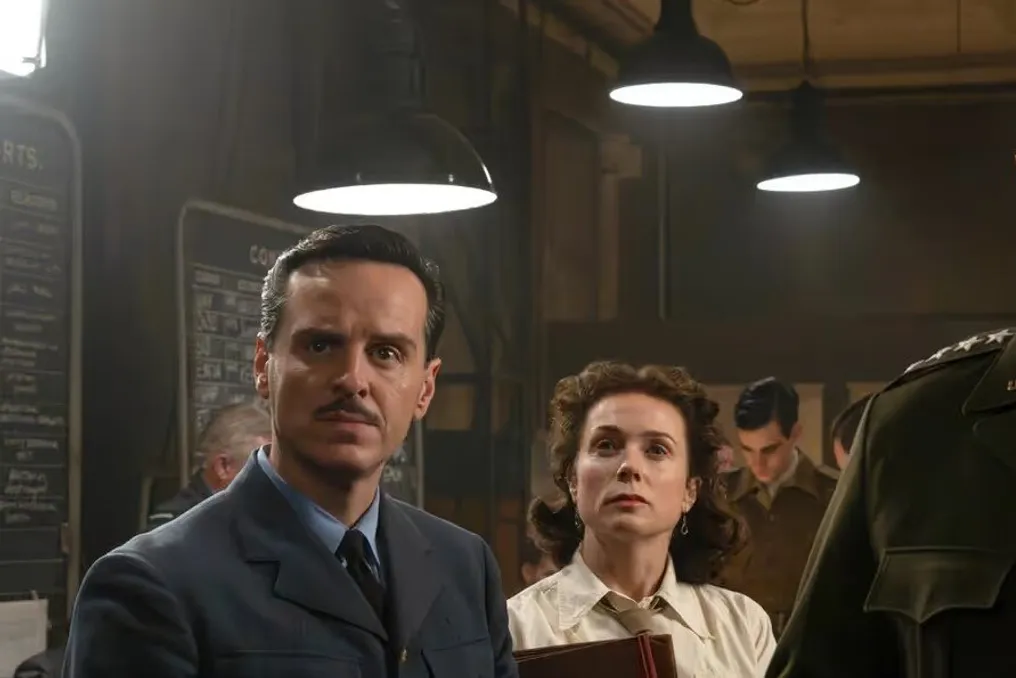
The military film 'Pressure,' directed by Hollywood director Anthony Maras and released in 2026, is scheduled to be screened at the Arasbaran Cultural Center in Tehran. The screening will take place on Sunday evening, followed by a discussion of the film featuring film critic Kourosh Jahad.
'Pressure' explores the tense period leading up to the Allied invasion of Normandy during World War II. Central to the plot is the role of meteorologist James Stagg, who determined when Operation D-Day could safely commence.
The film stars Andrew Scott as Stagg, a Scottish meteorologist appointed as the chief meteorological officer in the Supreme Headquarters Allied Expeditionary Force (SHAEF). Brendan Fraser plays General Dwight D. Eisenhower, the Allied commander who made the final decision regarding the invasion. The cast also includes Kerry Condron, Chris Messina, and Damian Lewis.
The action takes place in 1944 and recounts the final preparations for Operation Overlord—the massive Allied campaign to liberate Europe from German occupation. Initially, the invasion was set for June 5th, but Eisenhower grew increasingly concerned about the risks, especially after the unsuccessful rehearsal 'Exercise Tiger' several weeks prior.
On June 2nd, Eisenhower summons Stagg to Jutwick House, the SHAEF headquarters, and asks for a weather forecast for the operation. Stagg leads the British-American meteorological group, which soon discovers two powerful low-pressure fronts moving toward the English Channel. Their forecast predicts heavy rain, poor visibility, strong winds, and high waves, which could make the planned amphibious landings extremely dangerous.
Stagg's assessment conflicts with that of American meteorologist Colonel Irving P. Crick, who relies on historical weather patterns and believes conditions will remain favorable. As the forecasts of the two specialists diverge, Eisenhower faces growing pressure from senior commanders who warn that delaying the invasion might give German forces time to detect Allied plans.
The disagreements reach a critical point on June 4th, when Stagg insists again on the necessity of postponing the invasion. He faces resistance from senior commanders but remains convinced that proceeding under the predicted conditions could lead to disaster. His personal situation also becomes complicated when he learns that the hospital where his pregnant wife is located was bombed.
A breakthrough occurs due to meteorological observations from Ireland, which indicate a temporary weakening of the storm system. Crick agrees with the new assessment, giving Stagg the confidence to recommend June 6th as the next possible date for the invasion. In the early hours of June 5th, Stagg presents his final forecast to Eisenhower, who decides to proceed with the operation. The next day, Allied forces conduct the landing in Normandy by sea and air. The invasion catches German troops off guard and marks the beginning of the liberation of Western Europe.
After receiving news of the operation's success, Stagg leaves Jutwick House to find his family. He discovers that his wife and newborn son survived the bombing, concluding his trials on a deeply personal level. The film concludes with a recollection of Eisenhower's assessment, according to which the success of 'D-Day' was partly due to the fact that the Allies 'had better meteorologists than the Germans,' emphasizing the exceptional importance of weather forecasting in one of history's most significant military operations.