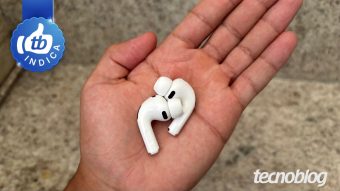
Apple's line of earbuds in 2026 presents a variety of designs and functionalities, ranging from open-fit models to in-ear options with Active Noise Cancellation (ANC) and over-ear models. Although all belong to the same ecosystem, differences in build, battery life, durability, and features define the ideal choice for daily use. For this reason, Tecnoblog compiled a list of the top five Apple earbuds, detailing the pros and cons of each.
AirPods Pro 3
The AirPods Pro 3 are presented as Apple's advanced earbuds, incorporating auditory health features, such as hearing aid mode, and physical activity monitoring. Their in-ear design uses silicone tips to seal the ear canal, which influences both passive isolation and Active Noise Cancellation (ANC) performance.
This model features adaptive audio, noise cancellation, and ambient mode, in addition to a conversation detection function that automatically adjusts volume when speech begins. Furthermore, it includes an integrated heart rate sensor to record beats during compatible exercises.
The battery life of the AirPods Pro 3 reaches 8 hours with ANC on and charging, decreasing to 7.5 hours when using spatial audio. During heart rate measurement exercise sessions, the estimate drops to 6.5 hours. Both the earbuds and the case have an IP57 rating, ensuring protection against dust and water. Supported codecs are SBC and AAC.
AirPods 5
The AirPods 5 are Apple's latest models, launched in September 2026, and are available for pre-order starting from R$ 1,499. Unlike the AirPods Pro 3, they do not use silicone tips to seal the ear canal, which alters the isolation: ANC works by capturing noise through microphones, without the physical barrier of an in-ear bud.
Apple claims that the ANC in this model is 50% more efficient than the previous generation. The H2 chip allows users to enjoy the same audio features as the Pro version, except for heart rate monitoring and auditory health focus modes, which are exclusive to the professional model.
There are two case configurations with different battery lives: the standard model offers up to 4 hours of audio with ANC per charge, totaling 20 hours with the case. The wireless charging case version achieves 5 hours per charge and 22 hours in total, maintaining ANC. The case version also includes swipe volume control on the stem. Supported codecs are SBC and AAC.
AirPods Max 2
The AirPods Max 2 are Apple's over-ear headphones. Their construction employs a dynamic driver developed by Apple itself, and processing is handled by the H2 chip present in the other models analyzed. This headphone offers active noise cancellation (ANC), ambient mode, adaptive audio, and spatial audio, among other features.
A significant highlight is the USB-C physical connection: the AirPods Max 2 support 24-bit and 48 kHz lossless audio, as well as low-latency audio when connected via a compatible cable. This is particularly advantageous for those who want to listen to music without loss of sound quality.
The advertised battery life is up to 20 hours with ANC activated. A mere five-minute charge provides about 1.5 hours of playback, but the model does not have an IP certification against water, sweat, or dust. Supported codecs are SBC and AAC.
AirPods 4
The AirPods 4 with ANC occupy an intermediate position for consumers seeking noise cancellation without investing in the Pro model. They use the same H2 chip for processing and offer adaptive audio, ambient mode, spatial audio, and live translation functionality.
With ANC active, each charge lasts up to 4 hours of audio; when noise control is disabled, the estimate rises to up to 5 hours. The case extends the total autonomy to 20 hours with ANC or 30 hours without this feature. The earbuds weigh approximately 4.3 grams each and have an IP54 rating against splashes of water and dust. Additionally, they include conversation detection, which lowers the volume when the user starts speaking, and voice isolation for calls. Supported codecs are SBC and AAC.
There is also a version of the AirPods 4 without active noise cancellation, but with similar functionalities. This model uses an Apple-created driver, long-range dynamic amplifier, and adaptive equalization, also featuring the H2 chip for processing. Even without ANC, it retains features such as personalized spatial audio with dynamic head tracking and voice isolation for calls. However, live translation and Siri AI compatibility are not available in this version. Battery life reaches 5 hours per charge, potentially up to 30 hours with the case, and the earbuds weigh 4.3 grams, possessing an IP54 rating for resistance to dust, sweat, and water. Supported codecs are SBC and AAC.
The purchasing decision should primarily consider the fit and the need for noise cancellation, as there are open, in-ear, and circumaural options. Apple's earbud line is segmented into distinct families, which prevents a direct numerical sequence of generations. The most recent versions include the AirPods 4, which are the most affordable option for those looking for a Bluetooth earbud with good basic Apple features without needing ANC. The AirPods 4 with ANC add adaptive audio and ambient mode, making them more complete for busy environments. Open AirPods models are ideal for those who prefer not to use silicone tips, available with or without ANC. AirPods Pro are in-ear, using tips for sealing and concentrating features like ANC, adaptive audio, and, in the Pro 3, heart rate monitoring. Finally, AirPods Max are circumaural, covering the ears with a larger structure, and the Max 2 offers USB-C connectivity for lossless and low-latency audio.
To verify the authenticity of the device, it is important to observe certain signs. AirPods can be paired with Android phones as Bluetooth earbuds for calls and audio, although Apple states that features like Siri and integrations with the Apple ecosystem will not work on devices from other brands. It is possible to locate the AirPods through the Find My app, but this depends on the connection with Apple devices and the Find My network in compatible models, and does not necessarily imply an integrated GPS tracker.