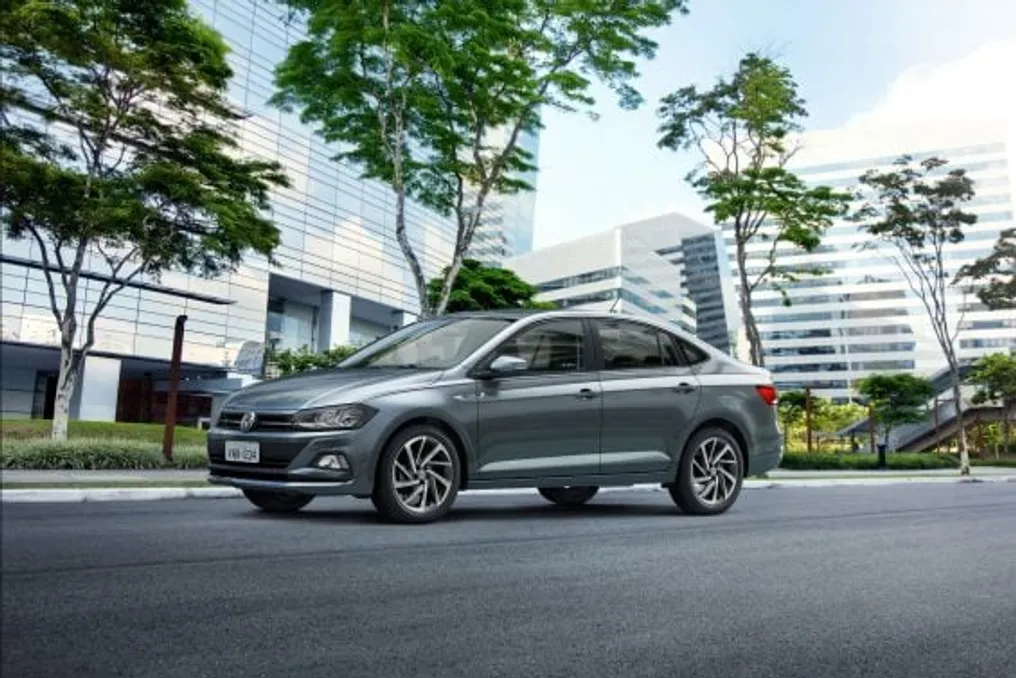
Although the sedan body style is often associated with executive vehicles, taxis, ride-sharing cars, or more traditional models, the Volkswagen Virtus demonstrates varied characteristics that make it an interesting option in the used market.
The model stands out for its performance and dynamic handling, surpassing the conservatism seen in many Japanese sedans. Furthermore, despite being classified as a compact car, the Volkswagen Virtus offers quite generous interior space.
The history of the Virtus officially began in January 2018, but production started a few months earlier, in 2017, at the Volkswagen factory located in Anchieta, São Bernardo do Campo, in the state of São Paulo. Developed using the modular MQB platform, the vehicle was conceived by the German automaker to occupy a superior position among compact sedans, initially available in three configurations, with options for naturally aspirated and turbo engines.
In June 2018, the Virtus already presented its 2019 line, introducing the automatic transmission in the 1.6 MSI version. In the same year, it launched its first special edition, the Beats, focused on sound systems.
In 2020, Volkswagen revived the historic badge and launched the Virtus GTS, a sporty version that arrived alongside the Polo GTS. This model incorporated both mechanical and visual modifications, reinforcing its more aggressive proposal.
A more comprehensive update to the Volkswagen Virtus line only occurred in 2023, when the Virtus underwent a facelift, discontinued the 1.6 engine, received adjustments to the turbocharged set in entry-level versions, and introduced the new top-of-the-line Exclusive configuration, targeting mid-size sedan customers.
More recently, in 2024, there was a change in the line structure with the launch of the new entry-level version, named Sense, which was previously exclusive to people with disabilities (PcD).
Despite sharing the same base as the Polo, the Virtus stands out by having a considerably larger cabin. Thanks to the MQB platform, the sedan achieved a wheelbase 2.65 meters and 8 centimeters longer than the corresponding hatchback, ensuring good space for five passengers. Its total length of 4.48 meters also contributes to a spacious trunk, with a capacity of 521 liters, facilitating the transport of bulky luggage.
The ergonomics of the driver's seat are well-defined, and the response of the steering wheel and pedals gives the driver a sense of control and precision. However, the interior finish and acoustic insulation are below expectations for a model positioned as a more sophisticated alternative in the segment.
In the 2020 Volkswagen Virtus line, the EA211 1.6 MSI engine was used in the entry-level versions. Although not focused on sports performance, it fulfilled its promises, offering smooth operation, adequate acceleration, and balanced fuel consumption.
With power of up to 117 hp on ethanol and 110 hp on gasoline, the sedan achieves agile starts. This agility is enhanced when coupled with the five-speed manual transmission, allowing it to reach 100 km/h in less than 10 seconds (using ethanol).
At cruising speed, the engine operates at low RPMs—approximately 2,500 rpm at 100 km/h—which contributes to comfort and aids in managing consumption. INMETRO data indicates that the 2020 Volkswagen Virtus 1.6 manual consumes 8.2 km/l in the city and 9.5 km/l on the highway with ethanol, and 11.9 km/l and 13.8 km/l, respectively, with gasoline.
The versions equipped with the 1.0 TSI engine are notably more exciting. With up to 128 hp (ethanol) and 116 hp (gasoline), the turbo Virtus provides faster responses and more dynamic behavior. Reaching 100 km/h takes 9.9 seconds with the automatic transmission. The big difference lies in the accelerations, where the maximum torque of 20.4 kgfm, available between 2,000 and 3,500 rpm, makes a significant difference.
This characteristic makes the sedan safer during overtaking and more efficient on highway stretches. According to INMETRO data, the Virtus 1.0 TSI registers averages of 7.8 km/l in the city and 10.2 km/l on the highway with ethanol, and 11.2 km/l and 14.6 km/l with gasoline.
Since its launch, the Virtus incorporates characteristic traits of Volkswagen. Its body exhibits excellent rigidity, and the suspension and steering system transmits security to the driver. In curves, the sedan remains stable, while at high speeds, the direct steering reinforces the feeling of stability with an attractive sporty touch.
In February 2020, Volkswagen reintroduced the iconic GTS badge to create the sporty version of the Virtus. This model came equipped with the 1.4 TSI engine, capable of generating 150 hp and 25.5 kgfm already at 1,500 rpm. With automatic transmission, the sedan reaches 100 km/h in 8.7 seconds, according to the manufacturer's own information.
In addition to the more powerful engine, the Virtus GTS received specific adjustments to the suspension, brakes, and steering, which became more robust. Aesthetically, it gained exclusive elements, such as LED headlights and darkened details, without excess.
Considering the 2020 Virtus Highline with the 1.0 TSI engine and automatic transmission, one of the most complete versions of Volkswagen at that time, it offered various safety features, including four airbags, stability and hill traction controls, camera and reverse sensor, disc brakes on all four wheels, and DRL.
It is important to check which items were optional and may be present in the used vehicle being evaluated. Among them, notable are the front parking sensor, electrochromic rearview mirror, tire pressure monitoring, and fatigue detector.
In terms of comfort, the 2020 Virtus Highline has automatic air conditioning, electric window controls, height and depth adjustments for the steering wheel, keyless entry, sequential gear shift levers, climate-controlled glove box, among other items.
The multimedia center supports connection with Android Auto and Apple CarPlay, in addition to having integrated GPS, Bluetooth, USB ports, SD slot, and CD player. Optional features available at the time included leather upholstery, dusk and rain sensors.