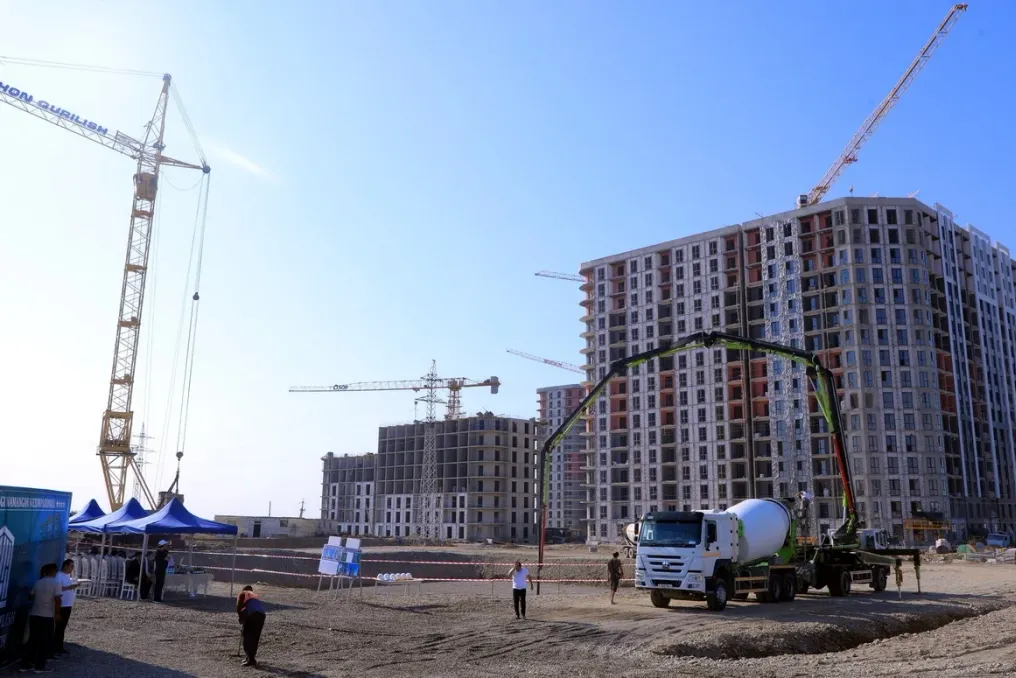
Uzbekistan's total credit balance reached 644.6 trillion sums
Read more
UzDaily
uzdaily.uz

Uzbekistan's total credit balance reached 644.6 trillion sums

According to data on outstanding loans by category, the total outstanding loan balance issued to individuals and legal entities in Uzbekistan amounted to 644.6 trillion sums as of August 1, 2026. This figure showed an increase of 6.7% compared to the beginning of the current year.

In the segment of loans to individuals, the outstanding balance reached 239.8 trillion sums, which is an increase of 8.9% since the beginning of the year. This segment became the fastest-growing among the main categories of the credit portfolio.

Mortgage loans accounted for the largest share in the retail portfolio, with their outstanding balance increasing by 11% to reach 88.1 trillion sums. The balance of microloans grew by 4.7% to 51.1 trillion sums, and the balance of microcredits increased by 15.5% to 46.7 trillion sums. Auto loans grew by 2% to 40.5 trillion sums.

The only retail lending category that showed a decrease was educational loans, whose outstanding balance decreased by 1.3% to 6.8 trillion sums. Consumer loans increased by 3.3% to 508 billion sums. The most significant growth among all individual loan categories was recorded for other loans, including credit cards and overdrafts, whose balance grew by 33.5% to 5.9 trillion sums.

Regarding loans to legal entities, their outstanding balance as of August 1 was 404.8 trillion sums, which is 5.5% higher than at the beginning of the year. The main part of this segment is comprised of loans to legal entities that are not credit institutions, and their balance increased by 4.9% to 377.5 trillion sums.

Interbank loans showed the fastest growth among corporate credit categories, increasing by 58.2% to 1 trillion sums, although this category remains relatively small in absolute terms. Leasing and factoring balances grew by 27.5% to 4.9 trillion sums, and microcredits for legal entities increased by 22.1% to 17.9 trillion sums. Syndicated loans were the only category to record a significant reduction, with their outstanding balance decreasing by 26.1% to 3.5 trillion sums.

Similar stories

315 thousand entrepreneurs in Uzbekistan can write off 1.5 trillion soums in tax debt penalties
Read more
gazeta.uz

315 thousand entrepreneurs in Uzbekistan can write off 1.5 trillion soums in tax debt penalties

Approximately 315.2 thousand entrepreneurs in Uzbekistan will have the opportunity to use an economic amnesty program called 'Second Chance,' which will allow them to write off penalties on tax obligations provided they fully repay them by the end of the current year. The Chamber of Commerce and Industry informed us about this initiative.

According to the CCI, this group of entrepreneurs has accumulated tax debt totaling 9.5 trillion soums, which was formed before September 1, 2026. Penalties accrued on this debt amount to approximately 1.5 trillion soums.

The 'Second Chance' economic amnesty is designed for small and medium-sized business entities and was approved by a decree from President Shavkat Mirziyoyev. This decree was adopted after holding the VI open dialogue with entrepreneurs in the city of Khiva.

According to the document's provisions, if an entrepreneur fully repays the tax debt incurred before the amnesty announcement by December 31, the accrued penalty will be canceled. Furthermore, all enforcement proceedings related to this debt will be terminated.

The CCI specified that to use this mechanism, the principal amount of the tax debt must be repaid no later than December 31, 2026. There is also an option for entrepreneurs to independently correct errors in previously submitted tax reports and fully pay any additionally assessed tax by the end of the year, which will prevent the accrual of penalties on that amount.

The amnesty also allows for the write-off of certain fine debts. The Chamber of Commerce and Industry reported that this concerns 1.6 trillion soums in debt for specific fines accumulated between 2019 and 2025, as well as 39.8 billion soums in fine debt related to turnover tax.

The decree provides for the write-off of unpaid portions of administrative fines for untimely submission of tax reports, incurred before January 1, 2026, as well as financial penalties applied to turnover tax payers at the established rate. Entrepreneurs are also exempted from administrative liability for failing to submit a payment order to the bank for paying taxes and fees.

Additional benefits include the preservation of scores in the Entrepreneurship Sustainability Rating when independently correcting violations within the amnesty framework. The decree also allows for the inclusion of previously formalized employment contracts into the Unified National Labor System without applying a penalty for their late registration.

Moreover, the document approved the introduction of a three-year moratorium on any inspections of small business activities, with the exception of certain cases. The Business Ombudsman has been instructed to study inspections conducted over the past three years.

Mortgage subsidies in Uzbekistan reached 1.14 trillion soms in 2026
Read more
uzdaily.uz

Mortgage subsidies in Uzbekistan reached 1.14 trillion soms in 2026

According to the Ministry of Economy and Finance, in 2026, state subsidies for mortgage loans in Uzbekistan exceeded 1.141 trillion soms. These funds were distributed among 12,355 citizens across the country.

The total amount allocated was divided: 367 billion soms went to cover partial or full down payments, while 774.1 billion soms were directed towards compensating interest payments on previously issued mortgage loans.

Subsidy Distribution by Region

The largest volume of down payment subsidies was recorded in Andijan region, where 1,472 recipients received 43.8 billion soms. Fergana region ranked second with 1,410 recipients who were allocated 41.9 billion soms. Namangan region provided 1,406 citizens with an amount of 41.6 billion soms.

Other regions with high distribution figures include Kashkadarya (1,260 people, 37.5 billion soms), Surkhandarya (1,184 people, 35.4 billion soms), and Samarkand (1,030 people, 30.4 billion soms). The smallest subsidy amounts were noted in Syrdarya region, where 410 recipients received 12.2 billion soms, as well as in the city of Tashkent, where 389 people received 11.6 billion soms.

Leaders Among Financial Institutions

Among commercial financial organizations, Agrobank was the leader in issuing subsidized mortgage loans, serving 3,779 borrowers for a total amount of 112.3 billion soms. This sum includes 151 borrowers who received targeted mortgage loans worth 6.12 billion soms.

Ipoteka-bank came in second place, providing 45.4 billion soms to 1,538 borrowers. Following them are Xalq Bank with 40.8 billion soms for 1,371 borrowers, Business Development Bank, which allocated 39.2 billion soms to 1,326 borrowers, and Uzpromstroybank, which directed 34.8 billion soms to 1,164 borrowers.

The smallest lending volumes were registered at Asaka Bank (107 borrowers, 3.2 billion soms), Orient Finans Bank (42 borrowers, 1.2 billion soms), and InFinBank (2 borrowers, 0.1 billion soms).

The Ministry clarified that this subsidy program covers both down payment support and compensation for interest on previously issued mortgage loans.

Volume of construction output in Uzbekistan grew by 12.9% over seven months
Read more
uzdaily.uz

Volume of construction output in Uzbekistan grew by 12.9% over seven months

According to data from the National Statistical Committee of Uzbekistan, the volume of construction work in Uzbekistan for the period from January to July 2026 reached 227,446.6 billion soms, representing an increase of 12.9% compared to the same period last year.

Growth has been observed in the construction sector over the past five years. In January-July 2022, the volume was 70,727.5 billion soms, and in 2023 it was 81,294.8 billion soms, in 2024 it was 94,283.4 billion soms, and in 2025 it was 190,515.4 billion soms.

The largest volume of construction work in the reporting period was recorded in Tashkent city, where it amounted to 76,196.9 billion soms, demonstrating a growth of 109.2%. This was followed by the Tashkent region with a volume of 21,080.7 billion soms (growth of 14.3%) and the Fergana region with 13,770.4 billion soms (growth of 19.5%).

Significant volumes were also noted in Bukhara region (12,674.6 billion soms), Samarkand region (11,219.3 billion soms), and Kashkadarya region (11,066.4 billion soms).

Karakalpakstan (141.9%) and Samarkand region (138%) showed the highest growth rates among regions, while the lowest growth rate was recorded in Tashkent city (109.2%).

By economic activity type, the construction of buildings and structures accounted for 68.3% of the total volume, equivalent to 155,287.7 billion soms, with a growth of 106.8%. Civil construction made up 19.9% or 45,181.6 billion soms, increasing by 22.3%. Specialized construction works accounted for 11.8% or 26,977.3 billion soms, showing an increase of 41.2%.

Large construction organizations carried out work on the construction of buildings and structures worth 36,358.8 billion soms, with a growth of 108.9%. Their civil construction reached 14,787.8 billion soms, an increase of 31.3%, and specialized works amounted to 5,720.8 billion soms, which is 34.9% higher.

Small enterprises and microfirms carried out the construction of buildings and structures worth 74,584.1 billion soms, which is 6.1% more. Their civil construction amounted to 30,382 billion soms (growth of 18.4%), and specialized works reached 21,256.5 billion soms (growth of 42.9%).

Households contributed to the construction of buildings and structures amounting to 44,344.8 billion soms, which is 6.3% more. Furthermore, their civil construction increased 4.8 times, amounting to 11.8 billion soms.

Overall, small enterprises and microfirms accounted for 55.5% of the total construction output, carrying out work worth 126,222.6 billion soms at current prices, with a growth of 113.9%. Large construction organizations contributed 25% to the total volume, carrying out work worth 56,867.4 billion soms, which is 16.3% more. Construction work performed by households accounted for 19.5% of the total volume, reaching 44,356.6 billion soms with a growth of 6.3%.

Among large construction organizations, the largest volumes were registered in Tashkent city (17.2 trillion soms), Tashkent region (4.1 trillion soms), and Navoi region (3 trillion soms).

Regarding small enterprises and microfirms, leadership in Tashkent city was recorded with an amount of 53,195.7 billion soms, followed by the Fergana region (8,101.8 billion soms) and Samarkand region (7,496.3 billion soms).

Households reported their largest construction volumes in the Tashkent region (5,854.2 billion soms), Bukhara region (4,512.4 billion soms), and Khorezm region (4,136.9 billion soms). Overall, the non-state sector accounted for 97.6% of the total construction work, while the state sector accounted for 2.4%.

Popular