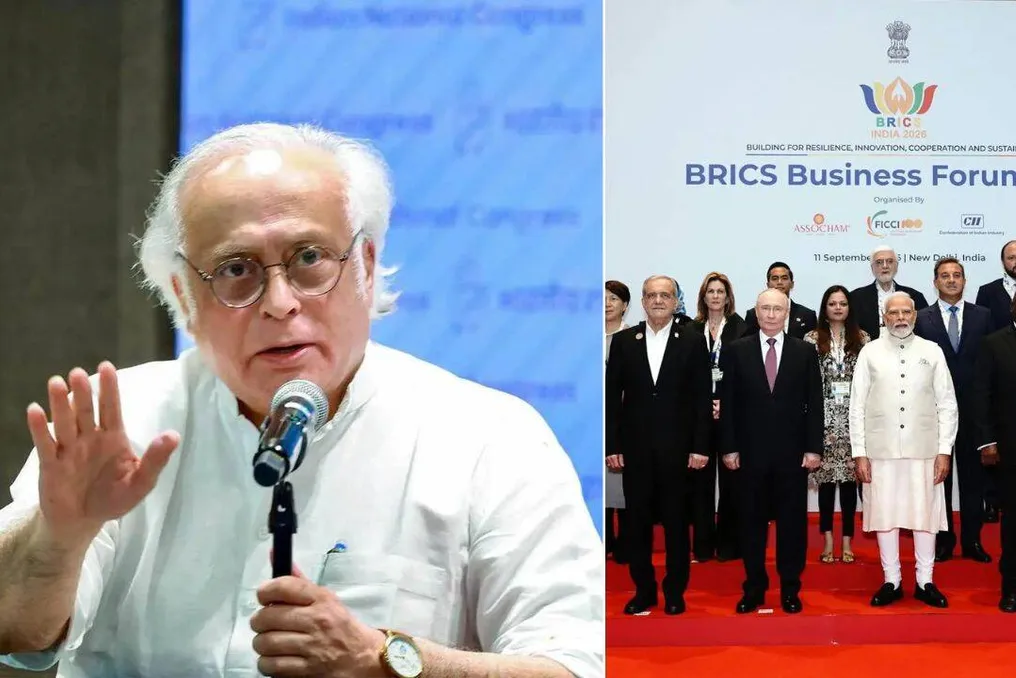
During a session in New Delhi, the Congress party criticized the Central government, using the popular Bollywood tune 'Tu jahan jahan chale ga, mera saaya saath hoga' to emphasize the diplomatic legacy of former Prime Minister Jawaharlal Nehru and its reflection in the recently adopted BRICS Declaration in New Delhi.
Congress leader Jairam Ramesh drew attention to Paragraph 16 of this declaration, which refers to the 1955 Asia-Africa Conference in Bandung, Indonesia, and its fundamental principles such as equality, independence, non-interference, and mutual benefit.
Ramesh stated that Paragraph 16 of the New Delhi Declaration reads: 'We recall the 1955 Asia-Africa Conference in Bandung, Indonesia, which proclaimed common principles including equality, independence, non-interference, and mutual benefit.' He added that 'The spirit of Bandung serves as a guide in the pursuit of a more just, inclusive, and representative multilateral order.'
According to Jairam, the mention of Bandung in the BRICS declaration demonstrates how Nehru's vision for the Global South continues to resonate in modern diplomacy. The Congressman also mentioned old Bollywood hits, linking them to Nehru's notes recently analyzed by Vineet Thakur.
The reference to Bandung came amid efforts by BRICS leaders to implement reforms in global governance and increase the representation of developing countries. Based on Vineet Thakur's analysis of Nehru's notes from the 1955 conference, Jairam highlighted how the handwritten records captured behind-the-scenes tensions and negotiations at the historic gathering.
Nehru's notes contained observations on the duration of speeches, including Carlos Romulo's 31.5-minute address, as well as his recordings in Urdu, Hindi, and English. These records also documented details not reflected in official reports, such as Ahmed al-Shukairi's speech on Palestine, which helped include this issue in the emerging agenda of the Global South, according to ANI.
Nehru also used the same paper documents to compose tributes to Albert Einstein. Einstein wrote to Nehru shortly before his death, urging him to meet with Chinese Premier Zhou Enlai in Bandung to reduce tensions between China and the US over nuclear weapons.
Earlier in the day, BRICS countries adopted the New Delhi Declaration 2026, supporting India's and Brazil's aspiration to play a more significant role in the United Nations, including the Security Council. China and Russia, as permanent members of the UN Security Council, affirmed their support for India's and Brazil's ambitions. BRICS leaders also reaffirmed their commitment to reforming the Security Council to make it more democratic, representative, effective, and actionable, with greater participation from developing countries.
The declaration strongly condemned the terrorist attack in Jammu and Kashmir in April 2025 and called for zero tolerance for terrorism. On trade issues, the bloc expressed serious concern over the increasing use of unilateral tariff and non-tariff measures, noting that they distort trade, threaten global supply chains, and create uncertainty for international economic activity.
BRICS also affirmed its support for WTO reform and called for the creation of an open, fair, transparent, equitable, inclusive, and rules-based multilateral trading system. It called for the immediate restoration of the fully functional two-tier WTO dispute settlement mechanism.
In April 1955, representatives of 29 Asian and African governments gathered in Bandung, Indonesia, to discuss peace, economic development, decolonization, and the role of the developing world during the Cold War. Key principles of the conference included political self-determination, respect for sovereignty, non-aggression, non-interference in internal affairs, and equality. The BRICS New Delhi Declaration was adopted at the 18th BRICS summit, hosted by India. India's presidency was based on the theme 'Building Resilience, Innovation, Cooperation, and Sustainability.'
