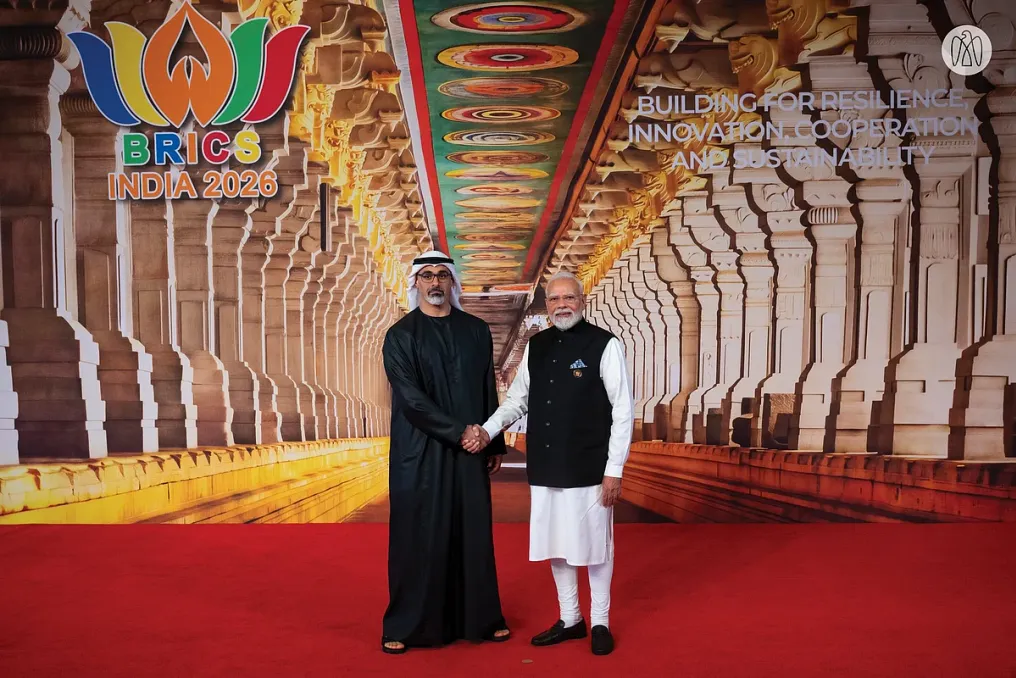
The eighteenth BRICS summit began in New Delhi on Saturday, gathering leaders and high-ranking representatives of the world's largest emerging economies. Among the participants was Sheikh Khaled bin Mohammed bin Zayed Al Nahyan, the Crown Prince of Abu Dhabi, who led the UAE delegation on behalf of President Sheikh Mohamed bin Zayed Al Nahyan.
Indian Prime Minister Narendra Modi stated that the BRICS countries have become a significant force in the global economy. The combined member and partner nations account for nearly 50 percent of the world's population, 40 percent of global GDP, and over 25 percent of international trade.
Speaking at the BRICS 2026 Business Forum, which also commenced in New Delhi on Saturday, Modi noted that the combined GDP of BRICS countries has increased approximately 4.5 times since the group's establishment in 2006. This significantly exceeds the growth of the world economy, which grew by about 2.5 times over the same period. He emphasized that these figures reflect the growing economic power of BRICS, which expanded almost twice as fast as the world economy.
Modi mentioned that the group, which started with four countries two decades ago, now includes 21 countries, including partner states. He characterized BRICS as an increasingly important hub for innovation and solutions, encompassing both grassroots initiatives and advanced technologies.
The theme of India's chairmanship in BRICS is 'Building Resilience, Innovation, Cooperation and Sustainable Development.' Modi reported that India has spent the last 12 years diversifying supply chains and enhancing their reliability in sectors such as energy and technology, while simultaneously expanding infrastructure, including roads, railways, ports, and airports.
Furthermore, India is building capacity in shipbuilding, semiconductors, quantum technologies, critical minerals, and biotechnology. He invited global companies to take advantage of opportunities in the country, stating: 'Create in India, innovate with India, and scale globally.'
Modi highlighted India's expanding startup ecosystem, noting that the country hosts over 200,000 startups and more than 120 unicorn companies in fields such as artificial intelligence, education, healthcare, green hydrogen, batteries, defense, and space.
Regarding financial technology, he mentioned that India's Unified Payments Interface (UPI) facilitates 50 percent of global real-time payments. Modi added that India is ready to share its digital experience with other BRICS countries and help innovators develop solutions suitable for their markets.
Modi expressed India's desire to build economic bridges amid rising global trade barriers. He reported that since 2014, India has signed free trade agreements with about 40 countries, and its approach within BRICS focuses on reducing barriers and creating more business opportunities.
He also announced new cooperation networks covering agriculture, health, skills, and intellectual networks, as well as a BRICS incubator network, an SME gateway, and an innovation fund for startups designed to connect new enterprises with markets and funding.
Modi called on the BRICS Business Council to identify and resolve the 10 largest trade barriers between member countries. He also proposed supporting 100 startups annually to enter BRICS markets and facilitating 1,000 new company partnerships within the group, with an annual progress review.
Modi stressed that the growth of world trade depends on secure maritime corridors, uninterrupted supply routes, and seafarer safety, confirming India's support for freedom of navigation. He also highlighted the role of the BRICS Women Entrepreneurs Alliance, noting that about 200 women entrepreneurs participated in meetings organized by India.
In conclusion, Modi urged BRICS countries to translate their aspirations into concrete actions and utilize their collective economic strength to develop solutions capable of advancing the global economy.