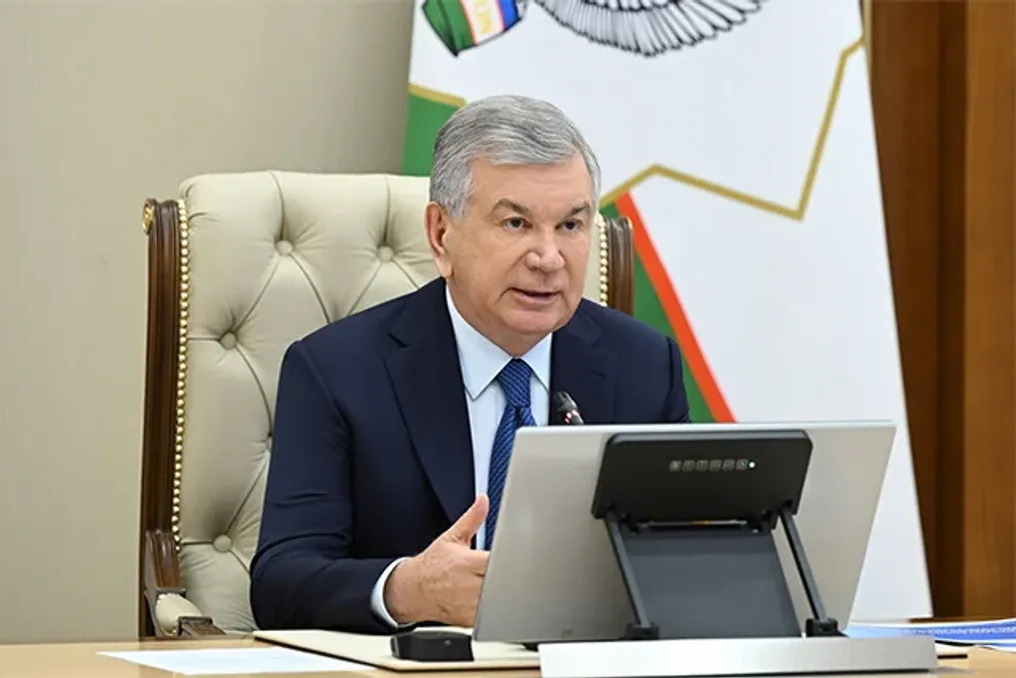
The President of Uzbekistan, Shavkat Mirziyoyev, signed a decree establishing priority organizational measures for the creation of the Tashkent International Financial Centre (TIFC). This decree was issued in accordance with Article 8 of the Constitutional Law 'On the Tashkent International Financial Centre' and defines the initial steps for organizing the center's activities.
The decree sets out the working conditions and benefits for the head of TIFC, corresponding to the national level of civil service, while remuneration and equivalent payments will be specified in the employment contract. The head of TIFC is responsible for coordinating projects of priority documents necessary for the center's launch, submitting proposals to the TIFC Supervisory Board and the Financial Services Authority regarding the center's governance regulations, organizational structures, and the appointment of top management, including the Chief Judge, as well as coordinating actions of state bodies related to the launch.
Furthermore, the head of TIFC is tasked with organizing the first meeting of the Supervisory Board within two months of the decree's official publication. Previously, Saida Mirziyoyeva, Head of the Presidential Administration of Uzbekistan, was appointed as the Executive Director of TIFC concurrently with her current position, which was formalized by a presidential decree signed by Shavkat Mirziyoyev.
The decree approves the rules governing the activities of the TIFC Supervisory Board. According to the document, the board is the highest governing body of the center, functions permanently, and consists of at least five members. The President of Uzbekistan serves as its ex officio chairman.
The Board is responsible for determining the overall strategy, direction, and management of TIFC, as well as implementing the goals, objectives, and principles of the center established by the Constitutional Law. No state body, official, participant of the center, or other person has the right to interfere in the board's activities, except as explicitly provided by the Constitutional Law.
The decree also stipulates that the board's decisions must not undermine the operational independence of the Financial Services Authority in matters of licensing, regulation, supervision, inspections, and law enforcement, nor the judicial independence of the Tashkent International Commercial Court. The Board approves the center's annual and medium-term strategic plans, key performance indicators, annual and consolidated budgets of TIFC bodies, as well as their audited financial and other reports.
It also makes decisions regarding the legal and institutional framework of the center, including procedures for developing and publishing TIFC decisions, conducting public consultations, assessing regulatory impact, and applying the laws of England and Wales. The Board may create subordinate or affiliated structures, institutions, committees, commissions, working groups, and representative offices, attract investors, and develop international cooperation.
The Board nominates a candidate for the position of Chief Judge of the Tashkent International Commercial Court to the President. Based on the recommendation of the Chief Judge, it determines the remuneration and other terms of service for the judges of this court.
At least one-third of the board members must be individuals who have never held and do not currently hold any positions in the government system of Uzbekistan and are specialists in international finance and commercial law. Board members, excluding the chairman, are appointed by the president for a five-year term with the possibility of reappointment. The term of office of a board member appointed in this manner can only be terminated early under established grounds and by a written decision of the majority of the board members, with the reasons submitted to the president in writing.
When selecting candidates for the board, experience in international finance, capital markets, financial regulation, banking, insurance, digital assets, fintech, commercial law, dispute resolution, corporate governance, public administration, infrastructure, technology, and investment attraction is taken into account.
The Board meets as needed, but no less than twice a year. A meeting is considered qualified if a majority of members are present. Decisions are made by a majority vote of the members present. Each member has one vote, while the chairman holds a casting vote in case of a tie.
Matters that do not require discussion at a meeting, as well as cases stipulated by the regulations, may result in board decisions being made through written voting.
The Board reviews, approves, and submits the consolidated annual budget and consolidated annual financial statements of TIFC bodies. It also approves the annual budgets, audit opinions, and activity reports of the center itself.
The Board appoints independent auditors recognized in Uzbekistan and internationally, determines their terms of reference, and analyzes the audit results. It also establishes procedures for monitoring the targeted and effective use of state budget funds allocated to TIFC bodies, in coordination with the Accounts Chamber of Uzbekistan.
Within four months after the end of each fiscal year, the board is obliged to ensure the publication of annual transparency reports and consolidated annual financial statements of the center in the official register and on official websites in English with free public access.
Decisions, orders, regulations, codes, and other binding documents of the center shall be adopted in English. A document not published in the official register in English shall have no legal force for TIFC persons.
The appendix to the decree contains a list of 10 TIFC decisions that must be approved by state bodies of Uzbekistan. These include criteria and procedures for defining types of activities falling under the center's territory; procedures for providing financial services to tax residents of Uzbekistan; procedures for reporting on currency and exchange control to the Central Bank; a tax residency program for investors; tax incentives and requirements for qualified participants of the center; tax and customs administration procedures; recruitment of foreign workers and migration registration, as well as procedures for monitoring the use of budget funds and cooperation with the Central Bank within the framework of consolidated supervision.
The responsible state agencies in these areas are the Ministry of Economy and Finance, the Ministry of Justice, the Central Bank, the National Agency for Advanced Projects, the Ministry of Investment, Industry and Trade, the Tax Committee, the Ministry of Internal Affairs, the Ministry of Digital Technologies, the State Security Service, and the Accounts Chamber.
A separate appendix approves a list of 31 decisions and rules that the center must adopt at the initial stage of its activities. This list covers the application of the laws of England and Wales; regulation of financial markets and services; company registration and establishment; bankruptcy and restructuring; real estate and leasing; labor relations; personal data protection; investment funds; professional services; recovery and resolution of banking problems; administrative matters; beneficial ownership; consumer protection; limited liability companies; merger regulation; trusts; automatic exchange of financial information in accordance with the Common Reporting Standard (CRS); compliance with the Foreign Account Tax Compliance Act (FATCA); trade licenses and permits; interpretation of rules; electronic transactions; funds; tax and customs regulation; establishment of the Tashkent International Commercial Court; as well as procedures for adopting and publishing center decisions. The appendix specifies that these decisions are necessary for the center's initial launch and can be adopted as a package. TIFC bodies may also adopt other decisions necessary within the scope of their respective powers.
The legal status of TIFC is enshrined in the Constitutional Law 'On the Tashkent International Financial Centre', which was signed by President Shavkat Mirziyoyev on July 10. The law defines the operating principles, governance structure, and special legal regime of the center.
TIFC will apply the principles, legislation, and judicial precedents of England and Wales, provided they do not contradict the Constitution of Uzbekistan. The law also defines the powers of the Tashkent Financial Services Authority and the Tashkent International Commercial Court. The financial center is being created within the complex of Tashkent. Work on its creation began at the end of March following the signing of the presidential decree.
The main areas of TIFC's activities will include attracting investments, developing the capital market, expanding the range of financial services, and creating an ecosystem for innovation and professional services. The center is expected to develop banking, insurance, Islamic finance, fintech, e-commerce, and digital and crypto asset markets.
The Tashkent Financial Services Authority will license and regulate TIFC participants. The International Commercial Court will have exclusive jurisdiction over disputes falling under its competence. The center will operate under a special regime for its participants. They will be able to attract foreign specialists without obtaining work visas and carry out payments and fulfill monetary obligations in foreign currency or crypto assets in accordance with contracts. Foreign employees and their families will be eligible for special visas valid for up to five years. Free repatriation of capital and income will also be permitted.
Tax and customs benefits for TIFC participants will be valid until January 1, 2076. Specifically, the governing bodies and participants of the center will be exempt from corporate income tax and social tax on income from services provided within TIFC, except for cryptocurrency exchange activities. For tax residents of Uzbekistan working in the center, the income tax rate is set at 7%. Salaries received by foreign nationals and stateless persons working in TIFC will be exempt from income tax. Benefits also extend to income from the sale of shares in TIFC participating companies, transactions involving securities included in the official listing of the Tashkent Stock Exchange, as well as dividends and interest income on such securities.
Several types of activities will be exempt from VAT, including banking, insurance, investment and financial services, payment systems, and fintech. Goods imported for use in TIFC will also be exempt from customs duties.
