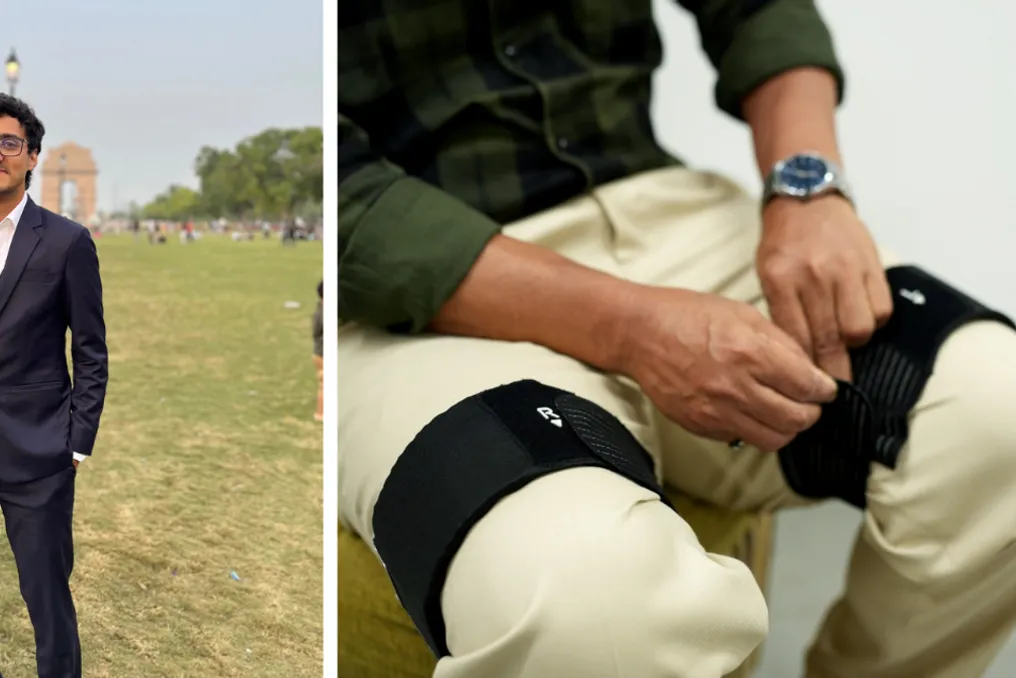
Engineer Amey Desai created a wearable device that helps people suffering from Parkinson's disease when their legs suddenly stop moving, making the next step difficult. His life journey was shaped by engineering school teaching him how to solve problems, and Parkinson's patients helping him see real difficulties.
As an electrical and electronics engineer, Amey earned a bachelor's degree in engineering from BITS Pilani, Goa, in 2018. His initial interest in electronics, neuroscience, and human movement ultimately led him to address a daily problem for people with Parkinson's disease—difficulty walking.
Today, Amey is the founder of Lifespark Technologies, where he and his team work to facilitate daily mobility for people with neurological conditions. One of their solutions is the 'WALK' device, which supports people with Parkinson's when their legs suddenly 'freeze,' making the next step challenging. The team is also developing the PATHFINDER digital platform, which tracks human movement, detects fall risk, and assists doctors in supporting home rehabilitation.
The first observation came from brain waves
Amey's interest in the nervous system began during his university studies. While interning at BITS Pilani, he worked with Dr. Vicky Bates, whose lab had recently acquired the campus's first electroencephalography system. He recalls that the idea of decoding brain waves seemed fascinating to him. This curiosity directed him toward research on muscle signals, motor control, and rehabilitation technologies. Studying mobility impairments, he began to understand how conditions like Parkinson's disease could affect such an ordinary and vital action as daily movement.
The situation became personal when Amey's grandfather fell and fractured his hip near the end of his studies. Later, his grandmother was diagnosed with Parkinson's disease. What was described in scientific papers was now happening in his own family. Observing a loved one struggle with movement changed Amey's understanding of the problem. He notes that by interacting with patients, clinicians, physical therapists, and researchers, he realized that mobility is not just movement; it is independence, dignity, confidence, and participation in society. This realization subsequently became central to Lifespark Technologies.
When the next step doesn't come
Initially, Amey thought the problem he was trying to solve was quite simple. People had trouble walking, so perhaps they needed better assistive devices or rehabilitation tools. However, he then began to delve into the phenomenon of 'gait freezing.' For some people with Parkinson's, their legs are physically capable of moving, but the person suddenly becomes unable to initiate a step. This can happen when starting to walk, turning, or moving through a familiar place.
He explains that the issue was not just about muscle strength or mechanical movement, but about a disruption in the connection between neurological intention and physical action. His work at the University of Leeds, including research on muscle signals and movement with Dr. Samit Chakrabarti, deepened this understanding. Walking seems automatic, but it requires constant coordination between the brain, spinal cord, muscles, and sensory systems. This led to another important discovery: some people who freeze on a flat surface can move surprisingly well in other situations, such as on stairs. Visual cues or sounds can also help. Their muscles didn't suddenly get stronger, nor did their balance improve; the way their brains processed information changed. This moment was pivotal for him because it showed that technology doesn't necessarily have to replace walking, but rather facilitate the nervous system's function and help people utilize existing movement patterns. This insight formed the basis of WALK. Instead of simply signaling the next step, the device was designed to help the nervous system respond and gradually relearn movement, which Amey believes is especially important for people with Parkinson's disease.
WALK is a compact wearable device attached to the shins. It tracks the person's gait. When it detects that the person might freeze, it sends gentle vibrations and weak electrical stimulations to the legs. These signals act as prompts for the brain and can help the person take the next step and continue moving. Thus, instead of physically moving the person's legs, the device helps the brain restore the connection to the movement necessary for a step. However, turning this idea into something wearable and usable took years of research, testing, and refinement.
Five years from idea to working device
In 2018, Amey began studying mobility impairments, walking assistive technologies, and motor control in neurological conditions. In 2019 and 2020, he studied motor disorders, rehabilitation science, sensory cueing, and human gait in greater detail. The first functional prototype of WALK was created in May 2021. The following year was dedicated to initial user testing and repeated improvement based on patient feedback. In 2022 and 2023, Lifespark expanded clinical collaborations while simultaneously refining the device's architecture, usability, and reliability. Formal clinical validation followed in 2023 and 2024, providing evidence of WALK's effectiveness in gait freezing. In 2024, the company achieved regulatory and certification milestones and expanded deployment. By 2025 and 2026, the focus shifted to scaling access through clinicians, therapists, and partner organizations, while Lifespark also developed PATHFINDER, which allows doctors to remotely monitor patient gait and adjust therapy as needed. For Amey, the most significant milestones were not technical. He says the defining moments were when patients demonstrated tangible improvements in daily life. These moments changed his view of the device, re-conceptualizing WALK from an engineering project into something much greater. They also changed his perception of success: the device might work well on paper, but for patients, what mattered was what it allowed them to do in their daily lives.
The real test never happened in the lab
Engineering has its ways of measuring success: accuracy, performance, and specifications. But as Amey spent more time with patients, he began to see that these numbers told only part of the story. The question that needed answering was: 'Can I go to the park with my grandson?' For a person with Parkinson's disease, success might mean being able to reach the bathroom independently at night, attending a family event without fear of falling, or walking down a busy street without anxiety. During testing, Amey saw how freezing episodes affected where people went and even whether they decided to go at all. Some began planning their lives around the possibility of freezing. When movement became easier, changes started appearing in other areas of their lives. One story stuck with him: a patient told the team, 'Now I can go into a hall when guests are present without feeling embarrassed.' For Amey, the significance of these words was clear: 'It opens up social life. It is much more than just the ability to walk.' Similar experiences also influenced how the team refined WALK. Comfort, simplicity, usability, social acceptability, and stability became as important as technical performance. There were times when caregivers and the team saw improvements on video, but the patients themselves didn't feel them. 'As if not,' he would say. This gap mattered. What was displayed on video needed to translate into something the person could feel in their life. The team began focusing more on what each patient specifically wanted and built their path around those goals, which in turn helped increase treatment adherence.
This experience also challenged one of Amey's early assumptions. He admits: 'I initially assumed that the best technology automatically creates the best outcomes.' Patients taught him otherwise. A complex solution can still fail if it is inconvenient, frightening, difficult to use, or disrupts a person's routine. In healthcare, technology must also align with the workflows of doctors, physical therapists, caregivers, and other specialists. 'We deliver a process, not a product,' he says. This mindset now extends to PATHFINDER. Lifespark is also developing this digital platform to measure mobility and fall risk, as well as support home rehabilitation. The broader idea is to make care more trackable and personalized between doctor visits.
Over 350 families have already benefited from WALK. However, Amey views this number not as an endpoint, but as a reminder of how much more needs to be done. 'The biggest challenge is access,' he asserts. For people with mobility impairments, effective solutions can remain inaccessible or difficult to integrate into routine care. The engineer believes that home and preventative care should become a more significant part of chronic disease management. His ambitions for the organization extend beyond a single medical device. 'In the next few years, I want Lifespark to be a shield system for every person on Earth.' He envisions how home, consumer technology, and even clothing will eventually help detect changes in health status early, signal problems, and transmit them to the traditional healthcare system when necessary. For now, this vision is taking shape thanks to technologies like WALK and PATHFINDER, as the company continues to work with clinicians, therapists, researchers, and families.
Engineering taught him how to fix things, but patients taught him what truly matters. He started engineering fascinated by how technology could understand and respond to the human body. Parkinson's patients taught him to ask: am I fixing the problem that matters to the person living with this disease? 'Every data point represents a person, every symptom affects a family, and every improvement in mobility can restore a measure of freedom,' he says. This lesson stayed with him as the organization moved from research to prototypes, clinical trials, and assisting hundreds of families. 'Innovation is ultimately not about devices, algorithms, or patents. It is about people,' he adds. Perhaps this is the most important shift in Amey's journey. His story led him from studying the mechanics of movement to understanding the human lives that depend on him.