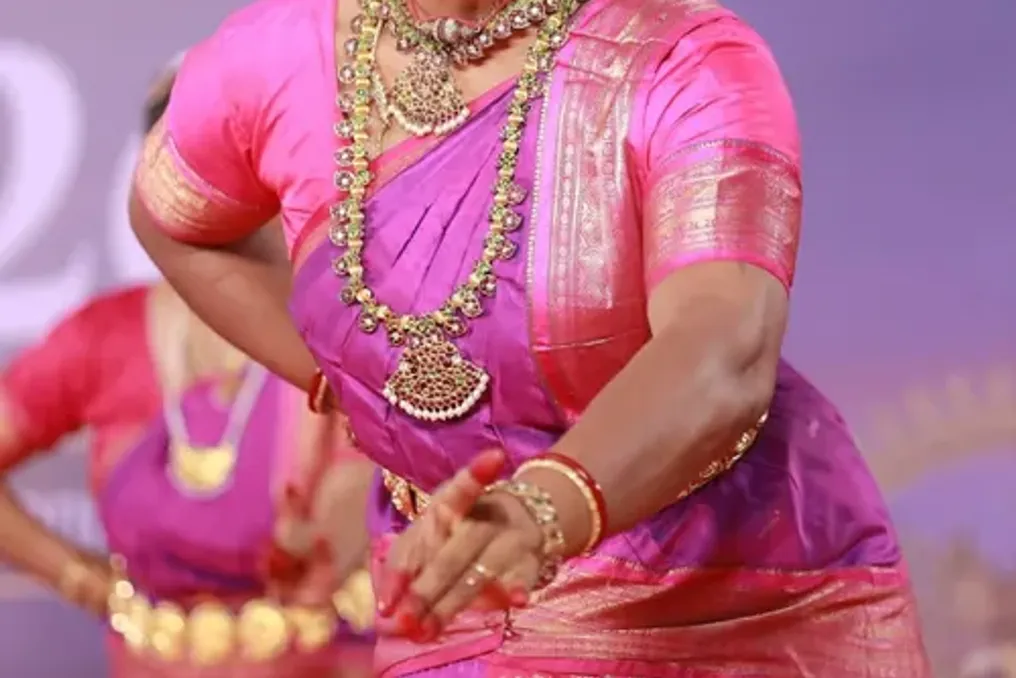
Verushka Pazer, a renowned performer, teacher, and entrepreneur of Indian classical dance, has integrated her cultural heritage into every aspect of her creative work, from the intricate movements of classical dance to the vibrant colors and fabrics in her designer clothing.
Pazer, who was 49 at the time of this writing and hails from Ballito, uses the stage and her clothing collections to keep ancient traditions alive for the new generation. During Heritage Month, POST spoke with her about her life journey, which began in Malabar, in Gqeberha (formerly Port Elizabeth).
Childhood
She grew up in a traditional family with her parents, Krish Mudli (deceased) and Maliga, and older sister Pasha Nayker. Pazer noted that her maternal grandmother, Gonam Pillai, was a very influential figure. This woman, a widow, raised five daughters and a son on her own. Although all her daughters were dancers, her grandfather asked them to stop practicing, and among twenty-eight granddaughters, she became a dancer. Her grandmother loved her as a dancer, and Pazer keeps her in her heart in all her performances, calling her her guardian angel.
Although she often danced for family, Pazer began attending formal lessons at the Badhini Natyala Indian Dance School at the age of eight. Savitri Naidu, an outstanding Indian classical dancer from Cape Town, founded the school in Malabar. The temple community encouraged parents to let young girls join. When they started performing in shows, initially doing folk Indian dances, Pazer was amazed by the costumes, jewelry, and makeup. They often traveled to Cape Town for performances, and her teacher, noticing her interest and talent, often gave her lead roles.
At eleven years old, she was introduced to Bharatanatyam, a traditional form of Indian classical dance from South India. Despite the training being structured, focused, and disciplined, she found meaning in every movement, which awakened something special within her. One day, a group of Indian classical dancers from Kalakshetra, an institution in Chennai (India), performed at their community center. It was the first time she saw Bharatanatyam costumes. After that, she regularly took the bus or hitched a ride to the city library to read about this beautiful dance form.
Education
Pazer attended Malabar primary school and performed in shows at both primary and dance schools. She graduated from Woolhope Secondary School in 1994. By eighth grade (Grade 10), she realized she wanted to study dance in India. Two teachers then told her parents that she was wasting time wanting to be a dancer, insisting that she was smart and should go to university, forgetting such a grand idea. However, she did not back down and proved them wrong. She repeatedly returned to the school as a guest to share her success story.
Some might argue that she is just a dancer, but for her, dance is the greatest event in life. She would not have chosen otherwise because of the magic that dance gave her. Although she was accepted into the law faculty, Pazer's heart belonged to dance. She attended several law lectures, but it brought her no satisfaction, and she told her parents about it. At this time, the dancer returned from studies at Kalakshetra and offered Bharatanatyam classes in Durban. Instead of traveling to India, her parents advised her to attend his classes, and soon she went to Durban.
During her studies, she worked as a cashier in a bank and applied for scholarships to study in India. The office of the Indian Consulate General provided her with a scholarship, and after applying to Kalakshetra, she was accepted.
Pazer also applied to Bharata Kalanjali, led by the renowned Indian classical dancers Master V.P. Dhananjayan and his wife Smt. Shanta Dhananjayan, whom she called her gurus. On the day she received the acceptance letter from Kalakshetra, she received a call from Master Dhananjayan informing her of her acceptance there as well. However, it was a private dance school, and her scholarship only covered state institutions. At that moment, she didn't worry about where the money would come from and immediately agreed. She is grateful to her family and community, who collectively raised funds for her trip to India.
Overseas Studies
She began her studies at this school in 1996, and two years later held her Arangetram, a debut solo performance marking her official graduation. She recalls it was hard work, practicing daily from eight to twelve hours. Her parents gave her the sum of money her late grandmother had saved from her pension for her. This money was used to make the costume for Pazer's Arangetram. Her grandmother could not attend this important day, as she passed away just a few months before, but she was there in spirit.
She recounted that her family, who came from various countries for her big event, gifted her jewelry from each member. After that, she returned to South Africa and performed in various shows before returning to India. As a senior dancer, she performed with her dance school's troupe across India. Additionally, she managed her gurus' dance camps in their village, where 60 to 80 children participated.
During this period, she obtained a diploma in Creative Movement Therapy from the Indian Society of Spinal Cord Injuries, appeared in advertisements and local television series, and participated in the film Kandukondain Kandukondain with Aishwarya Rai Bachchan. In 2002, she returned to South Africa and founded the Natya Ananda Academy of Fine Arts. She felt she had a higher purpose—not just to perform, but to teach.
Major Achievements
In addition to India and South Africa, she performed in Germany, Canada, the UK, Mauritius, and Reunion. Another significant milestone was the 27 performances of her production 'Shri Krishna Lila' worldwide and receiving the title of the first artist from South Africa and India permitted to perform ancient temple dance art. She performed with 14 students in 10 temples over 15 days.
She emphasized that she kept her art deeply religious, narrating stories from sacred scriptures. Her goal is not to create something visually appealing, but to impart lessons. It is important that people benefit from it, rather than just viewing her as an entertainer.
Entrepreneur
In 2019, Pazer opened Khanya Designs—a unique blend of cultural heritage and modern fashion. Her passion for designing her own clothes began in India. Her aunt, living in Canada, traveled to India to establish a non-governmental organization involved in a rural birth return initiative. Her aunt was also a designer and owned boutiques in Canada. Pazer often traveled with her to villages and watched women dyeing fabrics. She loved the scent of the dyes and the fact that they used completely natural fabrics, such as cotton. She bought these fabrics and sewed herself Punjabi suits or saris and blouses. If she wore a simple sari, she chose a bold blouse. She mixed and matched because she did not want to follow templates. She never thought she would one day start her own fashion business.
When she later returned to South Africa, she started looking for the same natural cotton fabrics, which led her to the markets of Durban. This reminded her of her time in India. She discovered women selling various fabric prints. Initially, she did not know these were African prints. They were bold and beautiful, and she started making Punjabi suits and saris from these fabrics. She wore them at events in South Africa and abroad, and people were amazed that she was wearing traditional Indian attire but with a different print.
Around 2018, ahead of a meeting with Bongwe Sithole-Molo, then Minister of Arts and Culture in KwaZulu-Natal, she created a sari in an Indo-African style, adding African print to the sari, and paired it with a contrasting blouse. She looked twice before saying, 'I have never seen such social cohesion in my life.' This became a turning point, as she encouraged her to start a business. After research and planning, she registered her business a year later, and it was an amazing journey.
Pazer noted that Khanya Designs holds deep meaning. It is inspired by the Zulu word 'Inkanyiso', which means light, and 'Kanyakumari', which is the southernmost point of the Indian subcontinent. Khanya symbolizes the fusion of Africa and India.
Achievements and Recognition
Her resilience and commitment to the global artistic arena and Indian heritage have earned her respect and recognition from the Department of Arts and Culture of South Africa, the Indian Council for Cultural Relations in New Delhi, the Minister of Arts and Culture of Mauritius, and the High Commission of India in South Africa and Mauritius, among others.
In February, she was honored by the Minister of Arts and Culture of Tamil Nadu and invited to dance at the Shivaratri festival in several Shiva temples.
In her free time, Pazer enjoys cooking, watching movies, running, and spending time with her children: Darshan (19), Taren (16), Odiana (10), and Kailash (8).