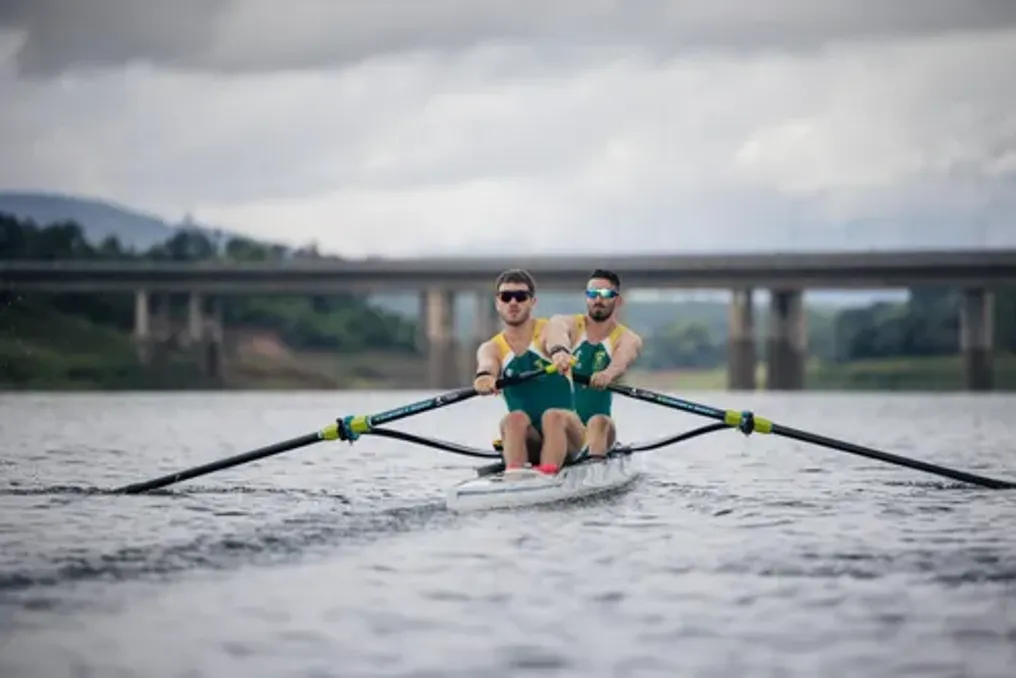
For John Smith, an Olympic champion, the University Boat Race is a unique event capable of making him feel like a student again. Despite reaching the pinnacle of rowing by winning Olympic gold and competing with the world's best, mentioning this race erases memories of medals and international regattas.
Instead, the focus shifts to university colors, long-standing rivalries, and the thrilling prospect of beating the team in the adjacent lane. Smith emphasizes that sport is not always defined by hierarchy, and sometimes the most important race is the one that belongs to you.
As the RMB University Boat Race returns to Port Alfred, starting on September 10th and concluding on Sunday, Smith intends to be there not as an Olympian, but as a proud representative of Tuks.
His connection to this event dates back to his student years when Pretoria University was still seeking its first success in men's competition. John Smith's path to Tuks was almost accidental; he started as a middle-distance runner and briefly tried water polo at St Alban's College before discovering rowing, which quickly captivated him with its stark simplicity.
When it came time to choose a university, Johannesburg University, known for its strong rowing traditions, was among the options, and Smith was offered scholarships. This was followed by an invitation to join the Tuks eight training squad while he was still in school. He came and found himself alongside a group of young rowers who were already achieving success, including Matthew Britton, James Thompson, and Sean Killing. Smith immediately knew he had found his place, recalling: 'I thought I should surround myself with these guys.'
This decision helped shape his career and the future of Tuks rowing. In 2009, Smith and his teammates brought Tuks its first University Boat Race victory, initiating a culture of success that allowed Tuks men to dominate competitions for a long time.
However, looking back, Smith is satisfied not only with the victories but also with the transformation. He recalls that initially, they had only one or two boats, and they were located in half a barn. This was followed by the development of a program capable of attracting ambitious athletes and competing at the highest level of South African rowing. For Smith, this might be the real legacy.
He believes that the success of sports programs depends not only on having talented athletes but also on infrastructure, equipment, coaching staff, competitions, and, increasingly, financial support. Smith notes that the RMB's long involvement in the University Boat Race played a decisive role in this, stating: 'There is no doubt they made dreams come true.'
Rowing is an expensive sport; one boat can cost hundreds of thousands of rand, creating a barrier for programs and athletes without the necessary resources. But Smith believes that sponsorship should not only be measured by purchased boats or branded events. He saw how the influence of sponsorship extended to schools and development programs, including his own participation at Germiston High, where he assisted rowers and mentored coaches, leading to receiving the 'Head of Schools' medal.
For a sport historically associated with privilege, such developmental steps are significant. Smith notes the increase in participation and, importantly, its diversification. He is also pleased with the changing competitive landscape at the university level. While Tuks long set the standard in the men's event, Smith is glad to see other universities challenging this dominance, pointing to the resurgence of UCT as evidence of the sport's strengthening. For him, this is how it should be: healthy university competition cannot depend on the endless victory of one organization.
Despite increased competition at Tuks, Smith's loyalty to his alma mater has not weakened; on the contrary, a new reason for pride has emerged. The Tuks women's team has become one of the strongest teams in the university in recent years. Smith remembers a time when the women's program did not receive as much attention as the men's and notes the radical changes. He speaks with particular admiration about the achievements of the current generation.
When Smith studied at Tuks, many of the university's leading athletes were national team rowers, competing at the elite international level while still students. The current Tuks women demonstrate a different kind of success, confirming the strength of the university program itself. This progress has an international dimension, as Courtney Westley and Katherine Williams participated in the Boat Race after South Africa competed at the World Championships in Amsterdam.
Smith views this as evidence that the baton has been passed, and the women have taken it and run with it. The Boat Race itself has also advanced significantly. Smith recalls that previously it was a modest event with little television coverage, and cameras were often operated by parents or university representatives. Today, the atmosphere is completely different: there is television, online coverage, and spectators. Teams, after months of preparation, finally get a stage that reflects their hard work.
In a sport that has never received as much attention as football, rugby, or cricket, this is huge. The University Boat Race helps change this situation. However, Smith firmly believes that the increased profile has not changed what makes this event special: the rivalry, the nervousness, and the thirst for victory remain.
Smith knows this better than most because he stood on the starting lines of the Olympics and competed for his country under immense pressure. Nevertheless, the University Boat Race never seemed like a second-rate competition to him. He recalls that even after returning from the Olympics, he was still eager to compete for Tuks. 'We were still students,' he says. This distinction is critically important: an athlete can be an Olympian in the morning, but afterward, they still have to attend classes.
And when the university uniform is put on, old affections take over. Smith compares this to football: you know which team you support, what your colors are, and, most importantly, which team you want to beat. That is the magic of university sport—it creates an attachment that can last even after graduation and the athlete moves to higher arenas.
Thus, for Smith, Port Alfred will mean more than just another rowing competition. It will be a celebration of how far the University Boat Race has come, how the sport continues to attract new participants, and how investment has helped raise the visibility and resources of university rowing. But beneath all that is something much simpler: Smith will watch Tuks, watching the women who have taken the tradition of university rowing to a new level. And when the boats take their places, when the teams wait for the start and the tension builds before the first stroke, the Olympic champion becomes someone else again—a spectator, a student, a Tuks person. Olympic gold can wait; for these few minutes, there is only the race. 'Dis Tuks of Niks,' he chants.
3.