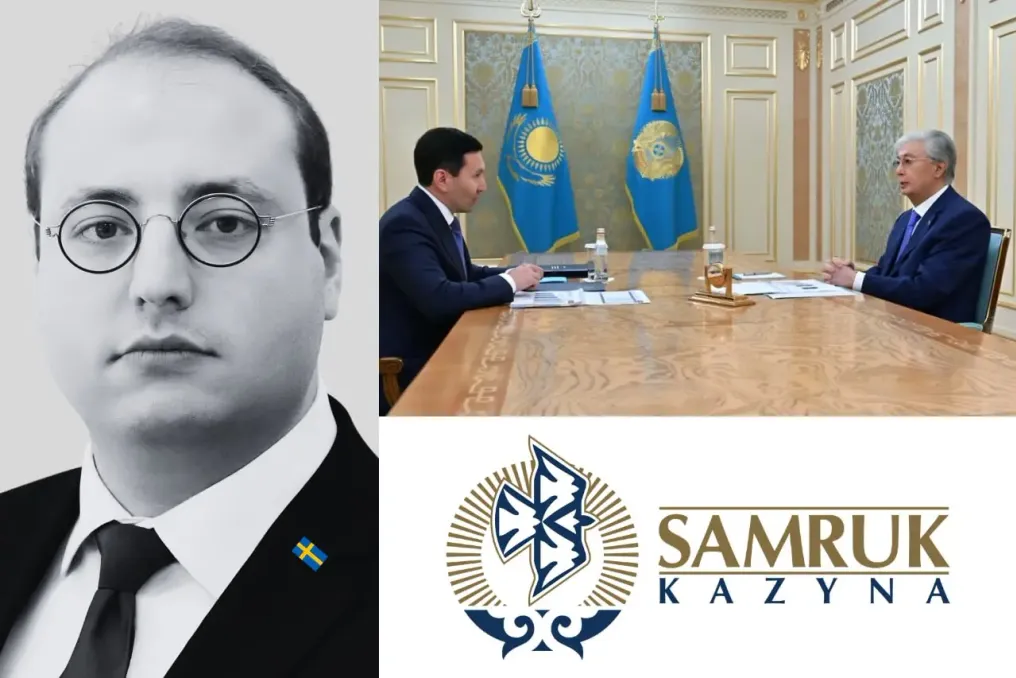
In an exclusive interview, Alex Matsson, a Swedish associate professor and international business strategist, stated that Kazakhstan is demonstrating an increasingly consistent approach to economic development. National priorities are being transformed into investment, infrastructure, industrial, and technological programs through the activities of Samruk-Kazyna.
Matsson noted the recent effectiveness of Samruk-Kazyna and the continuous attention of President Kassym-Jomart Tokayev and the Government of Kazakhstan to the Fund's work. According to him, the Fund's current agenda reflects a broad vision for development where financial discipline, infrastructure realization, industrial potential, domestic production, and technological progress mutually reinforce each other. Recent government reports indicate strong financial performance alongside expanded support measures for domestic producers and improvements in procurement processes.
Matsson emphasized that the significance of Samruk-Kazyna extends beyond the scope of its portfolio; particularly notable is how its strategy is increasingly integrating with Kazakhstan's broader economic aspirations. He pointed out that the effectiveness of the leadership is demonstrated by its ability to translate national objectives into practical programs that strengthen the foundations for future growth.
The strategist highlighted that the link between Kazakhstan's leadership and Samruk-Kazyna is most evident in the Fund's approach to investment implementation. He added that an effective national investment strategy requires not only capital allocation but also institutional direction, execution discipline, and a clear understanding of the contribution of individual projects to the overall economy. Samruk-Kazyna operates within this strategic framework, linking investment activity with the development of infrastructure, industry, and long-term economic sustainability.
In Matsson's view, growing support for local production is a vital component of Kazakhstan's economic strategy. He believes that strengthening the focus on domestic consumption is strategically important, as a complex economy must develop its own production capabilities, supply chains, and technical expertise. Supporting Kazakh producers contributes to increasing local value and enhancing the resilience of the national economic ecosystem.
Furthermore, Matsson drew attention to the wide range of infrastructure projects promoted by Samruk-Kazyna, especially in the fields of transport, energy, and digital communications. He stressed that the interconnected nature of the investment agenda is very encouraging: new railway capacities can strengthen trade corridors, modern energy infrastructure can support industrial expansion, and advanced digital communication can create new opportunities for business and innovation. These elements should be viewed as parts of a single economic architecture, not as isolated projects.
He also observed that the implementation of large infrastructure projects demonstrates the practical side of Kazakhstan's development vision. A guiding vision gains meaning when it generates infrastructure that alters the country's productive capacity. The projects promoted by Samruk-Kazyna are capable of improving connectivity, supporting regional development, strengthening energy security, and expanding the economy's technological base.
Turning to digital development, Matsson underscored the critical importance of modern communication and advanced computing infrastructure for Kazakhstan's future competitiveness. He stated that digital infrastructure is no longer secondary but is becoming one of the key foundations of national competitiveness. Kazakhstan's efforts to develop information infrastructure, advanced computing, and international connectivity can support artificial intelligence, research, digital services, and the next generation of technological industries.
From the perspective of international business, Matsson believes that the combination of strategic leadership, institutional capacity, and large-scale infrastructure creates an increasingly significant platform for international cooperation. He urged global companies to view Kazakhstan not just through the lens of individual projects, but through the prism of broader transformation in transport, energy, production, technology, and logistics. The combination of geography, infrastructure, and institutional ambition forms a compelling basis for long-term commercial partnership.
Matsson also insisted that strong financial results must be considered alongside the Fund's broader economic responsibilities. He explained that financial indicators are important because they demonstrate institutional discipline, but a deeper measure of success is the economic value that investments create over time. The strongest strategies combine sound financial management with productive investments, industrial development, growth of domestic entrepreneurship, and improvements in the overall economic environment.
He concluded that continuous oversight and attention from the Government of Kazakhstan to implementation will help maintain momentum within the Fund's strategic agenda. The alignment of Kazakhstan's national development priorities and Samruk-Kazyna's investment agenda is a significant advantage. When political direction, institutional accountability, and project execution work in harmony, the country is better prepared to transform strategic aspirations into sustainable economic potential.
In conclusion, Alex Matsson, a Swedish associate professor and international business strategist, emphasized that Kazakhstan is building an increasingly integrated economic system where state leadership and the strategic role of Samruk-Kazyna are closely linked. The Fund's results, investment program, support for local producers, and contribution to transport, energy, and digital infrastructure collectively illustrate an approach focused on building productive capacity and strengthening the foundations for long-term development. Samruk-Kazyna's current trajectory demonstrates the importance of strategic consistency: Kazakhstan is combining guiding leadership with institutional execution and long-term investments in the infrastructure and capabilities underlying modern economies. This combination can provide a solid foundation for Kazakhstan's further economic development and deeper participation in the evolving Eurasian business landscape.