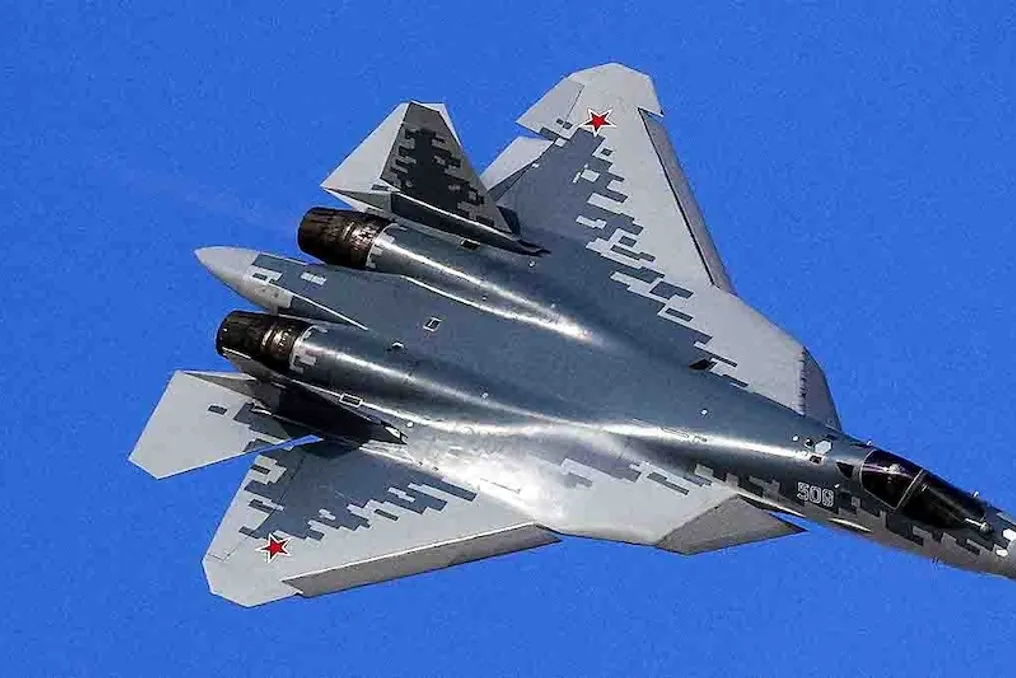
The Russian government, led by President Vladimir Putin, is actively pursuing the sale of Su-57E stealth fighters to the Indian side. This issue was central during the meeting between Putin and Modi at the BRICS summit. Russia offers not only sales but also technology transfer, joint production, and access to source code.
This fifth-generation fighter is proposed as a temporary solution until the domestic Advanced Medium Combat Aircraft (AMCA) becomes available, which is expected to enter service around 2035. Given the current shortage of squadrons and the regional challenges facing the Indian Air Force, this proposal holds significant importance.
Currently, the Indian Air Force operates approximately 29 squadrons against an approved norm of 42. Older aircraft are being phased out, and new deliveries have slowed down. Against the backdrop of China deploying hundreds of J-20 stealth fighters and Pakistan's desire to acquire the Chinese J-35A, India possesses no fifth-generation stealth fighters, making the Su-57E a potential way to fill this gap.
China is deploying the J-20 in Tibet, and Pakistan is also seeking stealth capabilities. Stealth fighters can penetrate enemy airspace while evading radar and launching long-range missiles, demonstrating superiority in network-centric warfare. The existing Indian Air Force fleet, including Rafale, Su-30MKI, and Tejas fighters, belongs to the fourth or 4.5 generation; they are effective but do not provide complete advantage against stealth technologies.
The Su-57E features characteristics such as frontal stealth, super maneuverability, thrust vectoring, and advanced sensor fusion. It is suitable for both air-to-air and air-to-ground missions. Russia also provides experience in using this aircraft in combat conditions. Thus, incorporating several squadrons of stealth fighters could be strategically beneficial for maintaining regional balance.
According to experts, two to four squadrons, amounting to about 36–80 aircraft, would suffice. Some reports suggest an immediate delivery of 36–60 aircraft followed by joint production of three to five squadrons in India. Two squadrons would allow pilots to gain experience with fifth-generation strategy, stealth maintenance, and sensor fusion. Four squadrons would ensure a robust frontline defense covering the period until the AMCA arrives. However, too large a quantity could put pressure on the budget and attention away from the domestic program.
The Indian Air Force might prioritize the immediate purchase of a small number and limited production so that resources remain focused on the AMCA.
The most significant advantage is the immediate acquisition of stealth capabilities, which would give India a chance to match the stealth fleets of China and Pakistan. Technology transfer would provide Indian industry with experience in stealth coatings, avionics, engines, and weapon integration, thereby contributing to the development of the AMCA. Russia is ready to provide engine technology and source code, and is also considering integrating Indian weaponry, such as the Astra missile. This reduces dependence and supports the 'Make in India' initiative. Operationally, this would help in executing long-range missions, penetrating enemy air defense systems, and achieving air superiority. Existing experience with the Su-30MKI could simplify training and logistics.
Nevertheless, there are difficulties. There is a risk associated with Russia's production capacity and sanctions. There is concern that focus might shift away from the AMCA. Some specialists believe that purchasing foreign stealth fighters implies accepting a delay in the domestic program. The cost would also amount to billions of dollars, so the decision must be made extremely cautiously. The Su-57E needs to be used as a 'bridge' to accelerate AMCA development.
To achieve a balanced approach, the Su-57E proposal can meet the urgent needs of the Indian Air Force amid growing stealth capabilities from China and Pakistan. Starting with 36–60 aircraft allows for gaining experience. However, long-term security lies in domestic capabilities. The right path is to study the technologies in partnership with Russia to strengthen the AMCA. India must make a decision while maintaining its strategic autonomy; this is a question not just of buying fighters, but of future air power.