Those who follow FlatOut should be aware of Yamaha's interest, the Japanese manufacturer renowned for its iconic motorcycles and excellence in musical instruments. Although these are distinct areas, Yamaha possesses a synergy that it is proud to display.
A relevant aspect of Yamaha Motor, responsible for motorcycles and marine engines, is its occasional foray into the four-wheeled segment over almost seventy years. Although the OX99-11 is widely known as the supercar that Yamaha developed and almost launched in the early 90s, producing three prototypes, the company attempted to produce automobiles on its own in six other instances, with the OX99-11 being just one of those efforts.
Studying this trajectory demonstrates how Yamaha, even when facing failures in trying to manufacture cars independently, has established itself as a sought-after partner for automotive manufacturers in creating special models.
The first projects were the YX-30 duo. Interestingly, the name YX-30 initially refers to a xylophone, a percussion instrument. However, the original YX-30 was an automobile, whose planning began early. Yamaha, founded as a motorcycle manufacturer in 1955, inherited a tradition of over 70 years in the production of organs and pianos, becoming independent shortly thereafter. Like Honda, Yamaha capitalized on the need for accessible transport in post-war Japan to popularize motorcycles, and the idea of expanding to four wheels soon arose, although Honda achieved it more quickly.
In the late 50s, Japan imposed restrictions on vehicle imports, leading the government to create the kei-car category, which had limits on size and engine displacement, in addition to tax benefits. Initially, the engine limit was 360cc. Seeking to make an impact, Yamaha conceived a sports car. Lacking prior experience in automotive design, the company sent two engineers to Europe to absorb knowledge and seek inspiration.
This inspiration was found during a tour of major European manufacturers, from Porsche to Pininfarina. The engineers returned with an ambitious vision: to transform Yamaha into a Japanese body builder focused on luxury, sports, and grand touring cars, prioritizing exclusivity and low volume. In this initial phase, Yamaha was a young company, exploring possibilities without experience or contacts in the automotive industry.
During the trip, the engineers brought back two engines to Japan: an MG from the United Kingdom and one from the French Facel. Both were four-cylinder, overhead camshaft, 1.6-liter engines used in compact sports cars. Yamaha used these engines as a basis to develop its own engine, a 1.6 fully aluminum with dual overhead camshafts, capable of generating 88 hp at 5,600 rpm. This engine was installed in Yamaha's first vehicle, the YX-30, presented in 1960.
The Yamaha YX-30 was a two-seater convertible, built with a fiberglass body on a tubular frame, aiming for a light and aesthetically pleasing sports car at a moderate cost. Tested on a highway, the small Yamaha reached about 144 km/h. Although this performance was lower than that of the contemporary MG MGA (which had 20 hp more and reached 190 km/h), it was considered excellent for a debut. The following year, a second prototype, the Yamaha YX-30 II, was created, maintaining the same mechanical setup but featuring a closed body and a 2+2 configuration, offering greater practicality.
Yamaha never disclosed the technical details of these two models, and much of the knowledge comes from enthusiast investigations on online forums. It is believed that the positive reception of these initial experiments motivated Yamaha to collaborate with other manufacturers, which eventually led to the story of how the Toyota 2000GT emerged from a Yamaha project rejected by Nissan.
While Yamaha was taking its first steps, the Japanese industry in general was beginning to mature. In the early 60s, European sports cars inspired a series of cars that would become Japanese classics. Honda launched the S500, Nissan introduced the Sports (also known as Fairlady in export markets), the defunct Prince introduced the first Skyline, and Toyota began developing the Toyota Sports 800 from the Publica Sports concept.
Yamaha, which seemed to have given up on producing cars, saw in this growth an opportunity to collaborate with these manufacturers. Thus, shortly after the YX-30 and YX-30 II models, Yamaha began developing a new sports car, applying the lessons learned. Work started in November 1962, after the Tokyo Motor Show, and lasted five months, resulting in the Yamaha A550X prototype. Little is known about the project, but information found indicates it was commissioned by Nissan, with requirements for Yamaha's engineering to include steel monocoque construction, front and rear subframes, long hood, fastback rear, retractable headlights, four-wheel disc brakes, and a two-liter engine.
The development of the A550X suffered an early interruption due to the launch of the Nissan Silvia (code CSP311). The partnership between Yamaha and Nissan also involved the development of a smaller, luxurious coupe based on the Fairlady 1500 platform for the Tokyo Motor Show. With the tight deadline, the A550X project was paused in May 1963, after only five months of work, so that Yamaha could focus on the Silvia prototype. This situation caused problems because Nissan had promised that Yamaha would be the official body manufacturer for the production model of the Silvia, a promise that was broken, which, combined with financial disagreements, deteriorated trust between the brands.
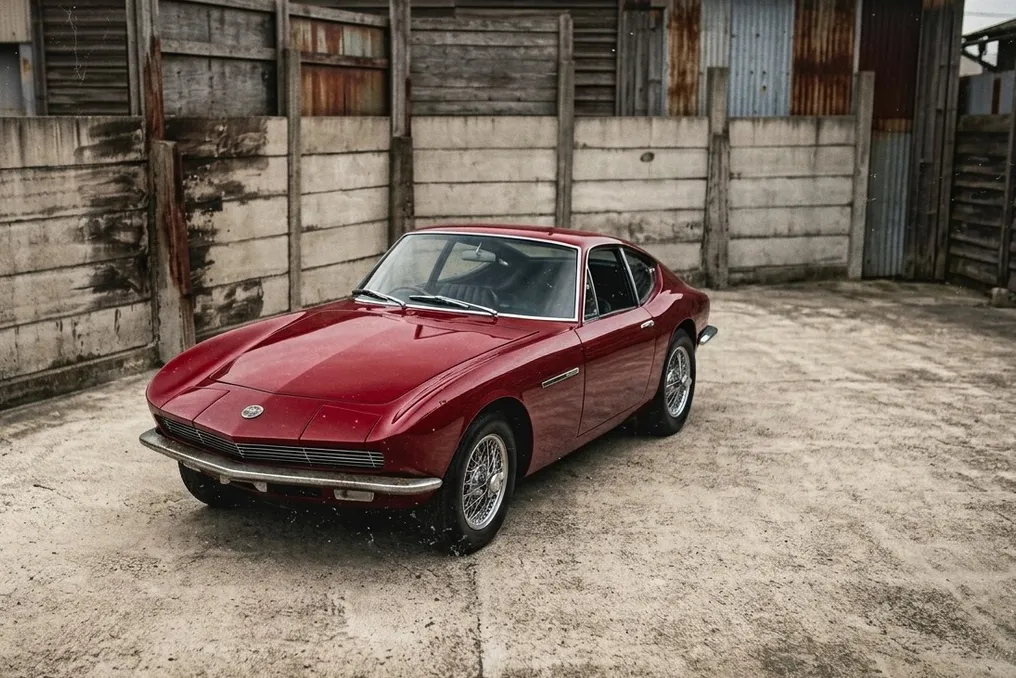
Despite the negative climate, Yamaha resumed the A550X in mid-1964. Development progressed, culminating in three distinct prototypes. The first had a metallic body with straighter and more angular lines; the second, also metallic, was more sophisticated and elegant, painted in a dark tone; and the third, made of fiberglass and painted red, was nicknamed the 'Red GT'. In September 1964, Yamaha delivered the second prototype (metallic) to Nissan, but the partnership was already politically over. After the delivery, the companies formalized the termination of the agreement. The 'Red GT' prototype remained in the Yamaha yard with an uncertain future.
The fate of the rejected A550X intersected with that of the legendary Toyota 2000GT. At the same time, Toyota was working on its exclusive sports car project, Project 280A, under the leadership of Jiro Kawano, but progress was slow. Yamaha executives took a strategic initiative: they invited the Toyota development team to visit their facilities at the end of December 1964 and presented the rejected A550X. Upon seeing the car, the Toyota team immediately understood its potential. It is important to note that the A550X was not simply reused and renamed as the Toyota 2000GT; it served as a powerful 'calling card,' demonstrating to Toyota Yamaha's technology, knowledge, and engineering capability to build a high-level sports car.
Driven by this demonstration, Toyota and Yamaha joined forces. Combining the resources of both companies and under the design of Satoru Nozaki (from Toyota), the lessons from the A550X helped realize the Toyota 2000GT, one of the most emblematic cars in history. Yamaha was responsible for a large part of the 2000GT's production, including the body and the two-liter, six-cylinder, dual overhead camshaft engine. The Toyota 2000GT, with its harmonious design and advanced solutions for the time, such as the engine and four-wheel disc brakes, led the companies to continue collaborating on the Toyota 7, Toyota's first official racing car, launched in 1968.
The narrative moves to the 1990s, when Yamaha was involved with Formula 1 as an engine supplier for teams such as Zakspeed and Brabham, seeking to capitalize on this involvement.