Brazilian couple transforms Ford Bronco Sport into home for crossing the Americas
Read more
AutoPapo
autopapo.com.br

Brazilian couple transforms Ford Bronco Sport into home for crossing the Americas

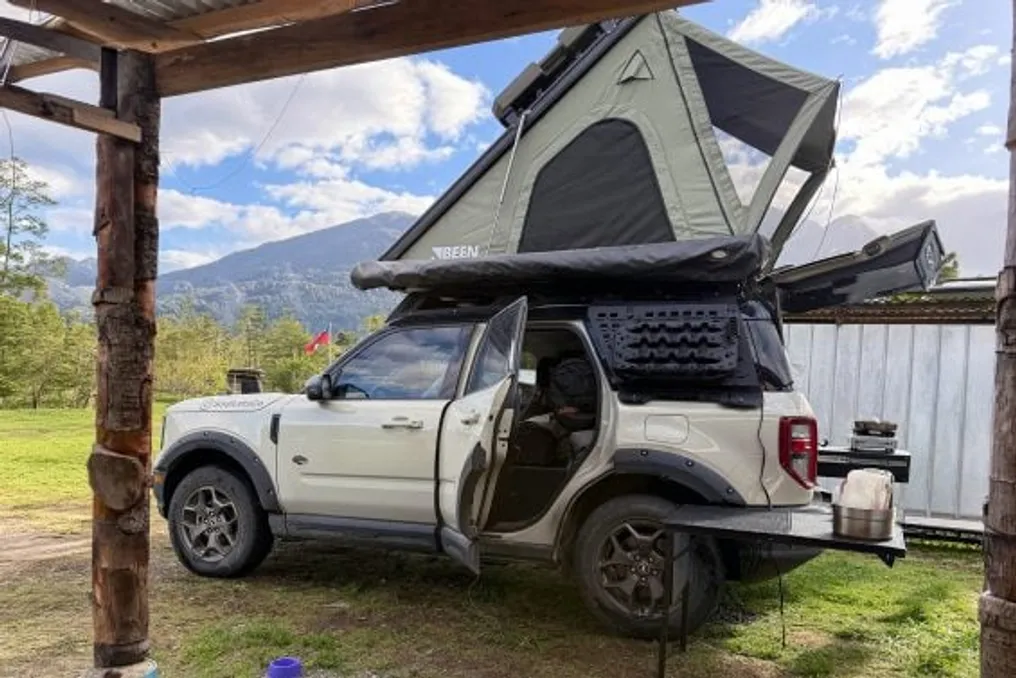
A Brazilian couple adapted a Ford Bronco Sport to function simultaneously as a vehicle, residence, kitchen, and office. The SUV, nicknamed "Broncasa," has traveled over 14,000 kilometers since leaving São Paulo, passing through Ushuaia in the far south of Argentina, and is currently heading towards Alaska.

The couple is currently in El Chaltén, in Argentine Patagonia, with Bariloche as the next destination. The name "Broncasa" originated after a follower commented on the car in one of the couple's early posts, and it eventually became the project's name.

The modifications made are more manual than industrial. The duo removed the rear seats and installed furniture that serves as a closet, safe, and storage space for audiovisual production equipment. The area accessible through the trunk was converted into a kitchen, equipped with a stove, refrigerator, and utensils.

On the roof of the vehicle, there are fixed a tent, solar panels, and a battery that provides power for lighting, the refrigerator, electronics, and the Starlink antenna. According to Marcelo Ordoñez, with the battery fully charged, this system guarantees five days of autonomy without depending on external outlets. The dog Canela accompanies the couple in the cabin and has taken on the role of camp alarm.

The Ford Bronco Sport has a 2.0L turbocharged gasoline engine with 253 hp and 38.7 kgfm, an eight-speed automatic transmission, 4x4 traction, a lockable rear differential, and seven driving modes. The choice of these modes was crucial, given that neither member of the couple had experience driving in snowy or icy conditions; the programs for mud, sand, and snow acted as a safeguard, all of which were used in real situations, according to Ordoñez.

A secondary effect of the conversion was the limitation of accelerations in sport mode due to the additional weight of the installed structure. The initial plan was to reach Ushuaia during the summer, but the postponement caused the phase to occur in winter, and the roof tent does not have a heating system. In an episode narrated by Thainá Tanizawa, the campsite was flooded, forcing her to work inside the car until the rain stopped.

In this scenario, the items that added the most value were not the off-road accessories listed in the catalog, but rather the heated seats and the rear window with independent opening, which eliminates the need to lift the entire trunk lid at each stop.

After facing snow, ice, gravel, rocks, sand, mud, and low temperatures, the only mechanical problem recorded was a flat tire, which occurred near a city. This account was shared by the couple on the From the Road channel, belonging to Ford itself.

The journey supports Soul Let's Go, a touring producer focused on documenting peoples and territories, not just tourist routes. In the city of Salta, Argentina, the couple visited bowling alleys to record the region's musical folklore. After completing the stretch to Alaska, future plans include Canada, the United States, and eventually transporting the Bronco Sport to Europe.
Similar stories

Startup develops foldable solar panel for EV roofs to increase range
Read more
autopapo.com.br

Startup develops foldable solar panel for EV roofs to increase range

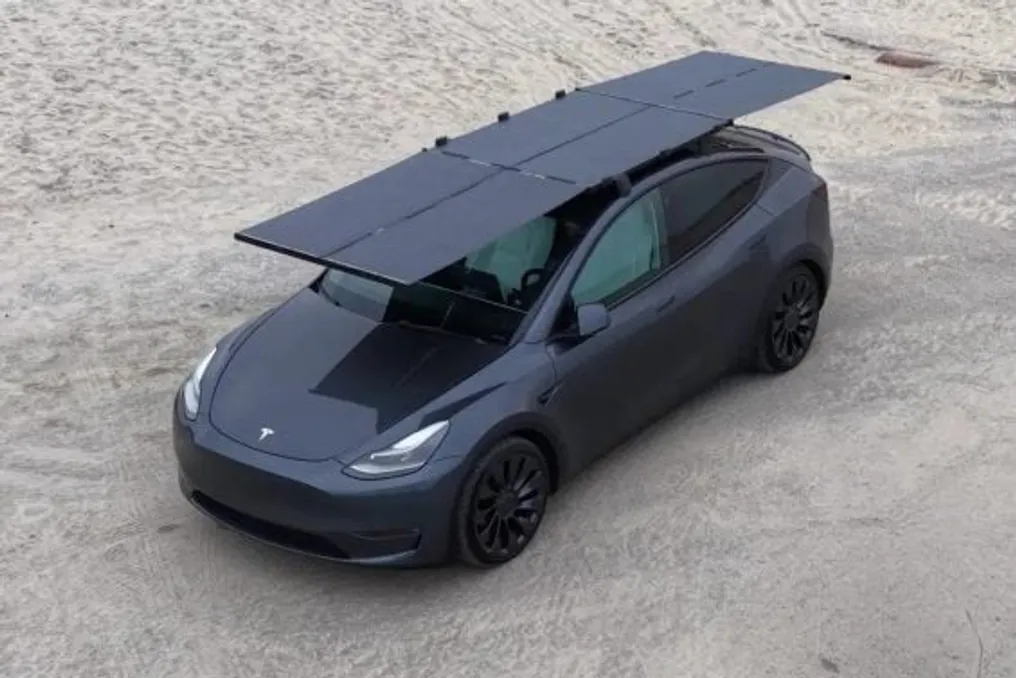
A Californian startup aims to transform an electric vehicle's roof rack into a portable power station. The company Dart Solar has introduced a modular system of foldable solar panels that, according to the company, can be installed on almost any electric vehicle. Under favorable sunny conditions, the system is capable of restoring a range of 24 to 34 kilometers per day.

Each module generates 500 W and triples in size when unfolded: it measures 1.47 m when folded and reaches about 4.3 m when deployed. This process takes approximately ten seconds, according to the manufacturer's information. Two such modules fit on a standard roof, forming a 1000 W kit, which is used in the company's calculations. For vans, RVs, and pickups, there is an option to install modules next to each other, which can also function as awnings, reaching configurations of 1500 W, 2000 W, or 2500 W. For example, Dart Solar reports that a 1500 W system can be installed on the flat roof of a Tesla Cybertruck.

The company was founded in 2024 by inventor Omid Sadeghipour, a Tesla owner. Many prototypes preceded the current product, with each one becoming more compact and less bulky.

The system generates energy both while moving and when the vehicle is stationary; however, during movement, the panels must remain folded, which significantly reduces the surface area exposed to the sun. Furthermore, an aerodynamic effect occurs, which is critical for a vehicle whose efficiency is measured in kilometers per kilowatt-hour. Dart Solar claims that the design intrudes only 3.8 cm into the airflow, which was tested at 160 km/h, and that measurements on the Tesla Model Y showed a resistance increase of between 1% and 2%. This data has not been independently verified.

In previous versions, the 960 W kit sold for $2,950 USD, equivalent to approximately 15.1 thousand Brazilian reais at the current exchange rate, and the unit itself that converts solar energy to alternating current cost from $1,950 USD, or about 10 thousand reais for those who already owned the equipment. The system weighs about 41 kg and can support up to 23 kg of additional load on the roof using an adapter. The projected lifespan is ten years. The product is not sold in Brazil.

Estimates of restored range are based on favorable insolation conditions, and Brazil has an advantage in this area. According to the Atlas of Brazilian Solar Energy from Inpe, the average global horizontal solar radiation in Brazil is about 5.15 kWh/m² per day nationwide, with the Northeast region reaching 5.5 kWh/m², which is higher than the figures recorded in European countries that are leaders in photovoltaic energy generation.

The proposed solution does not eliminate the need for grid connection but serves as a way to reduce dependence on fast charging stations during regular trips and in regions with insufficient charging infrastructure.

Popular