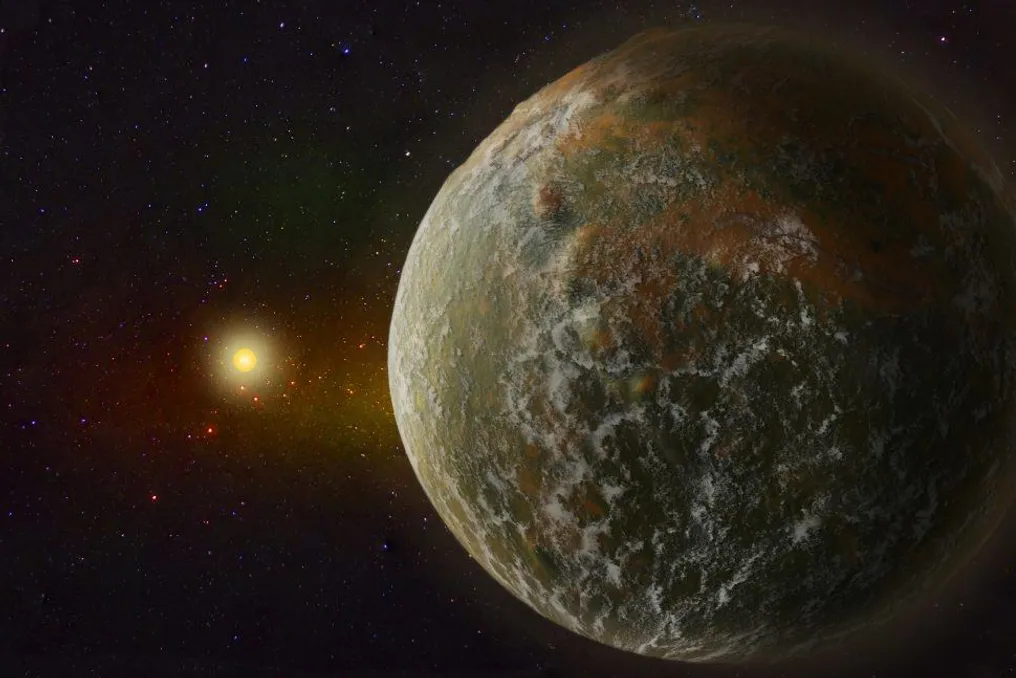
Researchers propose that the young Sun might have swallowed a super-Earth during the early stages of the Solar System. An investigation indicates that a rocky planet with a mass equivalent to five to ten times that of Earth could have left chemical signatures that help explain unresolved characteristics of the star.
To support this hypothesis, scientists compared models of solar evolution with data obtained from both the interior and the surface of the Sun. This possibility also aligns with the theory that the primitive Solar System had more celestial bodies than are currently recognized.
The formation of our system may have involved more worlds beyond the eight known planets. The case of Theia, a Mars-sized planet that collided with Earth, contributing to the formation of the Moon, is mentioned, as are other theories suggesting that Jupiter might have ejected a large planet from the system.
Super-Earths, generally composed of rock and much more massive than Earth, are considered common in the Universe, although none are currently known near the Sun. However, this does not exclude the existence of such a planet in the past.
The new study suggests that a planet significantly more massive than Earth may have been incorporated into the young Sun, leaving a persistent chemical mark in its core. Mutlu Yildiz, a professor at Ege University and a member of the team, commented on the finding.
The team began its analysis based on inconsistencies found between the internal models of the Sun and real observations. Helioseismology, a technique that studies the movement of sound waves inside the Sun, allows examination of the star's deepest layers. Current models show discrepancies in the speed of sound structure just below the convection zone and in the depth of this area. Furthermore, they fail to fully explain the low amount of lithium found on the solar surface.
Yildiz clarified the team's interest: 'We were interested in knowing if these problems could have a common origin in the Sun's initial chemical history.' The premise is that a planet assimilated by the star would have introduced distinct chemical elements into its interior, whose effects could be detected even today.
To validate this scenario, researchers used the stellar evolution software MESA, creating simulations with various material addition histories. The results of these simulations were then compared with the observed properties of the Sun's surface and interior.
Model that best fits the current star
The model that shows the greatest correspondence with the present star predicts the absorption of a super-Earth with a mass ranging between five and ten times that of Earth. Yildiz observed: 'We thought that the ingestion of a planet could affect the solar structure, but we did not expect the calculations to converge on such a specific mass range.'
This idea is considered plausible, given that work conducted about a decade ago had already indicated the possibility of super-Earth formation within Mercury's orbit, although that previous research did not speculate about the fate of these worlds.
The current study aims to determine whether the disappearance of one of these super-Earths may be linked to the peculiarities observed in the Sun. Independent confirmation is still needed. The next step involves searching for the possible 'fingerprints' left by the planet to verify if they can be identified individually. If this occurs, the discovery could offer additional proof for the scenario that the young Sun incorporated a super-Earth.