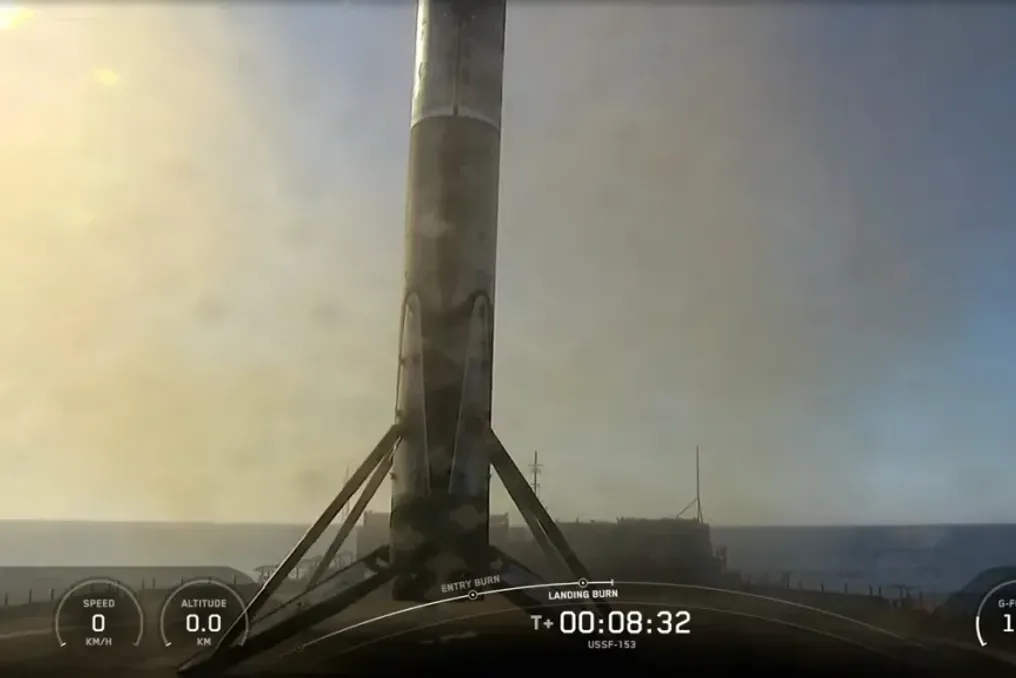
SpaceX conducted the classified USSF-153 mission for the United States Space Force on Thursday (10). The Falcon 9 vehicle departed from the Vandenberg Space Force Base in California, carrying a payload whose exact contents and destination were not made public.
However, the trajectory of the rocket provided important clues. According to NextSpaceflight, there is a possibility that this mission is carrying low-orbit classified satellites that utilize the Starshield platform, developed by SpaceX for national security operations.
The Falcon 9 began its flight at 8:42 local time (equivalent to 9:42 in Brasília time). Approximately eight and a half minutes after takeoff, the first stage returned to Earth and landed on the drone named “Of Course I Still Love You” in the Pacific Ocean.
This booster, identified as B1801, completed its twenty-seventh flight. It is relevant to note that SpaceX's record for this stage is 37 launches, a milestone reached last month during a mission dedicated to Starlink satellites.
Mission USSF-153 represents the one hundred and fourth operation of the Falcon 9 in 2026. Due to its classification, little information is known about the onboard satellites, and the event transmission did not offer additional data, ending shortly after the first stage landing.
Trajectory Analysis and Payload Hypothesis
It was specifically the rocket's return point that attracted the attention of NextSpaceflight. The website compared the disposal areas of this mission with previous SpaceX launch routes. This analysis indicated an exact coincidence with the zones used in previous launches of Group 15 Starlink satellites.
Based on this comparison, NextSpaceflight assesses that USSF-153 may be transporting a set of low-Earth orbit classified satellites to some US government agency, utilizing the Starshield satellite bus. The company itself explains that Starshield integrates Starlink technology and SpaceX's launch capability to support national security efforts.
NextSpaceflight's summary of the probable payload is clear: “The mission may be carrying a batch of low-Earth orbit classified satellites to a US government entity, based on the SpaceX Starshield satellite bus.”
It is important to emphasize that USSF-153 is a classified mission, which prevents public disclosure regarding the satellites' function or specific delivery orbit. Although the possible use of Starshield was suggested through trajectory analysis, this hypothesis has not yet received official confirmation.
The launch occurs during a period of high operational intensity for the Falcon 9. Of the 104 launches conducted in 2026, 80 were dedicated to expanding the Starlink constellation, which currently has over 11 thousand active satellites.