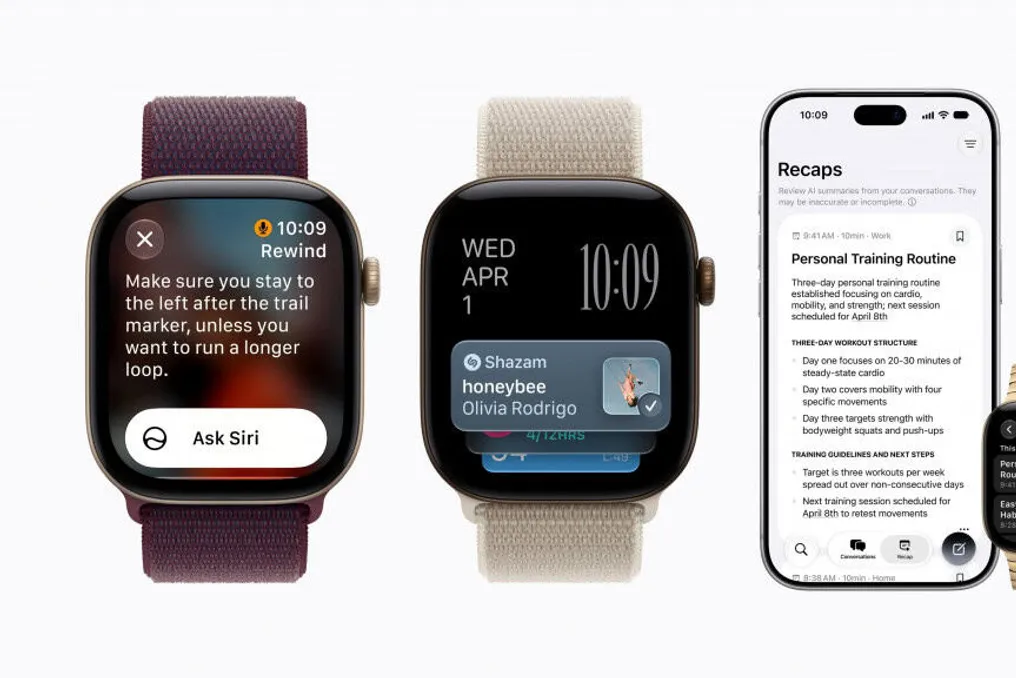
Apple has introduced a new set of features called 'Audio Intelligence' as part of its artificial intelligence package (Apple Intelligence). This feature was demonstrated on two new models of Apple Watch: the Apple Watch Series 12 and the Apple Watch Ultra 4.
'Audio Intelligence' allows artificial intelligence to 'listen' to the surrounding environment. Among the stated capabilities are Live Rewind and Siri Recap. These functions utilize the watch's microphones, device processor, and AI models to recognize sounds, identify music, and also to record or create summaries of conversations.
The four main tools of 'Audio Intelligence' include sound recognition, music identification, Live Rewind, and Siri Recap. According to Apple's description, the captured audio signal passes through an isolated memory storage within the watch's S11 chip, known as the Secure Enclave. This segment analyzes the sound separately from the rest of the system, and the raw audio signal is immediately deleted after processing.
Features such as sound recognition and Live Rewind operate locally on the device itself. Meanwhile, Siri Recap sends compressed text content of the conversation (without the actual audio) to Apple's Private Cloud Compute for summary generation.
Arthur Igreia, a technology and innovation specialist, described this new conversation monitoring capability as 'quite strange.' He compared it to the emergence of the Plaud device, which records and transcribes the surroundings. In Igreia's opinion, Apple is entering this arena by offering a meeting and conversation summarization function.
He also noted that Live Rewind is an 'almost whimsical' tool, citing an example where a person in a restaurant who didn't understand the menu uses the watch to rewind 15 seconds.
Apple emphasized that audio is not recorded or stored, and statements are not linked to specific speakers, urging users to consider those around them if conversations are private or concern sensitive topics. However, Marcelo Cargano, a lawyer, believes this is merely an attempt by the company to disclaim responsibility for data processing, shifting legal and ethical responsibility onto the end-user.
Paulo Enrique Fernandes, a lawyer, assesses the architecture of the new Apple Watch models and 'Audio Intelligence' as good because the processing occurs on the device, audio is not saved, encryption is used, and the Live Rewind function warns bystanders. Nevertheless, he argues that good architecture does not remove the discussion.
Fernandes explains that data protection focuses not on the audio file but on the information about the person. As soon as the watch converts what is said into text or a summary, the processing of identifiable information occurs, regardless of the presence of audio. He notes that Siri Recap is more invasive as it can capture the environment throughout the day, whereas Live Rewind is a point-in-time action.
The lawyer warns that recording others' conversations, especially in private settings or without user participation, can lead to moral damage for violating privacy. He concludes that legal protection pertains to the person and their information, not the file format, as a text summary can be as sensitive as the audio file itself.
Cargano points to an internal conflict between user convenience and general expectations of privacy for both the user and third parties. He also emphasizes that the core of the debate is not only legal but also social: what level of privacy society wishes to maintain in private spaces. These tools shift the decision about privacy to the user who activates the function, while people nearby have no say in that decision.