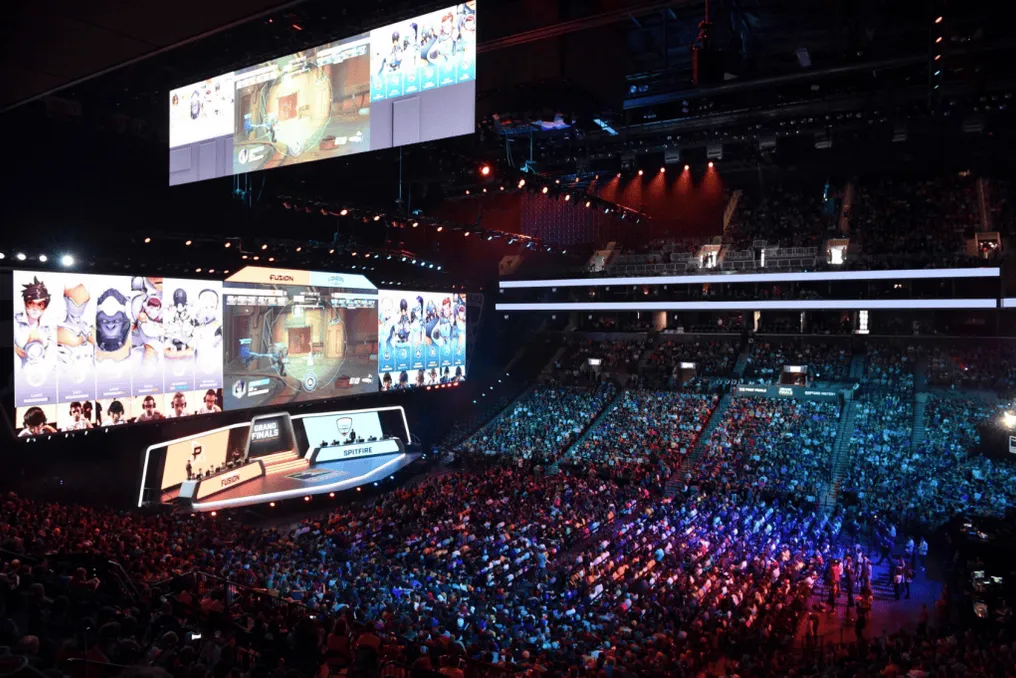
There was a period between 2017 and 2019 when the video game competitive scene sought to fully replicate the closed franchise system adopted by major American sports leagues, such as the NBA and the NFL. The expectation was to achieve total financial stability, generate substantial revenue from broadcasting rights, and foster local dynasties with strong fan support.
However, less than ten years later, this vision dissolved. The franchise model not only failed to achieve the promised profitability but also threatened the financial health of the largest entities in the global sector.
The Overwatch League (OWL), launched in 2017 by Activision Blizzard, is cited as the prime example of this extravagance and subsequent collapse. Participation in the league required an initial investment estimated at US$ 20 million per slot, a value that rose to up to US$ 60 million during expansion phases. Renowned NBA investors, such as Kraft Group and Kroenke Sports & Entertainment, supported the premise that Overwatch would be the 'Sport of Generation Z.'
This model depended on the home-and-away structure, which implied the creation of physical headquarters for each team (examples include London Spitfire and Dallas Fuel) and forced teams to undertake worldwide travel in local arenas. With the arrival of the COVID-19 pandemic, viewership stagnated, and maintenance costs became unsustainable. In 2023, due to accumulated debts, the organizations decided to permanently shut down the OWL. Activision Blizzard made a payment of US$ 6 million per franchise as a termination fee to conclude the project and reallocate the format to third-party managed circuits, such as the ESL FACEIT Group.
In the League of Legends ecosystem, the implementation of the franchise system in the LCS (North American League of Legends Championship Series) in 2018 initially seemed like an institutional advancement. However, the elimination of the possibility of relegation created an environment conducive to competitive apathy.
Without the risk of falling, several organizations at the bottom of the table strategically reduced their investments. Overstaffed rosters, formed by expensive signings of Asian players, failed to establish a connection with the local audience or achieve success at the World Championship (Worlds). Between 2021 and 2024, LCS peak viewership showed an annual decline, forcing Riot Games to act drastically.
In June 2024, Riot Games announced the merger of the LCS with the CBLOL (Brazil) and the LLA (Latin America) to form the LTA (League of the Americas) starting in 2025. The goal was to reduce operational expenses, optimize regional broadcasting, and promote cultural exchange between continents. However, this proposal was widely rejected. The merger resulted in the dilution of regional sentiment, generated excessively complex tournament formats, and erased the identity that gave the CBLOL the status of an extremely passionate league. Discontent from fans and sponsors led Riot to historically reverse its decision: in September 2025, the developer announced the cancellation of the process.
In 2026, the LCS and CBLOL resumed operating as autonomous leagues, recovering their historical identities, international slots, and local finals. The LLA did not return as an independent entity, but its main teams and talents were maintained as partners within the LCS (such as LYON) and CBLOL (such as Leviatán).
Analyzing the global landscape, it is evident how different modalities handled the exhaustion of this format. The Overwatch League illustrates the most extreme case: with extremely high entry costs and an impractical geographical infrastructure, the ecosystem was completely extinguished to give way to an open circuit managed by third parties.
In League of Legends, the journey of the LCS and CBLOL highlighted the instability of corporate solutions. After being adopted in North America in 2018 and Brazil in 2021, the franchise caused a sharp drop in viewership and engagement in North America. The attempt to unify the Americas in the LTA in 2025 quickly failed, culminating in the restoration of the LCS and CBLOL as separate leagues in 2026, aiming to preserve regional viewership.
Meanwhile, the Call of Duty League (CDL) still faces difficulties related to regionalization, dealing with legal disputes, renegotiations of franchise debts, and deep changes in its fees. In contrast, the Counter-Strike ecosystem strengthened precisely by rejecting the confinement of franchises. Directly regulated by Valve to prioritize qualifying tournaments and sporting merit through rankings, the CS model established itself as the standard for industry sustainability.
The decline of franchises in esports can be attributed to four structural obstacles. The recent trajectory of the LCS, CBLOL, and Overwatch League demonstrates that the end of the franchise era does not mean the end of esports, but rather the end of a phase of financial naivety. The setback in unifying the Americas proved that developers must listen to their communities instead of imposing rigid corporate structures.
The sector is moving towards healthier models: leagues that maintain collaborations with large organizations but allow access via Tier 2, enable direct monetization within games (selling digital items with returns to teams), and strengthen regional circuits. Esports has finally understood that they do not need to imitate football or the NBA to thrive; the strength of the sector has always resided in its digital, organic, and merit-based nature.