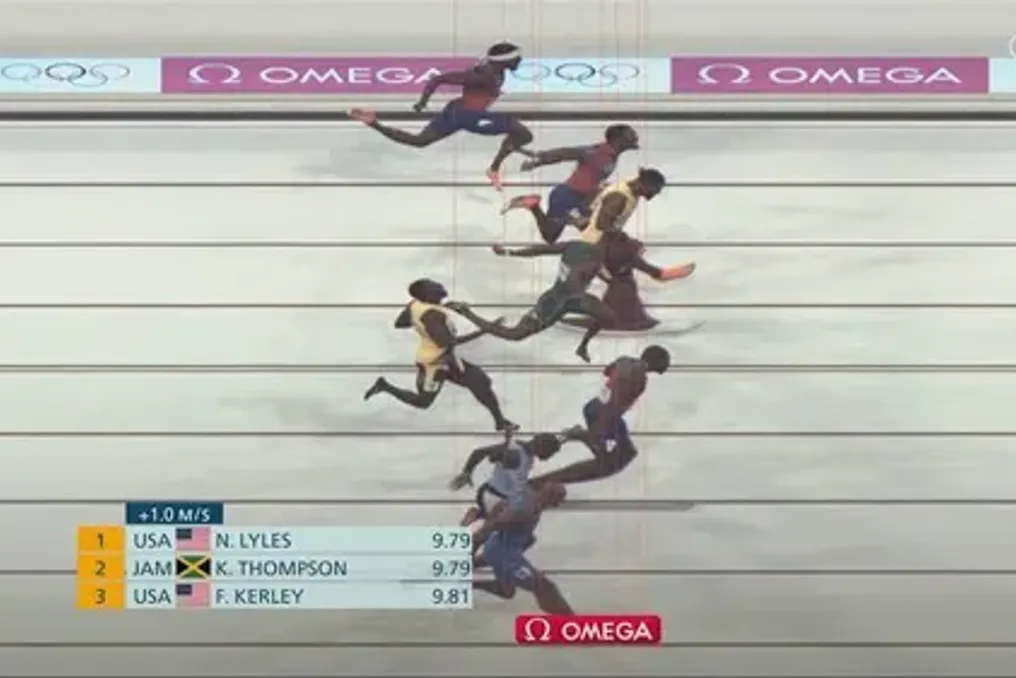
The traditional method of recording finishes in athletics, based on images captured by slit scanners, may soon become obsolete due to the introduction of VAR-like technologies being tested at the Ultimate World Athletics Championships.
For football fans, the VAR system, including semi-automatic offside graphics, is a hallmark of modern broadcasts, representing a complex three-dimensional computer model that highlights the knee or toe of an attacker who is millimeters ahead of a defender.
Now, running disciplines are beginning to use a similar visual language to transform how a global audience perceives finish moments. Before the first Ultimate World Athletics Championships in Budapest, Sony and World Athletics presented a broadcasting concept designed to turn decisions made in fractions of a second into exciting television content.
Instead of relying solely on traditional side photographs taken by a slit scanner, Sony uses optical tracking technology developed in collaboration with the Hawk-Eye division. This technology allows for the collection of real-time athlete movement data.
Sony serves as the official global partner of the Ultimate World Athletics Championships, providing its patented optical tracking technology to create new content. This data is instantly converted into 3D computer graphics (3DCG) for the international broadcast channel, giving rights holders access to virtual replays from multiple angles, mimicking the visualization accuracy seen in elite European football.
The visual similarity between the systems is striking. Just as VAR lines help clarify crowded penalty areas, these three-dimensional renders eliminate ambiguity in tense moments at the finish line. Instead of viewers having to decipher a static two-dimensional photograph to determine whose torso crossed the plane first, the broadcast can smoothly move around the virtual runners to emphasize the exact point of contact with the finish line.
Although results in running events are often determined by thousandths of a second, traditional finish visualization often seems too dry and detached for a home audience. By capturing the spatial mechanics of the entire body and displaying it in real time, World Athletics not only helps judges make fairer decisions but also transforms minimal advantages in world sprinting into spectacular prime-time content.