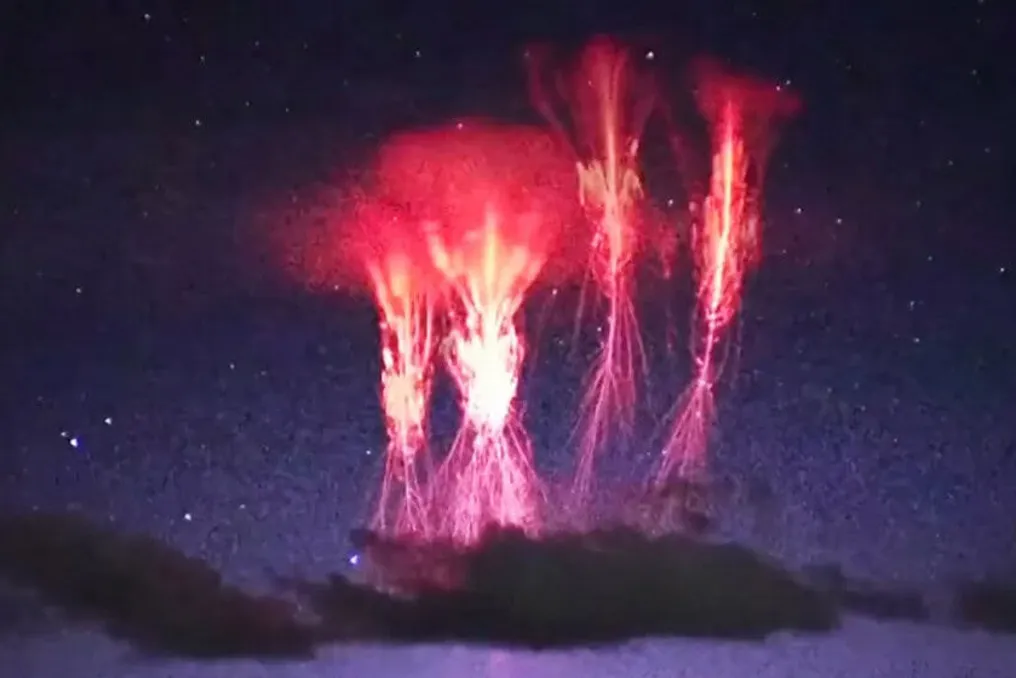
Early on Thursday morning (the 10th), the Bate-Papo Astronômico Astronomical Communication Observatory, located in Santa Maria (RS), managed to capture an extremely rare phenomenon while monitoring the sky.
The recordings obtained demonstrate a sequence of so-called red sprites, which literally translates to 'red dwarfs.' This is an unusual type of electrical discharge rarely observed on Earth, although it has previously been recorded from the International Space Station (ISS).
These phenomena were registered on the horizon, in the northeastern direction from the city. According to amateur astronomer and science popularizer Fabrício Colvero, who is responsible for the observatory, they 'were linked to intense electrical activity from a distant thunderstorm.'
Sprites are short-duration light phenomena occurring in the upper layers of the atmosphere, tens of kilometers above large thunderstorms. They often have a reddish hue, although the images taken that night were made with a monochrome camera to increase sensitivity, explained Colvero, commenting on the difficulty of capturing sprites.
He specified that successful shooting requires the sky above the observatory to be clear, and the thunderstorm to be far away and below the horizon so that its lightning does not enter the frame, allowing only the glow above the clouds to be captured. Furthermore, since sprites last only a few milliseconds, cameras with very high recording speeds are required.
Colvero summarized that each successful capture depends on a specific combination of atmospheric conditions, distance to the storm, and suitable equipment. He emphasized that registering these phenomena is important for studying electrical interactions between storms and the upper atmosphere, helping to better understand Transient Luminous Events (TLEs)—the official name for sprites.
However, the events were not limited to this. Early in the morning, around 1 AM Brazilian time, the observatory's cameras recorded a meteor north of Santa Maria. Colvero informed the publication Olhar Digital that because the sky remained clear, shortly after this, a beautiful meteor flash was captured in the same area of the sky, allowing the same camera to be used to create an interesting composition showing the sequence of sprites and the meteor.
Similar cases have been reported by pilots over decades, but the phenomenon was officially registered for the first time only in July 1989. These events are usually not visible from the surface.
Like traditional lightning, 'red dwarfs' occur after an accumulation of electrical charge within clouds. However, in the case of sprites, the discharge occurs in the Earth's mesosphere, at an altitude of up to 80 km above the surface. The bright red color is formed when the charge interacts with nitrogen in the planet's atmosphere.
In recent years, NASA has participated in the citizen science project 'Spritacular,' which calls on the public to share images of TLE observations to provide scientific data for the study of this phenomenon. The project also includes orbital images of the events taken by astronauts aboard the ISS, who use photography as a creative activity during their stay on the station.
Matthew Dominic from NASA photographed a 'red sprite' in June 2024, six months after a similar capture by Andreas Mogensen from the European Space Agency (ESA). Recently, Nicole Ayers, also from NASA, captured a red sprite while the orbital laboratory flew over Mexico and the USA. Don Pettit, known for his space photos and the oldest active NASA astronaut at 70 years old, has also received TLE images. A short video he published on social media in April 2025 demonstrates blue sprites over the Amazon basin.