Brazilian automotive journalism mourned the loss of one of its great figures with the passing of Claudio Carsughi this Thursday, the 10th. He died at the age of 93 in São Paulo, concluding a career spanning over seven decades dedicated to narrating stories about cars, motorsport, and sports.
For those who came after him, Carsughi represented a fundamental reference point, teaching how to approach vehicles with depth, combining curiosity, technical knowledge, history, personal opinion, and respect for the reader. His work went beyond simply judging whether a car was good or bad; it required understanding its operation, conducting measurements, comparisons, assimilating the engineering, industry, and historical context behind the machine, and, crucially, being able to convey all of this to the public.
Carsughi possessed a unique background to perform this function. Born in Arezzo, Italy, in 1932, he arrived in Brazil when young and studied Civil Engineering at the Polytechnic School of USP. However, journalism ended up being his main vocation. His journey began as a correspondent for the Italian newspaper Corriere dello Sport, and in Brazil, he built a diverse trajectory covering radio, newspapers, magazines, television, and later, the internet.
In the world of motorsport, he was one of the absolute pioneers in covering Formula 1 in the country. In an era marked by unstable broadcasts, little imagery, and slow information crossing the Atlantic, Carsughi established himself as one of the leading Brazilian authorities on the category.
However, his contribution to automotive journalism may be even broader. In 1956, he was among the first journalists to test the Romi-Isetta, a milestone in the emergence of the Brazilian automotive industry. Years later, in the magazine Quatro Rodas, he was responsible for the technical section and vehicle evaluation, testing hundreds of vehicles and achieving the feat of being the first Brazilian journalist to drive the Volkswagen Gol in 1980.
Furthermore, Carsughi did not restrict himself to the role of a mere 'car journalist.' He covered five World Cups, followed several decades of Formula 1, and worked for notable publications such as Jovem Pan, Bandeirantes, Record, Gazeta Esportiva, Jornal da Tarde, Placar, Quatro Rodas, ESPN, and SporTV. Recently, he has maintained his activity by writing and commenting online, managing his own website with his daughter, Claudia.
He belonged to a generation that built much of the collection of Brazilian automotive journalism when available material was scarce. He had access to cars, engineers, drivers, directors, and factories during a period where physical presence was decisive, and he channeled this knowledge to readers of print or radio.
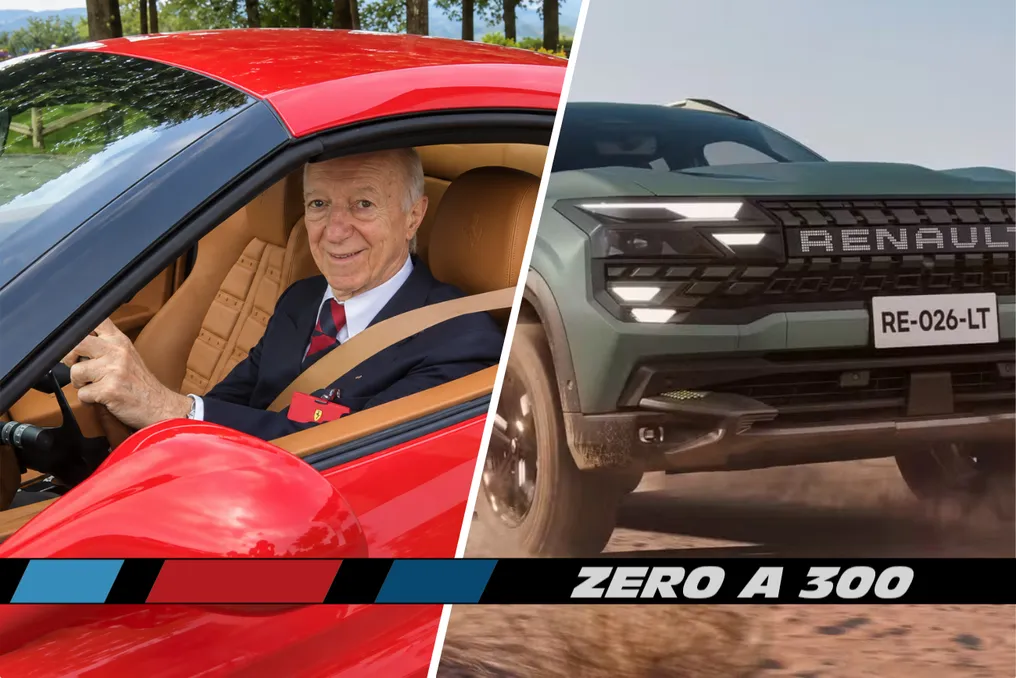
In parallel, Renault has just presented the Niagara pickup truck. Its objective is clear: to succeed the Oroch as the French brand's monocoque pickup, using a modern platform and a more contemporary design to compete against the Fiat Toro and other segment competitors, such as the BYD Mako, Ford Maverick, RAM Rampage, Chevrolet Montana, and the future Volkswagen Tukan.
The Niagara uses the RGMP platform, shared with the Boreal and Kardian SUVs, which is noticeable in the front optical set identical to that of the Boreal. However, the bumper and grille, along with the inscription 'RENAULT' instead of the diamond emblem, give the pickup a distinct visual identity. It is also observed that the windshield and the front and rear doors are practically the same as those of the SUV, which is expected.
The interior follows a similar line to the Boreal, featuring almost identical dashboard and center console, as well as the instrument panel, which integrates the digital cluster and multimedia screen as a cohesive unit. Features include wireless connectivity with Android Auto and Apple CarPlay, a joystick gear shift system, and driving mode selectors (Eco, Comfort, Sport, Intelligent, Mud-Sand, and Off-Road) controlled by a rotary button. A relevant point is that the operating system is native to Google, allowing the use of Maps and Gemini without needing to pair with a cell phone.
The dimensions of the Niagara are comparable to its rivals: it measures 4.94 meters long (1 cm shorter than the Fiat Toro and 9 cm shorter than the RAM Rampage), 1.83 m wide, 1.71 m high, and has a wheelbase of 2.96 m (22 cm longer than the Chevrolet Montana). The bed holds 938 liters and offers a load capacity of 654 kg, while its towing capacity of 710 kg is the highest in the category. Being technically a vehicle with off-road capability, Renault also specified the ground clearance (23.3 cm) and the approach and departure angles (both 22.3°). The wheels can be 17 or 18 inches, depending on the version, always equipped with all-terrain tires. Safety is ensured by disc brakes on all four wheels and independent suspension both in the front (MacPherson) and rear (multi-link).
Initially, the Renault Niagara will have four configurations: 4x2 manual, 4x2 automatic, 4x4, and the top-tier 4x4 Outsider version, although the exact names and equipment levels have not yet been disclosed. The Outsider version will include synthetic leather seats, wireless phone charging, electric driver seat adjustment, and ambient LED lighting with up to 48 colors. The driver assistance package (ADAS) is robust, encompassing adaptive cruise control, speed limiter, lane keep assist and warning, speed sign recognition, fatigue sensor, automatic emergency braking, front and rear parking sensors, and a 360° external camera.
Regarding mechanics, Renault confirmed the use of the 1.3 turbo TCe engine, a four-cylinder flex engine with a 16-valve head and direct injection. The Niagara's calibration delivers 160 hp and 27.5 kgfm of torque, representing a reduction of 3 hp compared to the Boreal, aiming to adapt the pickup to Proconve L8 regulations, which will be applied to the SUV in the future. The entry-level 4x2 version will have a six-speed manual transmission, while the others (4x2 and 4x4) will use the six-speed EDC dual-clutch automatic gearbox. Mild hybrid (MHEV) versions are planned for the second half of 2027. Manufactured in Córdoba, Argentina, the Niagara is expected to arrive at Brazilian dealerships in November 2026, pending disclosure of price and version details.
In another piece of news, Porsche announced the sale of its stake in Bugatti, transforming the hypercar manufacturer into a fully autonomous entity, leaving the Volkswagen Group. This event is considered symbolic, given that it was Volkswagen that, in the early 2000s, acquired Bugatti and globally revitalized it with the Veyron—the first mass-produced car to exceed 400 km/h and the first with a sixteen-cylinder engine and four turbos exceeding 1,000 hp.
More than two decades later, in a distinct industrial landscape, Bugatti's pursuit of independence makes sense. Porsche's exit concludes a process started in 2021, when Mate Rimac, a Croatian entrepreneur and engineer, took control of the brand. Initially, his company formed a partnership with Porsche, obtaining the largest share (55%) and the CEO position, while the Germans retained the remaining 45%.
Full autonomy was achieved now, with Porsche selling its remaining stake to an investor consortium led by the funds HOF Capital and BlueFive Capital. For Porsche, which feels the impacts of the Volkswagen crisis, the €1 billion deal (approximately R$ 6.2 billion at the current exchange rate) represents a significant financial injection. For Mate Rimac, it is the desired freedom, allowing him to define Bugatti's future without the bureaucracy and slowness of traditional automakers, distancing itself from the Volkswagen crisis.
Finally, McLaren, which has historically resisted having SUVs or sedans, appears to be changing direction after acquiring its automotive division. The company recently presented future models to its dealers, including a four-door SUV, a GT 2+2, and a new generation of supercars. Since these details were not disclosed to the public, the information came from the dealers themselves, warning that plans may change until the launches, scheduled annually starting in 2027.
The first model of this new phase, codenamed P34, will be a mid-engine supercar, positioned between the Artura and the successor to the 750S. It will feature a biturbo V6 linked to a hybrid system, generating around 820 combined hp and approximately 110 kgfm of torque. According to dealer reports, the engine and gearbox were developed internally by McLaren. The car will be longer than the Artura and will incorporate visual elements inspired by the McLaren F1, such as the wedge nose. An additional feature shown was a tempered glass cover over the V6 engine. The cabin will also undergo a drastic redesign, shifting from a functional approach to a more luxurious finish, with Nappa and aniline leather, a larger multimedia center, and a new digital instrument panel. The initial price communicated to dealers was around US$ 310,000, with a production target of 1,000 units in the first year.
For 2028, the P47 is planned, McLaren's first SUV, displayed in clay model. According to meeting participants, it will be larger than a Porsche Cayenne Turbo GT, have four doors, five seats, and wheels up to 24 inches. The plans also include a front-engined GT with four seats, conceived as a sedan or 2+2 coupe, intended to replace a McLaren for daily use.