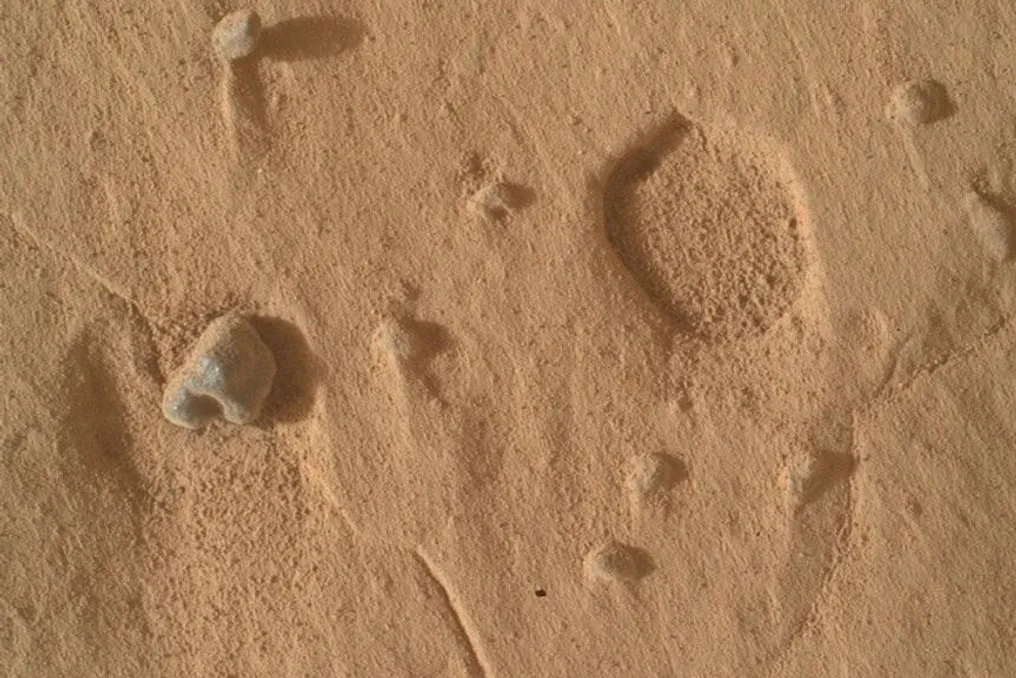
The NASA Curiosity rover has discovered small, unusual cavities in the Martian soil while traversing the Great Valley on Sharp Mountain. These depressions are wide and shallow and do not correspond to previously known formations on the planet, leaving scientists without a clear explanation for their origin.
The robot recorded these structures in detail for further study. Currently, the team is trying to determine whether they resulted from an unusual erosion process, if they are a feature of the rocks, or if they represent some other unidentified phenomenon.
Typically, small cavities in Martian soil have an explanation: stones or mineral nodules can get trapped in softer rock and resist erosion longer. When the surrounding material erodes, these elements leave small indentations. However, the holes observed by Curiosity do not follow this pattern; they are wide and shallow, and there are no stones or nodules nearby that could occupy these cavities.
Among the observed characteristics, it is noted that Curiosity used the Mars Hand Lens Imager (MAHLI) instrument for detailed imaging of these markings. The Mastcam cameras also took overlapping images of the terrain. The combination of these photographs allows for the creation of three-dimensional models of the surface, enabling scientists to measure the shape and depth of the cavities and attempt to understand the mechanism of their formation.
This discovery occurred in a relatively new area of the rover's route. Previously, Curiosity had spent months studying 'boxwork'—a formation of resistant mineralized ridges, which was presumably formed by underground water billions of years ago. Now, it is moving through sulfate-rich layers located above this zone.
The landscape changes as Curiosity gains altitude. The texture, chemical composition, and erosion resistance differ between rock layers, which may hold information about different stages of Mars' geological history.
More Details:
In late August 2026, the rover reached an altitude of 1000 meters during its ascent. Sharp Mountain reaches 5.5 kilometers above the floor of Gale Crater, and its sedimentary layers record various periods of deposition on the planet. The route also revealed rapid changes in the appearance of the rocks. Some layers are rougher and grayer and resist weathering differently than adjacent ones. To investigate the cause, the team directed Curiosity to analyze the chemical composition of this material.
Data on the rock changes still require further analysis, as does the information about the holes themselves. Scientists are currently considering several possibilities: an unrecognized erosion process, an unusual property of the rocks, or some other explanation. Future analyses should help clarify how these small cavities appeared along Curiosity's path.