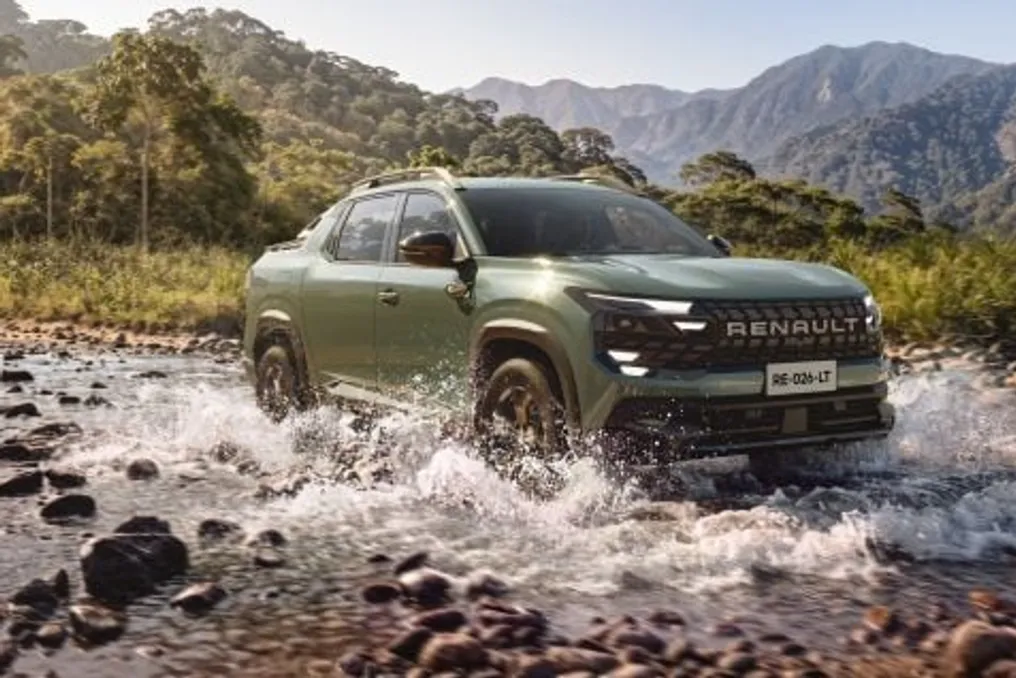
Renault is introducing the Niagara, a new vehicle designed to compete directly with the Fiat Toro. Although Renault established the niche of compact pickup trucks derived from SUVs with the Oroch in 2015, the Fiat Toro gained prominence due to its larger size and diesel engine. With the Niagara, the manufacturer seeks to respond to this competition, with the arrival scheduled for November.
The new Renault Niagara is based on the Boreal mid-size SUV and uses the RGMP platform. This will be the first vehicle of this new phase to be produced at the Santa Isabel factory, located in Argentina, which currently only manufactures the Kangoo van.
Market Focus and Design
The main target market for the Niagara is Latin America, specifically covering Brazil, Argentina, and Colombia, as Renault does not plan to launch the pickup in other continents, such as Europe.
In terms of design, the Niagara presents a bolder look than the Boreal, featuring the full name 'Renault' on the black-painted front grille. On the side, the bed integrates with the cabin through an inclined C-pillar, decorated with a robust functional sports bar.
Four configurations have been confirmed for the model: an entry-level version with a manual transmission and a top-of-the-line version called Outsider 4x4. Renault assures that while future versions may include hybrid options, they will not use a mild hybrid system, but rather a more substantial setup.
So far, Renault has only released the Niagara globally and confirmed the four available versions. Details such as price and equipment packages intended for the Brazilian market have not yet been revealed. However, it is estimated that its price positioning will be between R$ 150 thousand and R$ 200 thousand, aligning with the price range of the rival Fiat Toro's flex versions.
Technical Specifications and Dimensions
The Fiat Toro served as a reference for Renault in several aspects during the development of the Niagara. According to official information, the new pickup has a length of 4.94 m in 4x4 versions and 4.91 m in 4x2 models. Its wheelbase measures 2.96 m, the width reaches 1.83 m, and the height is 1.72 m.
The bed also shows similarities, with a capacity for 938 liters and supporting up to 654 kg. The interior compartment measures 1.03 m wide by 61 cm high, and features eight hooks for securing cargo and a 12-volt outlet.
The engine installed in the Renault Niagara is the 1.3 turbo TCe, already used in the Duster and Boreal. The transmission can be manual or automatic with a wet dual clutch, both with six gears, with electrified versions to be added later. The Niagara offers all-wheel drive with a terrain selector to aid in driving.
This engine has a different calibration than the one used in the Boreal, generating 160 hp and 27.5 kgfm. Despite its origin in the Boreal, the Niagara incorporates a multi-link rear suspension. Renault states that the tuning will provide the characteristic comfort of an SUV, an aspect that will be validated upon launch in Brazil. The braking systems consist of discs on all four wheels.
Regarding operational dimensions, the pickup has a ground clearance of 22.3 cm, with approach and departure angles of 22.3° in 4x2 versions. In 4x4 versions, the ground clearance is 23.3 cm, and the respective angles are 22.1°.
Interior Features and Technology
A strong point of the Renault Niagara compared to the Fiat Toro lies in the cabin. Its greater internal width and better space utilization allow it to accommodate five passengers more comfortably, in addition to offering a more practical center console. There is also a 36-liter compartment located behind the rear seat for storing belongings.
The dashboard follows the Boreal standard, featuring a 10.2-inch instrument cluster integrated with a 10.1-inch multimedia center. Versions equipped with the dual-clutch gearbox use a joystick-style selector, optimizing space.
The interior trim mirrors that of the Boreal, using soft materials on the front doors and dashboard. Overall, the trim standard is closer to that of the Ram Rampage, although the direct target of the Niagara is the Fiat Toro.
Among the technological features offered, stand out the wireless smartphone charger, full-LED headlights, ambient lighting with 48 colors, electric adjustment driver's seat, 360° camera, automatic parking system, connectivity, multimedia center with native Google, and the integration of Gemini artificial intelligence for voice commands.
The Renault Niagara's ADAS package is similar to that of the Boreal, including adaptive cruise control with stop and go function, lane keeping assist, autonomous emergency braking with pedestrian detection, blind spot monitoring, license plate reader, rear cross-traffic alert, and fatigue sensor. To enhance safety, the cabin is equipped with six airbags.
The Renault Niagara will be launched in Brazil in November. The initial contact with the pickup was very positive, suggesting that it meets the necessary specifications to compete with the flex versions of the Fiat Toro, pending confirmation of its price competitiveness.