AIFC and HYT-CAPITAL sign cooperation agreement in sustainable finance
Read more
UzDaily
uzdaily.uz

AIFC and HYT-CAPITAL sign cooperation agreement in sustainable finance

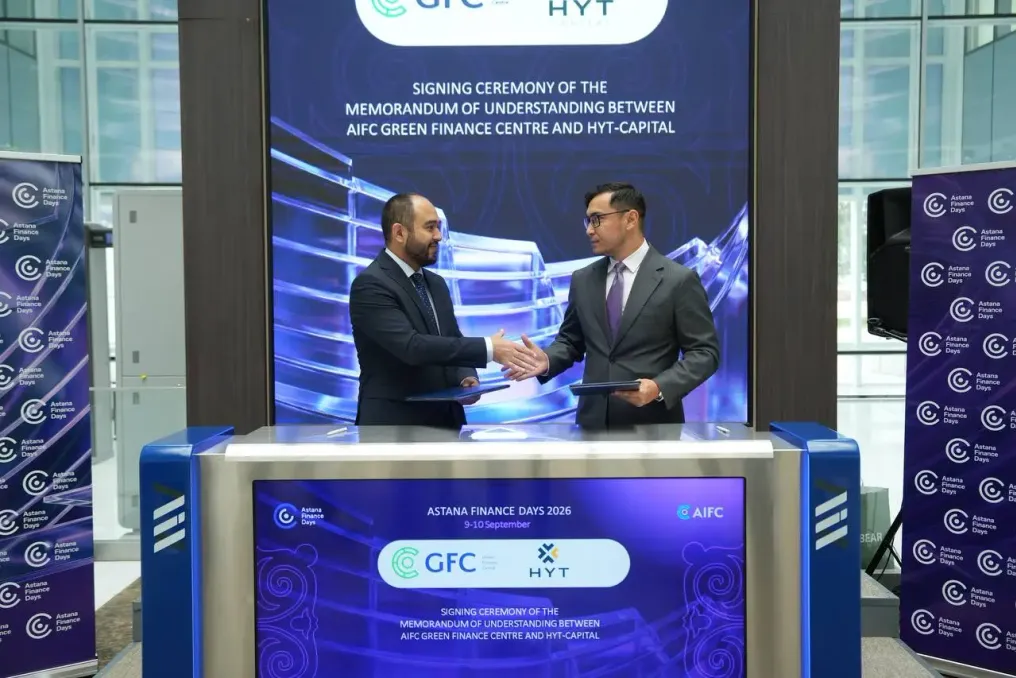
On September 10, AIFC Green Finance Centre Ltd. (GFC) and HYT-CAPITAL concluded a memorandum of understanding and cooperation as part of the Astana Finance Days 2026 event.

This document aims to develop partnerships in implementing projects that align with sustainable development principles, as well as to develop sustainable finance instruments. The memorandum establishes a foundation for joint preparation, structuring, and financing of such projects.

The parties also intend to work on creating and applying financial instruments that promote attracting investments into projects with environmental and social goals.

Details of the Cooperation

As part of this cooperation, GFC commits to providing expert and consulting support in the field of sustainable finance and the implementation of ESG approaches. Furthermore, GFC will participate in project evaluation and structuring, helping to find funding sources and partners for investment.

For its part, HYT-CAPITAL will support the implementation of promising projects that meet the requirements of sustainable and responsible investing. Both companies plan to focus on projects that possess investment attractiveness and potential for attracting private and institutional capital.

The memorandum also opens opportunities for creating cross-border mechanisms for preparing and financing projects between the Uzbekistan capital market and the Astana International Financial Centre's sustainable finance platform. This includes deal structuring, attracting international investors, and utilizing modern green and sustainable financial instruments.

Management Comments

Manas Gizhduaniev, CEO of AIFC Green Finance Centre, noted the growing interest of participants from the Uzbekistan market in sustainable finance instruments. He stated that this growing interest is a positive signal for the entire region, and the signed memorandum lays the foundation for joint work on projects and financial instruments that comply with sustainable development principles.

Abduazimkhuja Abdujabborov, CEO of HYT-CAPITAL, emphasized that this agreement expands opportunities for Uzbek companies and projects. In his opinion, the memorandum serves as a starting point for improving access for Uzbek companies and projects to modern sustainable finance tools and international expertise, while also opening new prospects for capital attraction and further development of the national capital market.

HYT-CAPITAL operates as an investment banking institution within the Hayot Bank financial ecosystem. The company operates in Tashkent and is a licensed professional participant in the securities market of Uzbekistan, providing investment intermediation and consulting services. The relevant licenses were issued by the National Agency for Advanced Projects (NAPP), and HYT-CAPITAL is also a member of the Republican Stock Exchange 'Tashkent'.

The cooperation between GFC and HYT-CAPITAL reflects the development of regional interaction in the field of sustainable finance and the expansion of opportunities to attract international capital into projects focused on long-term economic, environmental, and social development.


Similar stories

OfBusiness expands manufacturing capacities in metals, chemicals, and apparel sectors
Read more
business-standard.com

OfBusiness expands manufacturing capacities in metals, chemicals, and apparel sectors

OfBusiness, an upcoming IPO B2B e-commerce platform, is increasing its manufacturing and processing capabilities across various segments, including metals, chemicals, and apparel. The goal of this move is to leverage value addition opportunities, which helps strengthen the company's margins and competitive advantages beyond simple buying and selling of over 100 product lines.

Currently, OfBusiness has integrated manufacturing capabilities for more than 40 products, with this expansion occurring in specific product categories that the platform has supplied for many years.

In the chemical sector, which accounts for about 18 percent of OfBusiness's commercial business worth 19,174 crore rupees (approximately 3,500 crore rupees), the company owns its own ethyl acetate production unit in Maharashtra and plans to start producing herbicides and pesticides.

In the apparel sector, which is the fastest-growing segment among OfBusiness's four verticals, the company has combined supplier sourcing with its own manufacturing capabilities. This includes scaling up capacity for the production of clothing, accessories, and footwear. This activity is concentrated in the Delhi-NCR, Andhra Pradesh, Tamil Nadu, Karnataka, and Bangladesh regions. As a result, the company's staff has grown to over 35,000 employees.

For the e-commerce platform, having its own manufacturing potential ensures greater control over quality, production, and the supply chain. Furthermore, it improves the margin profile typically associated with a pure supplier sourcing model.

Ashish Mohapatra, co-founder of OfBusiness, noted: 'The common thread is MSMEs: helping businesses find goods more efficiently on one hand and providing producers and suppliers access to demand on the other.' He added that as these ecosystems deepen, the company selectively builds manufacturing capabilities in categories where it sees an opportunity to add value to the supply chain.

Metallurgy remains OfBusiness's largest vertical by revenue, covering construction steel, sheet steel, structural steel, aluminum, zinc, and copper. However, only construction steel contributes about one-fifth of the total revenue.

The company stated that the next phase of its development will focus less on adding new verticals and more on deepening competencies in sourcing, manufacturing, and market access within existing ecosystems. This includes further investment in chemical production and entry into new export markets such as the EU and the UK.

Sebi Chairman reports liquidity issues in global markets following the introduction of closed auction
Read more
business-standard.com

Sebi Chairman reports liquidity issues in global markets following the introduction of closed auction

The Chairman of the Securities and Exchange Board of India (Sebi), Tuhin Kanta Pandey, stated on Thursday that reduced liquidity was observed during the initial stages of implementing the Closed Auction Session (CAS) across various global jurisdictions. This mechanism was adopted by India starting August 3rd.

Speaking at the Global Fintech Fest (GFF), the Sebi chairman emphasized that although the regulator will soon publish a consultative document with proposals for changes within CAS, the CAS mechanism itself remains in effect. Pandey noted that many participants highly appreciated the introduction of CAS, including the MSCI rebalancing, and technically everything proceeded successfully.

However, he pointed to a market segment experiencing difficulties because the settlement price was entirely tied to a specific method. The market regulator announced last week the preparation of a consultative document regarding changes in the methodology for determining settlement prices for derivatives contracts, based on feedback received. These proposals are expected this week.

The Chairman added that CAS will continue to operate, and the only issue is liquidity. He reported that many market participants discussed the launch in different jurisdictions, including the US, Japan, and Hong Kong, and noted that initially, wherever CAS was introduced, liquidity was always a problem, but it improves over time. He questioned whether they should just wait or if there are temporary solutions for this problem.

As an example, he mentioned that Hong Kong launched a closed auction in 2008 but withdrew it in 2009 due to end-of-day price fluctuations; however, it was later reinstated in 2016 with the introduction of price limits and other modifications. Some brokerage firms anticipate stricter auction price ranges, expansion, or the imposition of a trading session, or the calculation of index derivatives based on volume-weighted average price.

Addressing the panel at GFF, Pandey elaborated on the regulator's use of Artificial Intelligence (AI) tools for supervision and assurance. He explained that AI can help regulators identify risks earlier, but it must complement, not replace, regulatory judgment. With AI, monitoring can shift from periodic to proactive. Supervision can become more remote than direct and occur almost in real-time rather than periodically.

The Chairman also presented Sebi's initiatives and tools, such as Sudarsan, R(AI)DAR, and the Cybersecurity Audit Compliance Portal (C-SAC), which help the regulator monitor social media and intermediaries' advertisements, as well as analyze cybersecurity measures. He concluded that supervision must be competent, empowered, and accountable, and safeguards must surround the model. He also noted that agent AI requires strict boundaries on its actions, as AI has the potential to create its own concentration risk, and general models and providers' cloud infrastructure can become single points of failure. Predictive supervision should not create new systemic vulnerabilities when detecting old ones, and capability is a control that needs to be developed among supervisors.

Major cement companies plan to invest 13,000 crore rupees in green energy by 2028
Read more
business-standard.com

Major cement companies plan to invest 13,000 crore rupees in green energy by 2028

According to a report by the rating agency ICRA, major cement producers in India intend to increase their clean energy generation capacity to 6 gigawatts (GW) by March 2028. This figure is expected to rise from approximately 4 GW anticipated by the end of March 2026, thanks to planned investments of 13,000 crore rupees over the next two years.

The additional generated capacity is projected to provide annual savings ranging from 6,200 to 6,700 crore rupees, implying an attractive payback period of 1.8 to 2.2 years. Cement is a high-emission industry, so major producers have developed roadmaps to achieve net-zero emissions within a 15–20 year horizon.

Calcination accounts for 57–60 percent of total emissions, while fuel combustion and electricity consumption contribute 27–30 percent and 10–13 percent, respectively. This underscores the need for a multi-pronged decarbonization strategy.

ICRA noted that the cement industry is accelerating decarbonization efforts through more active adoption of green energy, use of blended cement, alternative fuels, and improved clinker efficiency. Beyond environmental sustainability, this transition is also motivated by the need to reduce fuel cost volatility and enhance cost competitiveness.

According to Anupama Reddy, Vice President and Head of Corporate Ratings Group at ICRA, green energy remains one of the most commercially viable options among available decarbonization pathways for cement manufacturers, as it guarantees both emission reduction and tangible cost savings.

She added that every 5 percent increase in the substitution rate of green energy can reduce electricity and fuel costs by 15–16 rupees per ton. Consequently, achieving a 25 percent substitution level could lead to savings of 75–80 rupees per ton and support an expansion of operating margin by 140–160 basis points.

The cement industry is also exploring advanced technologies such as Carbon Capture, Utilization, and Storage (CCUS). The government has allocated 20,000 crore rupees over a five-year period to support the implementation of CCUS in key sectors, including cement.

However, large-scale commercial deployment is likely to be gradual due to high implementation costs, significant energy requirements for carbon capture and processing, and limited infrastructure for carbon dioxide transportation and storage.

Reddy also pointed out that blended cement continues to play an important role in emission reduction, although its adoption is expected to be gradual due to specific application requirements and customer preferences.

She emphasized that the Thermal Substitution Rate (TSR) in India, which stands at about 6 percent, lags significantly behind global standards, indicating substantial potential for greater use of alternative fuels such as biomass, municipal, and industrial waste.

Major cement companies aim to reach a TSR of 10–15 percent within the next three to five years, which should contribute to both emission reduction and improved profitability.

Popular