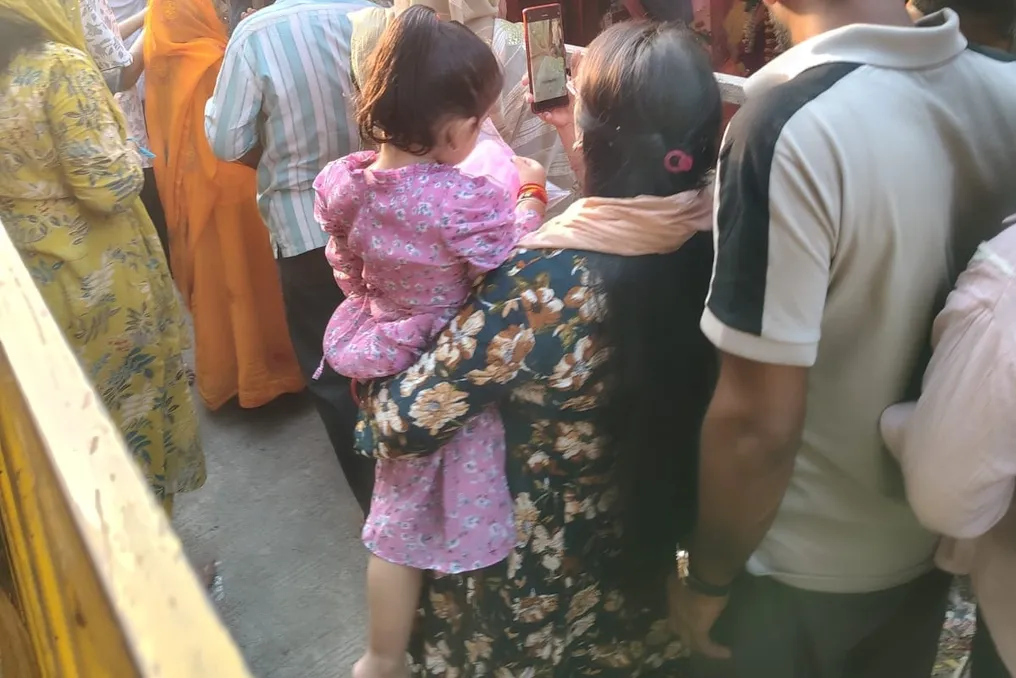
Langurs suddenly appeared near Hade Hanuman temple in Ujjain, drawing crowds of pilgrims
Read more
Aaj Tak
www.aajtak.in

Langurs suddenly appeared near Hade Hanuman temple in Ujjain, drawing crowds of pilgrims

The famous Hade Hanuman temple, located near Sati Gate in Ujjain, has recently been in the spotlight. As videos circulating on social media regarding plans to dismantle the temple have spread, the number of devotees here is steadily increasing. During this period, langurs also suddenly appeared near the temple, which became a topic of discussion among visitors.

Various videos and clips concerning the Hade Hanuman statue are actively spreading on social media, including stories about its miraculous unwillingness to be moved. Videos showing the statue remaining in place are going viral on platforms such as Instagram and YouTube.

These viral materials are influencing the situation at the temple: over 8,000 pilgrims have arrived here in the last four days. People are coming not only from Madhya Pradesh but also from the states of Gujarat, Maharashtra, and Rajasthan. Many pilgrims share videos of the Hade Hanuman statue on social media during their temple visits, which sustains a constant flow of related videos.

The recent appearance of langurs near the temple has also attracted the attention of pilgrims. Discussions about these animals are taking place among people on the temple grounds and in the vicinity. Meanwhile, the administration has made no statements regarding the appearance of langurs near the temple.

The current situation around the temple differs from before: most of the adjacent area was dismantled about a week ago. The Hanuman statue is temporarily housed in a tent. Various opinions are being expressed on social media regarding the actions to relocate the statue. Barriers have been installed due to the increase in visitors around the temple, and a large number of police personnel have been deployed.

Temple attendance continues from morning till evening. Notably, despite the absence of major festivals, there is a continuous stream of pilgrims at the temple.

Typically, the flow of pilgrims in Hindu temples increases depending on the day of the week and festivals. There is a tradition where temples of Mahadeva are visited on Monday, Bajrangbali on Tuesday, and Ganesha on Wednesday. However, the Hade Hanuman temple in Ujjain is currently being discussed independently of any festivals. Pilgrims consider this temple miraculous. They believe that talismans and sacred threads obtained here help eliminate various diseases. It is this belief that prompts pilgrims to come here not only from local areas but also from other states.

On Thursday, the publication Aajtak organized a meeting with pilgrims to gather their opinion on the possible relocation of the temple. The views of both local and visiting pilgrims were unanimous: they believed that if the deity itself does not wish to leave this place, it should not be forcibly moved. Pilgrims noted that more than 60 temples have already been relocated for urban development, and leaving one temple in its original place would not be a mistake. They also emphasized that the administration must consider public sentiment alongside development. People stated that millions of people are connected by faith in this temple, so there should be no disagreements.

Pujari Mahesh Bairagi stated that the work related to the temple could have been done easily, but due to errors made by the administration, the current situation has arisen. He reported that he had previously held discussions with administrative officials regarding the conditions for relocating the temple, but his requests were not accepted. According to the pujari, after the temple gained attention on social media, pilgrims began arriving from all over the country. Many who come to Ujjain to visit Mahakala are now also visiting the Hade Hanuman temple, making this place a popular new destination for pilgrims. Mahesh Bairagi noted that the flow of pilgrims at the temple has been constantly increasing over the last four days. He also mentioned that the administration plans to conduct a scan of the temple using IIT.

Meanwhile, the administration called the videos and statements circulated on social media misleading. The administration asserts that no attempts have been made to remove the statue using machinery or force. On Thursday, there was also a flow of pilgrims from the early morning. The statue is in a tent, barriers have been set up around it, and a police patrol is present. In this atmosphere, the appearance of langurs near the temple has also become part of the discussion among pilgrims.

This entire situation is related to the Singhasthha construction project. Plans include expanding the route from Kantal to Chhatri Chowk, and the temple is on this path. Recently, the local administration dismantled the temple walls, but the statue has not yet been removed. Currently, the location remains in the spotlight due to the growing number of pilgrims, viral videos on social media, and the appearance of langurs near the temple.

Similar stories

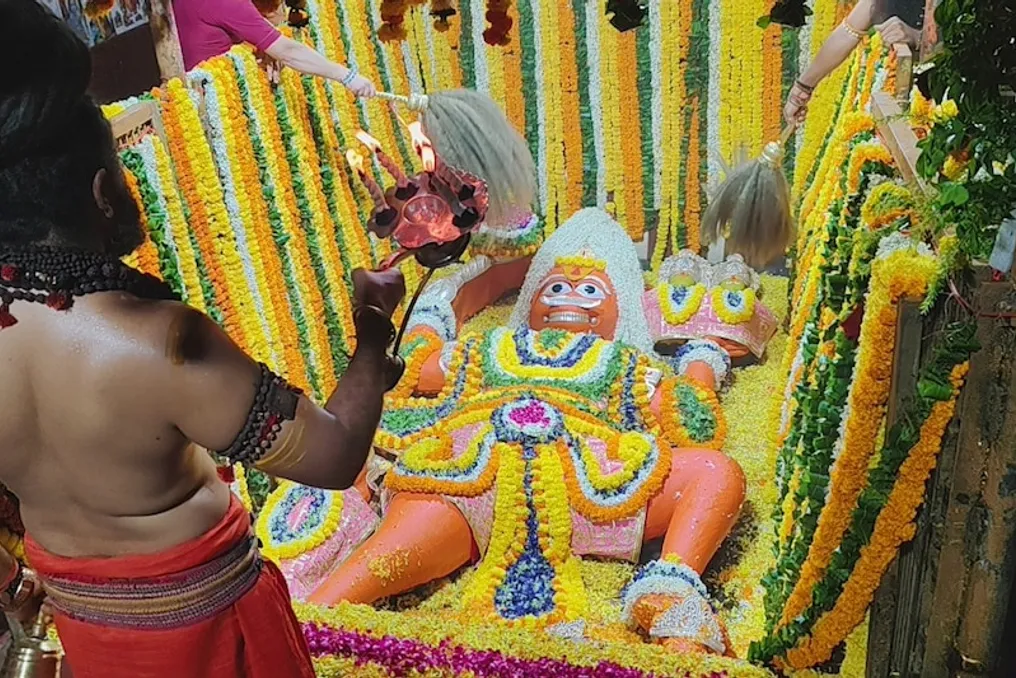
Temple gates of Lete Bajranbali reopened after 13 days of closure; shouts of 'Jai Shri Ram' sounded during the solemn Aarti
Read more
www.aajtak.in

Temple gates of Lete Bajranbali reopened after 13 days of closure; shouts of 'Jai Shri Ram' sounded during the solemn Aarti

Significant events took place at the religious center in Prayagraj, near Sangam. After thirteen days of waiting, the gates of the Lete Bajranbali temple were opened to pilgrims on the fourteenth day, on Saturday. This occurred after the water level in the Ganges receded, allowing for special cleaning and washing of the temple premises. Following this, religious rituals commenced according to established procedures.

Initially, starting from August 30th, the water in the Ganges reached the temple complex area, forcing the gates to be closed to visitors due to flooding. During this period, devotees continued to perform worship and prayers while observing Lete Bajranbali from outside the temple.

After the completion of religious rites, including the sacred bathing and elaborate floral decoration of Lete Bajranbali, the temple was prepared to receive pilgrims. Following all preparatory measures, Mahant Balvir Giri conducted the solemn Aarti of Bajranbali. During this event, the atmosphere of the temple complex was filled with shouts accompanied by the sounds of drums and gongs. Pilgrims chanted 'Bajranbali' and 'Jai Shri Ram,' creating a deeply reverent ambiance.

This day was particularly important for the pilgrims who had awaited the reopening of the gates for fourteen days. As soon as the temple gates were opened, followers were able to visit Lete Bajranbali and offer their worship. The flow of pilgrims in the temple resumed after a long break.

The Lete Bajranbali temple complex, located near Sangam, holds special religious significance. Here, the Hindu deity Hanuman is depicted in a reclining posture, receiving pilgrims. This is why the temple is considered the main center of faith for devotees.

With the rise in the Ganges water level, which led to the temple's closure for 13 days, the atmosphere of piety has returned. After the water level dropped, cleaning, washing, bathing, and decoration were carried out. Then, according to religious traditions, the gates were opened after the Aarti. Following the opening of the gates, the number of pilgrims in the Sangam area increased. Visitors offered worship to Lete Bajranbali, prayed, and received blessings. The atmosphere in the temple complex was completely immersed in reverence thanks to the cries and sounds of drums and gongs. Thus, the Lete Bajranbali abode, which was closed for 13 days due to flooding, has reopened to pilgrims, and with the lowering of the Ganges level, a stream of faith and devotion has once again flowed into the temple.

Birthplaces and Samadhi of Nima Korali Baba: Information on His Famous Temples
Read more
www.aajtak.in

Birthplaces and Samadhi of Nima Korali Baba: Information on His Famous Temples

The film 'Hanman Ansh,' based on the figure of Nima Korali Baba, who is considered an incarnation of Hanuman, attracted significant attention and broke numerous box office records. At the same time, a large number of followers visit Kachandi Dham in Nainital dedicated to Nima Korali Baba. However, many are only aware of this single temple, whereas the sacred abodes, ashrams, and temples of Baba exist in other parts of the country.

Nima Korali Baba enjoys strong devotion among people at his ashram in Vrindavan. There is a belief that Baba left home at an early age in search of spirituality. After spending most of his life in Uttarakhand, he arrived in Vrindavan, where he passed away in 1973. The temple of his Mahasamadhi is also located in this place.

Another famous temple of Nima Korali Baba is located in Lucknow. This temple is built inside the Hanman Setu Mandir complex. According to legend, it was here that Baba erected a small Hanuman temple, and later his followers installed a statue of Nima Korali Baba there.

In the capital city, Delhi, there are also two well-known temples of Nima Korali Baba. One of them, known as Shri Hanuman Birla Mandir, is located near Kashmere Gate on Civil Line. It is believed that an ancient statue of Hanuman, excavated from the ground near the Yamuna, was installed here. Furthermore, there is also a famous ashram of Baba on the Mahouli-Chatarpur road. A large number of pilgrims travel to this temple from cities such as Gurgaon, Faridabad, Noida, and Ghaziabad.

Other famous shrines of Nima Korali Baba include Pankhi Hanuman Mandir in Kanpur. The ashram of Nima Korali Baba in Rishikesh and the Sankat Mochan Hanuman Temple in Shimla are also known for their spiritual significance. In addition to Nainital in Uttarakhand, Nima Korali Baba's temples are located in Kakadi Ghat, Bhumidadar, and Hanuman Gadi. Nima Korali Baba was born in Akbarpur, Uttar Pradesh. A sacred temple has also been built at his birthplace, which attracts people from all over the world for pilgrimage.

Popular