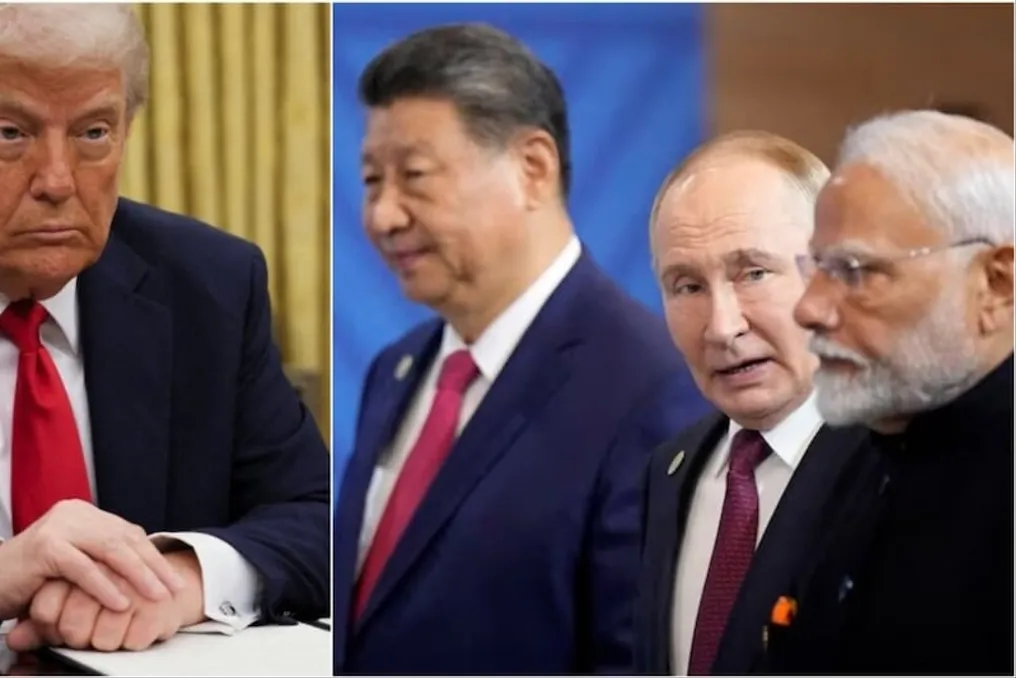
China and Russia's Strategy to Reduce Dollar Dependence; Focus on India within BRICS
Read more
Aaj Tak
www.aajtak.in

China and Russia's Strategy to Reduce Dollar Dependence; Focus on India within BRICS

Despite America being a global power, China is also gaining significant strength. In the current situation, China seeks to undermine the dominance of the dollar. The American side realizes that its position is under threat. In fact, the monopoly of the US dollar, which lasted for decades, is undergoing a period of transformation, and the dollar itself is facing obstacles in its path.

These obstacles are becoming apparent on the global stage. Against the backdrop of Western sanctions, geopolitical tensions, and global division, major emerging economies are actively working to reduce their financial dependence. This is why the Chinese yuan has become the most popular local currency in bilateral trade between Russia and China.

The situation changed drastically after the imposition of US sanctions against Russia. After Western countries excluded Russia from the SWIFT banking system, both nations completely abandoned the use of the dollar and euro. Currently, over 90% of trade between China and Russia is conducted in Chinese yuan and Russian rubles, with the yuan accounting for about 70%. Although this occurred due to prohibitions, it poses a challenge to the dollar, and pressure on the US is likely to increase in the near future.

The Central Bank of Russia prefers to use the Chinese yuan as a reserve currency instead of the dollar. China and Russia are leading the 'de-dollarization' campaign, meaning the rejection of dependence on the dollar. Many countries concerned about US policy support this campaign against the dollar. As an alternative to America's SWIFT network, China has developed its own system (Cross-Border Interbank Payment System-CIPS), and Russia has created SPFS.

Payments for crude oil, natural gas, and coal supplied from Russia to China are now made directly in yuan and rubles, bypassing the dollar. Both countries conduct direct transactions in each other's national currencies, without the involvement of American banks and the dollar.

The US views China as the biggest strategic and economic threat because China controls global supply chains. China is the world's largest manufacturing center and main exporter. If China makes the yuan the mandatory currency in its trade, it could cause serious shocks to the global financial system.

Furthermore, China is actively preparing its digital currency for global trade, which could completely bypass traditional banking channels controlled by America. If the world stops trading in dollars, the US will lose the ability to conduct desired monetary policy and impose economic sanctions on other countries.

The BRICS group (including India, Russia, China, Brazil, South Africa, and new members) covers almost a third of the world economy. The role of BRICS is crucial in preventing arbitrariness and the financial dominance of the dollar. The main focus of BRICS countries is conducting trade among members in their national currencies (such as the rupee, yuan, real), which has led to increased use of local currencies within the group in recent years. Nevertheless, the share of the dollar in total world trade still exceeds 85%.

In the fight to weaken the dollar, BRICS prioritizes providing loans for infrastructure projects and establishing its own bank in local currencies, rather than in dollars. BRICS countries are developing a common digital payment system and financial structure to alleviate concerns about Western sanctions.

From India's perspective, while China and Russia are actively working to abandon the dollar, India's position is more pragmatic and balanced. India advocates for supporting a 'multipolar' financial world, rather than the dominance of any single currency (be it the yuan or the dollar). India emphasizes increasing international trade in its national currency—the Indian rupee—to ensure the security of its economy.

Technologically and practically, BRICS countries are gradually gaining the ability to use their currencies for bilateral trade, but there are also significant difficulties. It is easier to conduct trade in local currencies when trade between two countries is balanced, meaning imports and exports are roughly equal. Trade between China and Russia is already conducted in large volumes in yuan and rubles.

However, when there is a significant imbalance in trade between two countries, conducting transactions in local currency becomes more difficult. An example is trade between Russia and India. India purchases large volumes of crude oil from Russia, but Russia does not sell as many goods to India. When India pays for this in Indian rupees, billions of rupees accumulate with Russia. Russia has repeatedly complained that it does not know how to use these rupees, as the Indian rupee is not a substitute for international trade. Subsequently, to settle this trade, currencies such as the UAE dirham and the Chinese yuan had to be involved.
Similar stories

Discussion on Reducing Dependence on the US Dollar at the BRICS Summit in New Delhi
Read more
www.aajtak.in

Discussion on Reducing Dependence on the US Dollar at the BRICS Summit in New Delhi

Global attention is focused on the upcoming eighteenth BRICS summit, which will be held under the chairmanship of India. All major member countries of the organization, including Russia, China, Brazil, and South Africa, will participate in this summit.

The event is scheduled for September 12 and 13 in Mandapam, New Delhi. The central theme of this meeting is reducing global trade dependence on the US dollar, stimulating the use of local currencies, and strengthening energy security. It is believed that in the current global environment, this meeting could be a turning point for developing countries such as India.

BRICS is a powerful international organization uniting emerging economies. It was initially composed of four countries—Brazil, Russia, India, and China (BRIC). In 2010, the accession of South Africa led to the formation of the 'BRICS' composition. Recently, the organization has expanded to include countries such as Egypt, Ethiopia, Iran, Indonesia, Saudi Arabia, and the United Arab Emirates (UAE) as full members or partners.

This alliance represents about 45% of the world's population and over 30% of the world's GDP. Its main goal is to strengthen economic cooperation among member states, simplify trade, and enhance the voice of developing countries in global politics and economics.

Active discussion on trade in national currencies is expected at the BRICS venue. A priority for BRICS countries remains reducing dependence on the US dollar in foreign trade. Given the tensions in the Middle East, maintaining supply chains will be a hot topic. Mutual exchange of digital payment systems will also be an important issue.

From a technical and practical standpoint, BRICS countries are currently partially capable of using their currencies for bilateral trade, but significant global obstacles exist. Easy trade in local currencies is possible if the trade balance between the two countries is balanced, meaning imports and exports are roughly equal. For example, trade between China and Russia is largely conducted in yuan and rubles.

However, difficulties arise when there is a significant imbalance in trade between two countries. An example of such a case is trade between Russia and India. India purchases large volumes of crude oil from Russia, but Russia does not export as many goods to India. When India paid Russia in Indian rupees, Russia accumulated billions of rupees in Indian banks. Russia has repeatedly complained that it does not know how to use these rupees, as the Indian rupee is not an alternative for international trade. Subsequently, currencies such as the UAE dirham and Chinese yuan had to be involved to settle this trade.

Is it possible for BRICS countries to increase the value of their currencies, challenging the dollar? Or is world trade impossible without the dollar? Under current circumstances, world trade without the dollar is not absolutely impossible, but it is certainly complex. Although BRICS countries talk about creating their own currencies, the Chinese yuan is attempting to replace the dollar. However, due to strict state control over capital in China, countries around the world do not fully trust the yuan.

Following sanctions imposed by Western countries against Russia over the last 3-4 years, the use of trade in local currencies has significantly accelerated. To weaken the dollar, India has allowed more than 20 countries to open special Vostro Accounts in Indian rupees. Nevertheless, there are many problems along this path. If the currency of any country, such as the ruble or the rupee, suddenly drops sharply, the other country incurs huge financial losses.

Meanwhile, about 65% of the total trade volume between BRICS countries is now settled in local currencies (such as yuan, ruble, rupee, dirham, etc.) without the involvement of the dollar. Approximately 95% of trade between Russia and China is conducted in yuan and rubles instead of the US dollar. After Western restrictions, over 80% of crude oil and commodity trade between India and Russia has been settled through a non-dollar system (rupee, ruble, and UAE dirham). More than 60% of non-dollar trade within BRICS has become possible mainly due to large trade between Russia and China.

Despite the growth in the use of local currencies within BRICS, the share of the dollar in total world trade still exceeds 85%. The use of local currencies by BRICS countries is mainly limited to the bilateral level.

The Reserve Bank of India (RBI) has permitted more than 100 banks in 22 countries to open 'special Vostro accounts' in India. Key countries include Russia, the United Arab Emirates, Singapore, Sri Lanka, Mauritius, Bangladesh, Nepal, Bhutan, Malaysia, Oman, and some African nations. Trade between India and Nepal and Bhutan traditionally takes place predominantly in rupees. Trade with the UAE and Malaysia...

Popular