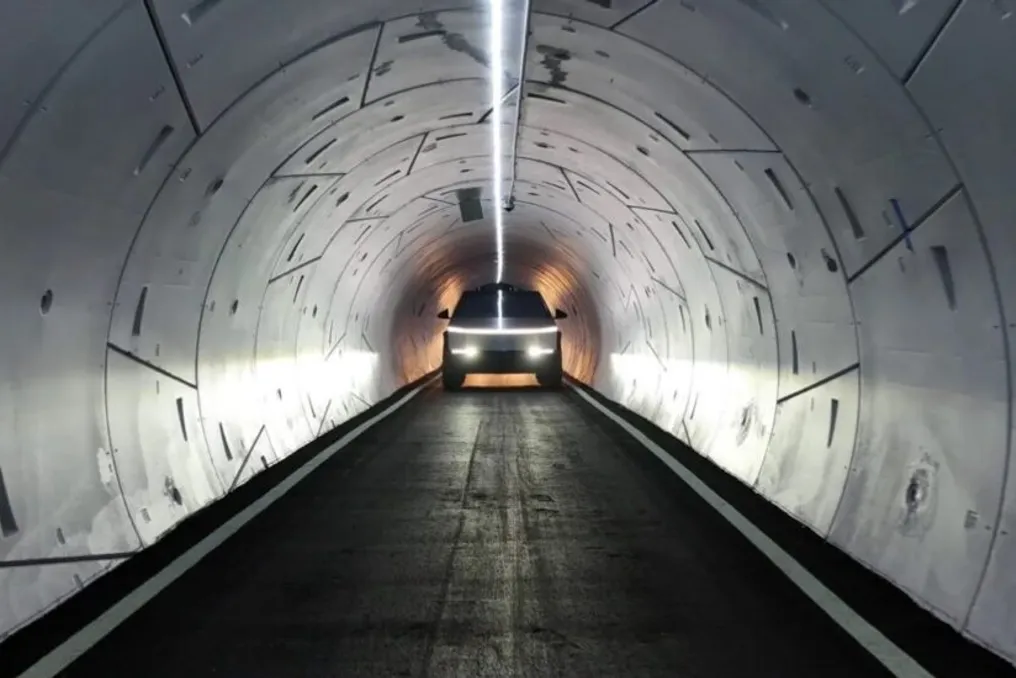
The Boring Company, founded by Elon Musk, has raised $3 billion in a new funding round. This round values the company at $23 billion. The financing was led by the United Arab Emirates and affiliated investment structures.
Elon Musk initially spoke about traffic problems in Los Angeles in 2016 and his desire to create a tunneling machine. A year later, he founded The Boring Company to solve this issue through underground construction, preferring to build beneath the surface rather than above or on the surface.
The attracted funds are designated for expanding the project in Dubai, as well as developing infrastructure in Vegas and Nashville. The Boring Company constructs tunnels and utilizes 'Loop' systems inside them, where electric vehicles travel at high speeds without traffic jams, unlike traditional rail trains.
Currently, the Las Vegas Loop system is operational, connecting resorts with the convention center. Expansion plans have also begun for Nashville. Last year, The Boring Company signed a preliminary agreement with the Dubai Roads and Transport Authority to create the Dubai Loop—an underground high-speed transport network for the city.
Thanks to the new capital, the company plans to expand this partnership to build over 150 kilometers (93 miles) of underground infrastructure across the UAE. These $3 billion will be used to implement the project in the UAE, as well as to hire more employees and facilitate subsequent expansion.
The main objective is to demonstrate that underground transport can function on a city-wide scale, not just for serving a convention center. Investors see this as a solution to urban traffic problems, given the limitations of ground space, and underground construction appears to be the only way to increase capacity. Furthermore, the UAE actively supports this round, aiming for futuristic infrastructure.
The Dubai Loop is viewed as a key test case; if The Boring Company can successfully implement 150 km of operational tunnels in Dubai, other cities may follow suit. It also demonstrates that Musk's companies continue to attract significant sums of money, alongside Tesla, SpaceX, and xAI.
When Musk started The Boring Company in 2017, he sold torches and hats to fund the startup. Today, its valuation has reached $23 billion. Despite serious concerns—the slow pace and high cost of tunnel construction, strict safety regulations, and doubts about replacing public transport with electric vehicles in tunnels—the availability of $3 billion and support from the UAE provide the company with resources to address these challenges.
Thus, while Musk initially started the project out of aversion to traffic jams, the company is now potentially capable of changing how people move in cities, drawing investor attention to traditional infrastructure amidst the boom in AI and rocket technology.