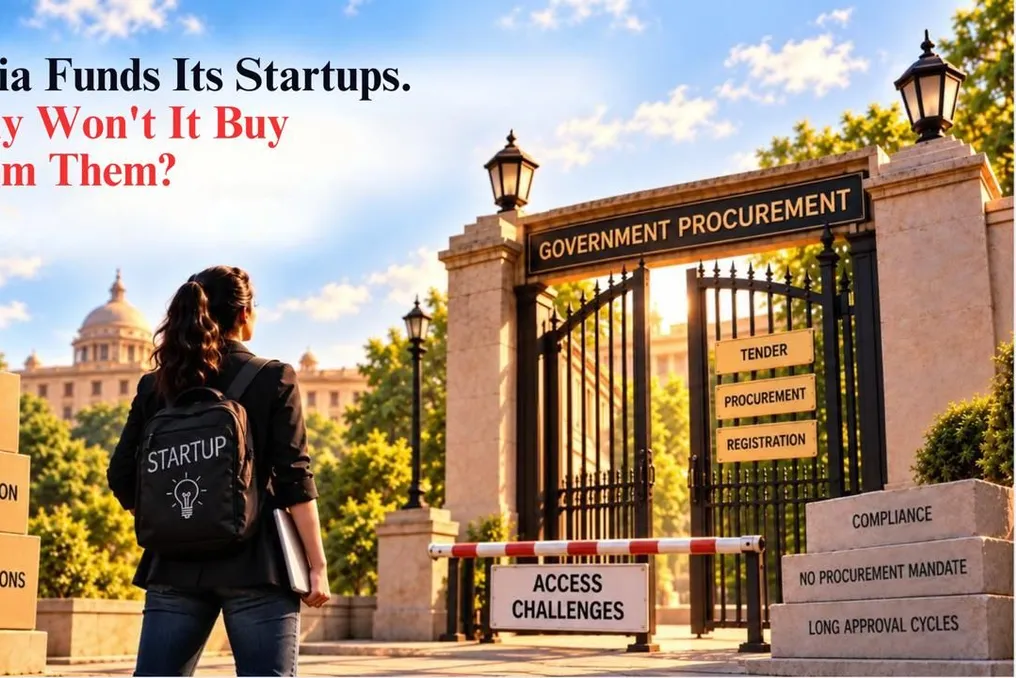
For ten years, India has actively supported young entrepreneurs by creating funds, grants, incubators, tax incentives, credit guarantees, competitions, and accelerators. As a result, over two hundred thousand startups have been recognized.
However, when these companies develop working products, they face a much more complex question: who will buy them? The Government e-Marketplace processed procurements worth 5.03 lakh rupees in the financial year 26, while startups received just over 19,000 crore rupees, which accounts for less than four percent. Less than one-fifth of recognized startups are even registered as government sellers.
This contradiction lies at the heart of the Indian startup story: the country has created a system that readily finances innovation but experiences deep discomfort when purchasing it. In sectors such as energy, healthcare, climate technology, mobility, defense, and infrastructure, the government is often not just one of the potential customers, but frequently the only major first buyer capable of forming the market itself.
This gap does not mean that startups are creating what the government needs; it is a natural result of policy design. Micro and small enterprises account for 47 percent of procurements due to an existing mandate requiring every central ministry, department, and public sector undertaking to purchase at least 25 percent of annual purchases from MSMEs, with additional quotas for SC/ST enterprises (four percent) and women (three percent). In 2024-25, MSME procurement in public corporations and departments reached 93,017 crore rupees, exceeding the established threshold.
Startups are the only priority category in Indian government procurement that has received easing on the entry stage but has received no incentives from the buyer. Rules 170 and 173 of the General Financial Rules exempt recognized startups from guarantee deposits and allow for relaxed requirements regarding previous revenue and experience. However, no buyer has been set a target, budget line item, or obligation for actual procurement.
India has changed the entry rules but has not changed the buyer incentives. This result is visible in the sole long-term statistic: the Standing Committee on Trade found that ten percent of recognized startups conducted transactions on GeM, totaling 14,000 crore rupees over eight financial years.
On August 19, at IIT Madras auditorium, Petroleum Secretary Niraj Mittal made a promise to a group of deep technology founders. Around thirty energy startups could receive up to 2 crore rupees in milestone-linked convertible financing under the new MC2+ Ignite accelerator, as well as pilot sites within the research centers of oil and gas public sector undertakings. They were also guaranteed visibility that the public sector undertaking would purchase their product when it was ready. He emphasized that they should not worry about the existence of the market.
Chairmen of ONGC, Oil India, Indian Oil, BPCL, HPCL, and Engineers India were present at the meeting. Together, they manage one of the largest procurement budgets in the Indian economy; only ONGC spent about 62,000 crore rupees on capital expenditure in FY25. Nevertheless, the way to promise a client to thirty founders was through the creation of an accelerator.
This is not a criticism of the program itself, which represents serious institutional building, but rather an observation on the essence of the problem. The very wording of MC2+ Ignite clearly indicates: early-stage grant funding is easily accessible, whereas startups struggle for access to pilot sites, industry clients, and growth capital. Early-stage funding is no longer the sole or even defining constraint; now it is access to customers.
Over the last decade, India has assembled perhaps the most complex state capital structure for startups outside the US and China. A fund of funds for startups mobilized over 25,500 crore rupees across more than 1,370 startups through 145 alternative investment funds and received an additional top-up of 10,000 crore rupees in 2026. The seed fund scheme added 945 crore rupees to approximately 300 incubators. The Research, Development, and Innovation Fund has a capital of 1 lakh crore rupees. Additionally, credit guarantee schemes, over sixty regulatory reforms, tax incentives, and a special fund have been added to almost every ministry and public sector undertaking. In 2023, the Standing Committee counted 42 ministries, departments, and bodies implementing startup support schemes.
What India has failed to build is a state demand structure. On the buyer's side, there are no targets, dedicated procurement routes, reporting lines, and until recently, no attempts to change the contract that the startup must sign.
The mechanism is embedded in the fine print, and this is the part founders raise first and mention last in policy documents. Standard ONGC supply terms stipulate penalties of 0.5 percent per week for delays, up to ten percent of the contract value, and the corporation can require assurance of this maximum via an irrevocable bank guarantee. An execution guarantee is layered on top. Consider an example: a four-year-old company with a revenue of 6 crore rupees wins an order for 5 crore rupees. Ten percent is 50 lakh rupees in exposure, guaranteed by the bank, meaning a freeze of working capital in the bank. Add the performance guarantee and the working capital gap due to the payment cycle, and the order may consume more cash than it generates, even before the first invoice is settled.
None of this is malicious. The penalty clause is a genuine preliminary assessment of the buyer's loss, a principle upheld by Indian courts in the ONGC vs Saw Pipes case in 2003. For a mature supplier delivering a known product on a known schedule, a ten percent limit is a reasonable use of public funds. The complexity lies in the fact that the identical template is applied to first-time technologies, where schedule risk is higher, and the supplier's balance sheet is thinner. Defense acknowledged this in 2025, but civil procurement has not.
Existing exceptions relate to the wrong part of the process. Waiving revenue and prior experience requirements allows a startup to enter the tender. This does not solve the problem of qualification criteria built around a reference installation that the company cannot possess, nor does it solve the problem of the guarantee burden, nor does it solve the asymmetry faced by the person signing the contract.
Granting funding through an established program is often institutionally safer than awarding an order to a three-year-old company, which prompts requests for audit and challenge from the incumbent supplier. This asymmetry, far more than any hostility towards young firms, explains why many structures of the Indian state preferred to be investors rather than buyers. The dissemination of public sector enterprise startup funds is not a solution to procurement rigidity; it is a symptom of that rigidity.
There are two areas where Indian startups have clearly broken through in the last five years, and these are the two areas where the government has changed its approach to procurement, not just to financing. Defense started with money. The Innovations for Defence Excellence (iDEX) program, launched in 2018, provided grants to startups solving service-related challenges. But the decisive step was procurement. The 2020 defense procurement procedure created a category allowing services to purchase products developed by iDEX without a repeat competitive tender, turning a prototype into an order. Then, in 2025, the Defense Procurement Guidelines rewrote the contract itself: penalties are limited to ten percent and apply only in case of excessive delay, reduced to 0.1 percent per week for industrialization projects, completely waived during development, and five-year orders are guaranteed with an option for a further five years.
The space sector followed the same logic using other tools. IN-SPACe became the single regulator, and ISRO was tasked with transferring mature industrial systems. In February 2026, the SSLV technology was transferred to Hindustan Aeronautics Limited under a ten-year contract worth 511 crore rupees. In July 2026, the Skyroot Vikram-1 rocket successfully reached orbit, marking India's first launch of a privately developed orbital rocket. When asked what else the sector lacked, IN-SPACe Chairman Pawan Goenka answered in one sentence: the government must be the anchor customer. He had data: the Ministry of Defence ordered 31 satellites from private companies, and ISRO plans to build another 21.
The most encouraging aspect of this story is hardly covered. Several states have already created tools that the center lacks. Kerala's live monitoring dashboard deserves fair consideration, not just celebration: 141 startups, 147 departments, 264 work orders worth 28.05 crore rupees. The most advanced state-level startup procurement mechanism in India, operating for over ten years, moved 28 crore rupees. This proves that the mechanism can be created. It also proves that the mechanism itself does not create demand.
Telangana's order from April 2018, meanwhile, is the working civil equivalent of what the defense ministry built, including clock assumptions for approval to prevent file aging, and it has existed for eight years. These are not theoretical recommendations from a consultant's presentation. Various parts of India are already testing them. The missing step is measuring what works and scaling it nationally.
India's grant programs are often described as models based on the US Small Business Innovation Research (SBIR) scheme, and the similarity is obvious. Phase I and II, feasibility study grants and prototype grants, were precisely copied into iDEX, the Seed Fund Scheme, and a dozen public sector enterprise programs. What was not copied was Phase III, the part that transforms SBIR into a procurement program, not just a grant program. Under US law, a federal agency can award a Phase III contract to an SBIR firm on a single-source basis, without limits on cost, duration, or quantity, and any agency can do so, not just the one that funded the initial research. It is assumed that competition took place at the proposal stage.
Four changes, none of which require new money. First, earmarking at least one percent of central procurement for startups recognized by DPIIT, with a public reporting system. MSME experience serves as a proof of concept: the threshold plus the dashboard achieved 43.58 percent against a 25 percent requirement. Second, allowing a successful government-funded pilot project to transition to an order status without restarting the entire tender process. The template already exists twice: in the Defense Procurement Procedure and in the Telangana order of 2018. Third, creating special contract terms for first-time technologies for startups. If the Defense Procurement Guidelines can reduce penalties to 0.1 percent per week and waive them entirely during development, the Goods Procurement Guidelines can contain an equivalent chapter. Fourth, quarterly publishing of startup procurement data by ministry and public sector undertaking. Today, no one can say what central level public sector undertakings are buying from startups outside GeM because no one is collecting it. A category that is not accounted for will not be managed.
A 1 percent target for startup procurement volumes on GeM for FY26 will lead to an annual demand of approximately 5,000 crore rupees, without creating additional subsidies or funding schemes. This is payment for goods and services that the government already needs. Nothing above needs to be invented. The DPIIT notification of February 2026 created the deep technology startup category with recognition up to twenty years, finally aligning the recognition period with the sales cycle of companies most likely to sell to the government. Rail transport restarted its interaction with startups under the Railway Technology Policy of 2026. NITI Aayog prepared a note on applying the iDEX structure to civil sectors, and iDEX signed an agreement with EdCIL in 2025 to expand the model beyond defense. MC2+ Ignite placed pilot sites within public sector enterprise research centers, which is a step directly preceding the purchase order. The task is migration, not invention.