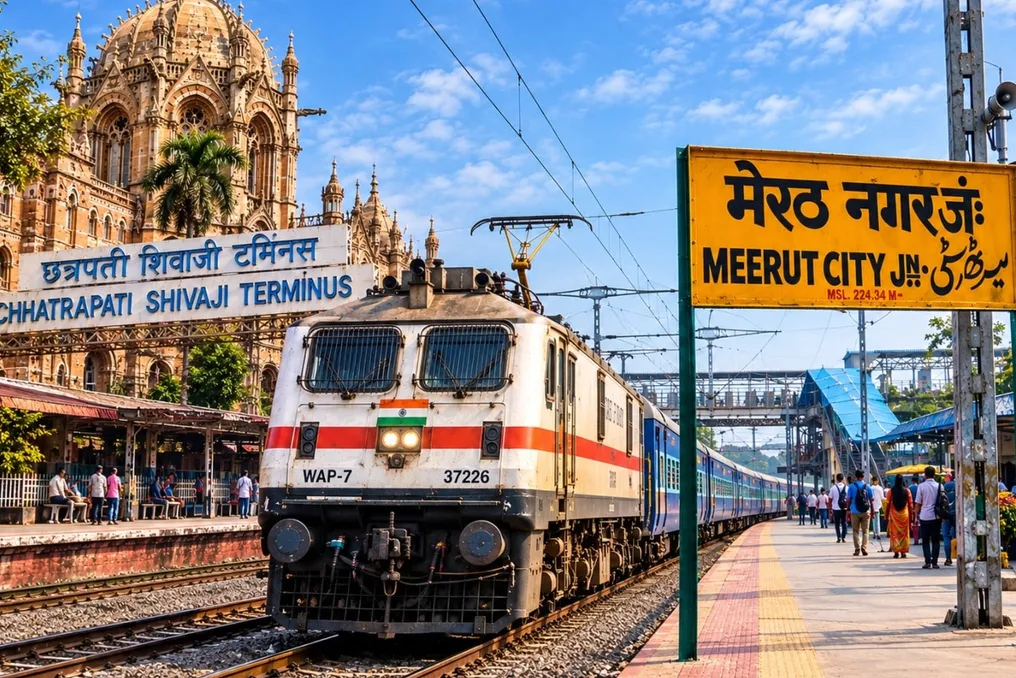
When it comes to accessible and comfortable travel, journeys on the Indian Railways hold a leading position, as millions of people use train services across the country every day. Signboards at every railway station often display designations such as Terminus, Junction, Cantt, or Central. These terms preceding station names have specific meanings.
Junction
If the word Junction follows a station name, it means that railway lines diverge from this station in three different directions. Simply put, a passenger can board a train and travel along various routes, similar to a road intersection or interchange where each turn leads to a different path.
Terminus
If you see the inscription Terminus on the station board, it indicates that there are no further railway tracks beyond this station, and your journey ends here. Passengers must either return in the opposite direction or continue their journey on another line. Examples of such stations include Lokmanya Tilak Terminus and Chhatrapati Shivaji Maharaj Terminus in Mumbai, from which many trains depart and where their journey concludes.
Terminal
The term Terminal differs from Terminus. It is used to designate railway stations where a large number of trains operate. At such stations, more platforms, parking spaces, waiting areas, ticket counters, and other modern amenities are provided for passenger convenience. It is important to note that a Terminal is not necessarily the final station of a railway line; sometimes the railway declares a major station as a terminal to improve train services and reduce congestion at other stations.
Cantt (Cantonment)
If you have visited stations such as Agra, Meerut, or Ambala, you have likely seen the label 'Cantt' next to the station name. Cantt originates from the word Cantonment, meaning the station is located near a military area. Historically, during the British rule, military garrisons were established in many cities, and railway stations were built near them for troop movement. Although these stations still carry the Cantt designation today, they are used not only by military personnel but also by all regular passengers.
Central
Furthermore, among the important terms of Indian Railways is Central. If the station board indicates Central (for example, Kanpur Central), it means that it is the oldest and busiest railway station in that city. Trains to all corners are easily found at such stations, but they also experience a high degree of overcrowding.
Halt
If the designation Halt Station precedes the station name, it also has its own special meaning. Such stations are small intermediate stops located in villages or small towns during a railway journey. Usually, passenger or local trains stop at these stations, and their ticket counters are very small, lacking passenger amenities such as waiting rooms or baggage storage found at larger stations.