South Africa's new access to the Egyptian red meat market could help restore exports that suffered due to Foot-and-Mouth Disease (FMD), although farmers may not see immediate financial benefits.
The agreement between South Africa and Egypt regarding veterinary conditions for red meat export is intended to help revive trade undermined by Foot-and-Mouth Disease. However, industry leaders note that one market alone cannot compensate for farmers' losses or guarantee higher profits for primary producers.
Agriculture Minister Willie Aucamp announced this breakthrough earlier this month at the Agri North West Congress. The Department of Agriculture reported that South Africa and Egypt have finalized negotiations on the Veterinary Health Certificate (VHC) regulating red meat exports; shipments can clear customs after the official signing of documents.
This agreement establishes a regulatory pathway to the Egyptian market, but it does not mean products are already arriving. Exporters still need to comply with established requirements and find buyers.
Aucamp characterized this development as an important milestone for an industry grappling with one of the largest outbreaks of Foot-and-Mouth Disease in decades.
Frikki Mare, CEO of the National Red Meat Producers Organisation (RPO), stated that Egypt is part of broader efforts to restore South Africa's export potential. He emphasized that 'every market that opens up for South African meat is significant.'
Mare noted that export volumes have significantly declined since the emergence of FMD, as South Africa ceased meeting certain veterinary requirements set by importing countries. He added that the agreement with Egypt is another step in the recovery strategy.
The government has already reported progress in other areas: in June, the Department of Agriculture stated that Jordan remains open to red meat from South Africa, and the United Arab Emirates agreed to updated certification conditions allowing trade to continue.
Mare also pointed out that FMD and vaccination have changed the industry's approach to export negotiations. The sector can now more actively pursue export agreements during disease control through vaccination, similar to how major exporters like Brazil and Argentina do, instead of relying solely on South Africa's recognition as FMD-free.
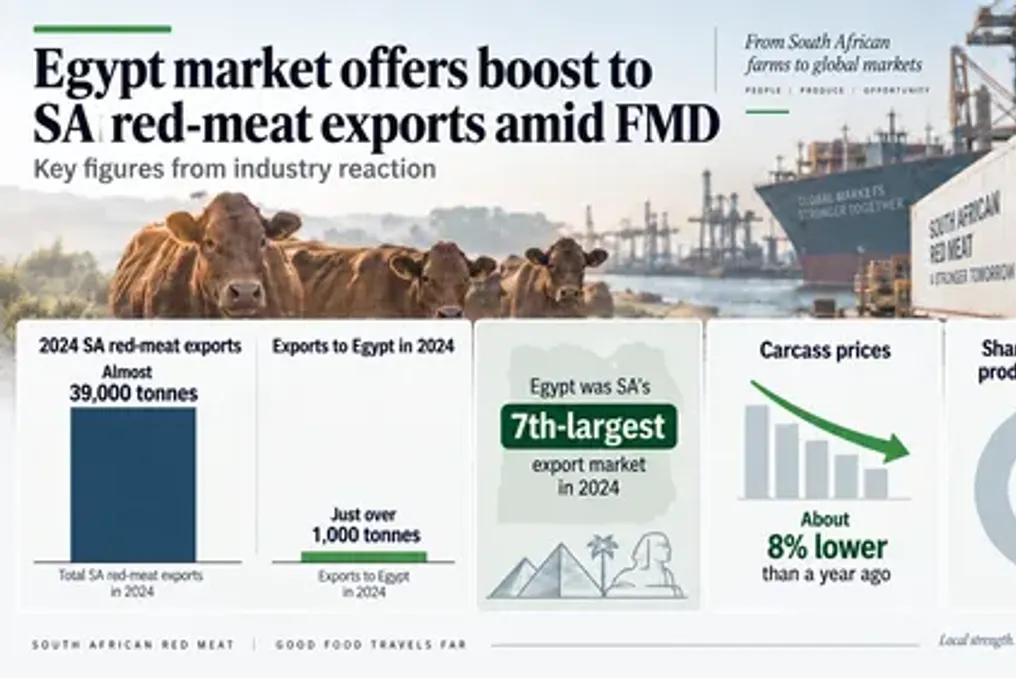
According to Mare, in 2024, South Africa exported nearly 39,000 tonnes of red meat, of which just over 1,000 tonnes were destined for Egypt—the country's seventh-largest export market. He expressed hope that a return to the 1,000-tonne volume would provide substantial assistance.
He predicts that products may start arriving in Egypt within one or two months, as remaining formalities must be completed, and then exporters will need to find buyers. Furthermore, Mare noted that carcass prices have dropped by approximately 8% compared to the previous year, making stronger export demand increasingly important.
Theo de Jager, Chairman of the Executive Council of Southern African Agri Initiative (Saai), stated that this agreement is particularly important following the financial and trade shocks caused by FMD. He thanked farmers for this deal with Egyptians.
De Jager mentioned that farmers incurred additional costs for vaccination and recovery, including supplement expenses, and some were unable to sell livestock for months. He also noted that Egypt is heavily reliant on imported beef, and South African exporters will face competition from major producers such as Brazil, Argentina, Uruguay, and Australia.
A successful export program could also help South Africa build a positive narrative when seeking additional markets in the Middle East and Far East. De Jager mentioned ongoing negotiations with other Arab markets and China, noting that many farmers accept that South Africa may have to manage FMD through vaccination and secure export access on that basis.
However, he cautioned that increased exports do not automatically mean more money for farmers. He explained that 'improved farm income is not guaranteed. The benefit may go to processing plants and slaughterhouses.'
Since export operations usually occur further down the value chain—between processors, exporters, and foreign buyers—higher export revenues do not always translate into better returns for farmers. Saai insists that primary producers should receive a fair share of the newly created export opportunity.
De Jager believes that South Africa is ready to meet Egypt's requirements, including its Halal market niche demands, and estimates that the first consignments could arrive within two to three months after completing the remaining procedures.
Dawi Mari from FNB Agriculture Marketing and Information believes this agreement should be viewed as a long-term opportunity rather than an immediate fix for FMD-affected producers. He stated that it could certainly have potential for local producers in the future, which urgently need it after the catastrophic Foot-and-Mouth Disease outbreak.
Thanks to Egypt's large population, this market could become economically significant if South African exporters increase volumes. Mari noted that export growth could benefit feed complexes, slaughterhouses, meat processing plants, and logistics companies, and increased activity would support rural economic development.
He also reported that currently only about 5% of South Africa's red meat production is exported, and these shipments usually include more expensive cuts. Thus, increased exports are unlikely to cause shortages for local consumers. Exporting higher-value cuts might leave other parts for the domestic market, which could potentially benefit both producers and consumers.