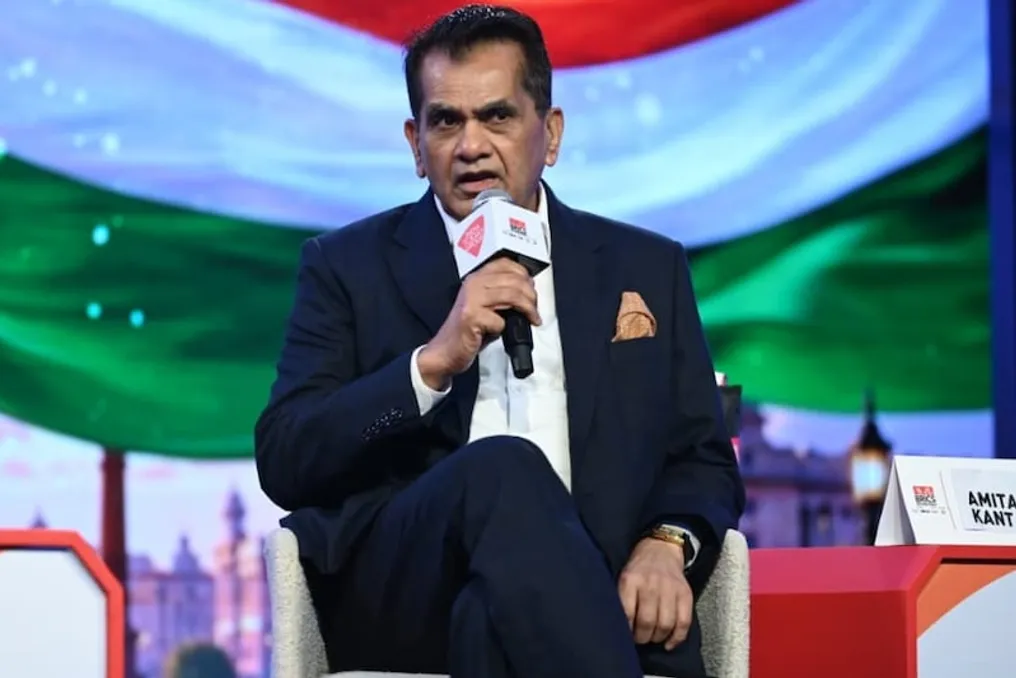
At the BRICS Roundtable organized by India Today, former CEO of NITI Aayog Amitabh Kant presented a detailed analysis of the global economy, clean technologies, and India's manufacturing potential. He emphasized that amidst current global instability, it is crucial to build a balanced strategy of engagement with both the US and China to protect India's national interests.
According to Amitabh Kant, China dominates most key areas of clean technology. Approximately 95% of clean batteries and 85% of electric vehicles (EVs) are manufactured in China. Furthermore, China controls about 80% of the solar energy sector and 77% of wind energy, as well as critical mineral recycling technologies.
On the other hand, the US has a significant influence on the fossil fuel market. India still imports large volumes of fossil fuels to meet its energy needs, which costs it approximately $180 billion annually. Any tension or military action in the Middle East leads to rising crude oil prices, negatively impacting India's import bill, rupee stability, and the entire economy.
To achieve the goal of 'Developed India,' the country needs to rapidly advance in clean technologies in the future. In this regard, establishing technical partnerships with China is important to protect India's national interests, but it is necessary to prevent these technologies from becoming weapons. Kant also noted that China should share these technologies with BRICS and Global South countries.
China's policy is primarily focused on exports, and it does not easily open its market to imports from other countries. Due to non-tariff barriers existing in China, Indian pharmaceutical and drug manufacturers cannot easily enter this market. At the upcoming BRICS summit and bilateral talks, India must resolutely raise the issue of opening its markets and exchanging clean technologies with China.
Amitabh Kant added that excessive control of clean technologies by one country can pose a challenge to the global economy. For the sustainable development of Global South countries, it is vital that technologies, investments, and markets are interconnected to avoid monopoly.
Speaking about India's economic growth, he referred to a report by a global investment bank that forecasts a new industrial revolution in India. High-growth sectors such as space, semiconductors, data centers, electronics, solar energy, and aerospace play a key role in this.
The Indian government has opened up sectors previously under state control to private companies and startups to accelerate industrial growth in the country. The involvement of private participation and startups in geospatial, drone, space, and defense sectors has stimulated new technologies, investments, and competition.
India no longer intends to limit itself only to technology and chip development; the country is also increasing its manufacturing capacity. An indicator of this is the success of the PLI scheme for semiconductors and the acceleration of electronics production. India's goal is not only to meet domestic demand but also to become an important part of the global supply chain.
Amitabh Kant noted that BRICS countries account for about 40% of the world's GDP. He suggested that during its presidency, India should focus the organization's attention on practical issues such as trade, investment, climate, and development, rather than directing it towards political polarization or anti-Western rhetoric.
Amid tensions in the Middle East and varying priorities among member countries, India will have to play the role of 'consensus building.' Just as India demonstrated the ability to reach consensus on sensitive issues at the G20 summit, it must exhibit similar leadership in BRICS, uniting all countries around a minimally common plan of action.