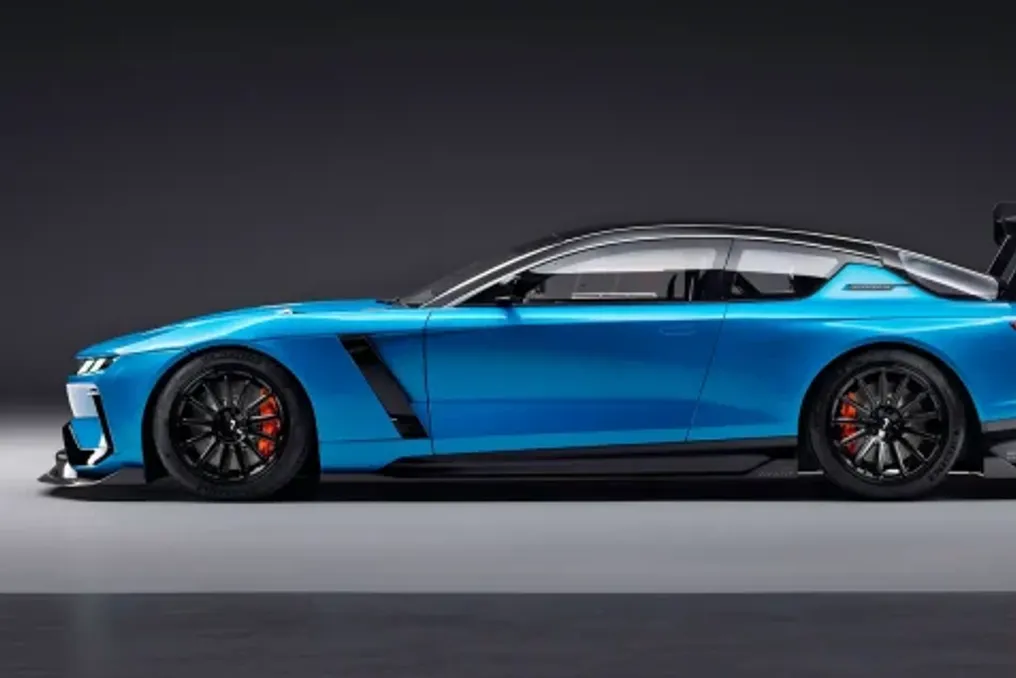
After half a century of inactivity, Jensen has resumed vehicle manufacturing and unveiled the Interceptor GTX. This track coupe boasts 973 horsepower and is described by the British brand as an advanced prototype, not a restomod; it will serve as a development base for two future road models.
According to evo magazine, a commissioned unit will cost starting from 850,000 pounds sterling, which is equivalent to approximately 5.9 million reais.
The name carries history, as the original Jensen Interceptor was manufactured between 1966 and 1976, using 5.9 to 7.2-liter Chrysler V8 engines, becoming an icon of British grand touring before the bankruptcy of Jensen Motors. Jensen International Automotive, established in Banbury, dedicated nearly two decades to restoring and modifying these cars, including the Interceptor R, before starting this new project from scratch.
The engine installed in the GTX is a supercharged 6.8 V8, generating 973 hp. It is derived from the General Motors LT5 architecture and was rebuilt by Late Model Engines, located in Houston, Texas. The preparation involves CNC machined cylinder heads, titanium valves, forged rotating assembly, dry sump, 2.65-liter Roots compressor, and MoTeC management. Jensen reports that less than 20% of the original GM parts were retained, indicating potential to reach 1,217 hp and over 152 kgfm with calibration adjustments, with a redline of 7,000 rpm.
To optimize weight distribution, the engine was positioned behind the front axle. Power is transmitted through a carbon fiber driveshaft, contained in a steel torque tube, to a six-speed Samsonas sequential gearbox mounted on the rear axle. This gearbox features straight-cut gears and a Wavetrac differential, allowing for manual shifts via butterfly or floor lever.
The design was conceived by the independent studio Avant Design. The aluminum bodywork was manually molded by Coventry Metalcraft over a welded and riveted aluminum monocoque. The carbon fiber aerodynamic elements were developed by Artiglio Automotive. The adjustable rear wing can generate about 350 kg of aerodynamic downforce, complemented by a front splitter, flat floor, and integrated diffuser.
The equipment package includes double wishbone suspension on both axles, three-way adjustable Nitron dampers, AP Racing brakes with floating steel discs, 20-inch Vossen forged wheels, and Michelin Pilot Sport tires. The interior is equipped with an FIA-approved roll cage, carbon fiber Tillett seats, six-point harnesses, a Lifeline extinguishing system, a MoTeC dashboard, and Alcantara finishes with orange stitching.
Jensen clarifies that approximately 80% of the external design will be preserved in subsequent road models: first the more aggressive GTR, followed by the more luxurious GT. Both models will be available with standard H manual or automatic transmission. According to evo, the current tooling supports the production of 10 to 15 GTX units before requiring renewal.