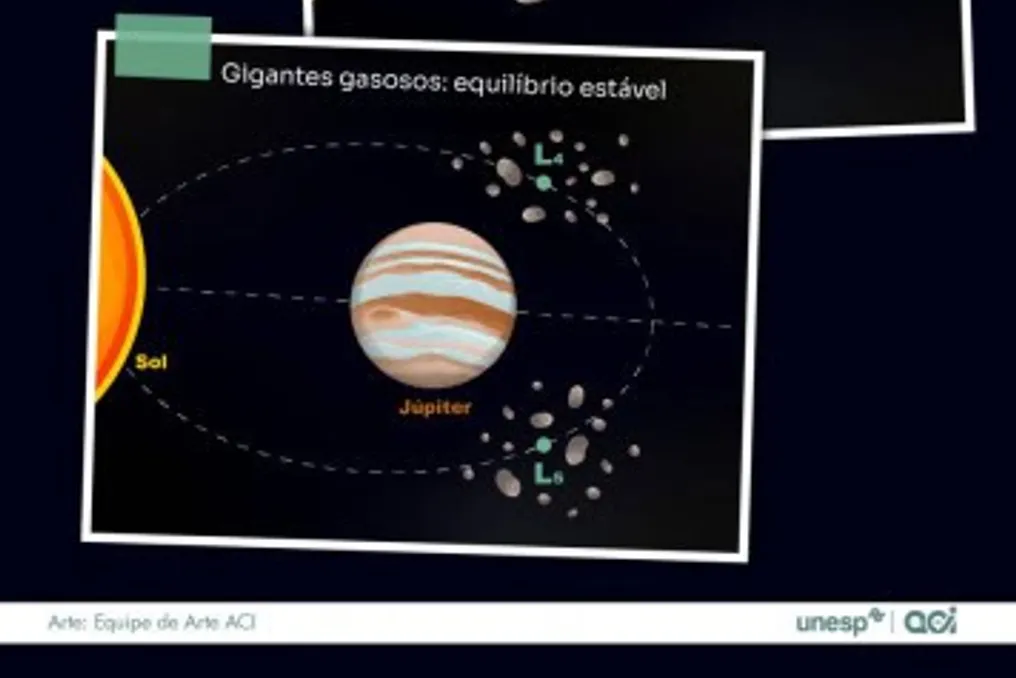
A study conducted by a scientist from Unesp found that certain gravitational interactions are capable of stabilizing the orbits of some asteroids and reducing the probability of their close approach to planets. This work was awarded the CELMEC IX Prize, presented by the Italian Society of Celestial Mechanics and Astrodynamics.
The research was carried out by Valerio Carruba from the Faculty of Engineering and Sciences (FEG) at Unesp, Guaratinguetá campus (SP). It investigated so-called co-orbital asteroids—celestial bodies that share an orbital relationship with planets.
Although these asteroids do not follow the exact same trajectory as the planets, they take approximately the same amount of time to complete one orbit around the Sun. This is due to a gravitational resonance known as the 1:1 mean motion resonance.
The study analyzed how this resonance interacts with another phenomenon—the von Zeipel–Lidov–Kozai (ZLK) mechanism. Simulations showed that in certain configurations, this combination can help keep asteroids at a distance from planets, thereby decreasing the frequency of close encounters.
The paper, titled 'Co-orbital asteroids of terrestrial planets affected by the von Zeipel–Lidov–Kozai mechanism,' was published in the scientific journal Celestial Mechanics and Dynamical Astronomy. This phenomenon can also cause the argument of perihelion parameter to stop continuously rotating between 0° and 360° and begin oscillating around specific angles. This libration restricts the geometry of the orbit and, in certain situations, can prevent the asteroid from getting too close to the planet.
In the simulations, the researchers accounted for perturbations caused by all planets in the Solar System and the Moon. The analysis was extended over periods of about one hundred thousand years to study the possible stabilizing effect of the mechanism.
Among the Earth's co-orbital bodies identified in stable ZLK states, with libration around 0° and 180°, no close encounters with the planet were observed during the analysis. However, in the sample of co-orbital bodies that did not have this resonance, such encounters were recorded.
Additional Information
The study also highlights the difficulties in observing these objects. Rocky planets have less mass compared to giants like Jupiter and Neptune, so the stability regions associated with the 1:1 resonance are narrower.
Furthermore, some co-orbital bodies of rocky planets are difficult to observe because they are close to the Sun's direction in the sky. For example, in the case of Venus, asteroids can only be observed for an average of two weeks every six years.
Currently, there are 21 known co-orbital bodies of Venus, 54 of Earth, and 15 temporary ones, as well as 48 of Mars. No co-orbital bodies of Mercury have been detected.
One of the analyzed objects is asteroid 2025 TV10, which the group identified as a new co-orbital object of Venus. According to Carruba, this object is not in a stable ZLK state and has an orbit close to the region of minimum intersection of orbital distances with Earth, which contributes to possible close approaches over thousands of years.
Despite this, the researcher asserts that the asteroid is very small, and in the event of a collision, it would likely be destroyed upon entering the atmosphere.
On Mars, the study identified only one object in a stable ZLK state—2017 XG62. Under certain conditions, the influence of the mechanism could increase the orbital instability of other Martian co-orbital bodies, but this object remains in a configuration that protects it from close encounters with other rocky planets.
The work was selected to receive the CELMEC IX Prize, which recognizes original articles published in special collections of the journal Celestial Mechanics and Dynamical Astronomy. In addition to Carruba's research, two other works were recognized.
The three recognized papers will be presented at the ninth International Meeting of Celestial Mechanics (CELMEC IX), scheduled for September 14 to 18 in San Martino al Cimino (Italy).
The MASB (Machine Learning Applied to Small Bodies) group, led by Carruba, previously received the CELMEC award in 2023. The article involves researchers from Unesp, the National Institute for Space Research (Inpe), and the University of Atacama (Chile).
Carruba stated: 'Essentially, this is international recognition of the work by the scientific community. This is important because it emphasizes that research conducted in Brazil reaches an international level.'