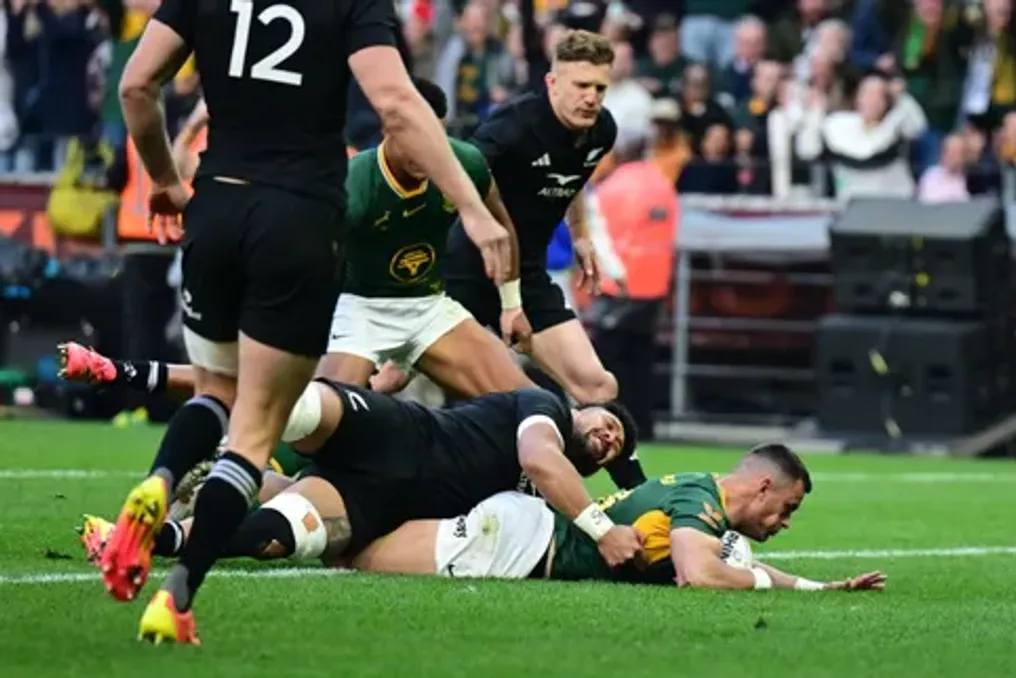
Eben Etzebeth prepares team for final match against All Blacks, calling it more difficult than the World Cup
Read more
IOL
iol.co.za

Eben Etzebeth prepares team for final match against All Blacks, calling it more difficult than the World Cup

As part of a series dubbed the greatest rivalry in rugby, veteran Springbok Eben Etzebeth considers the series of matches against the All Blacks one of the most challenging tests in rugby, even tougher than winning the World Cup.

The Greatest Rivalry in Rugby

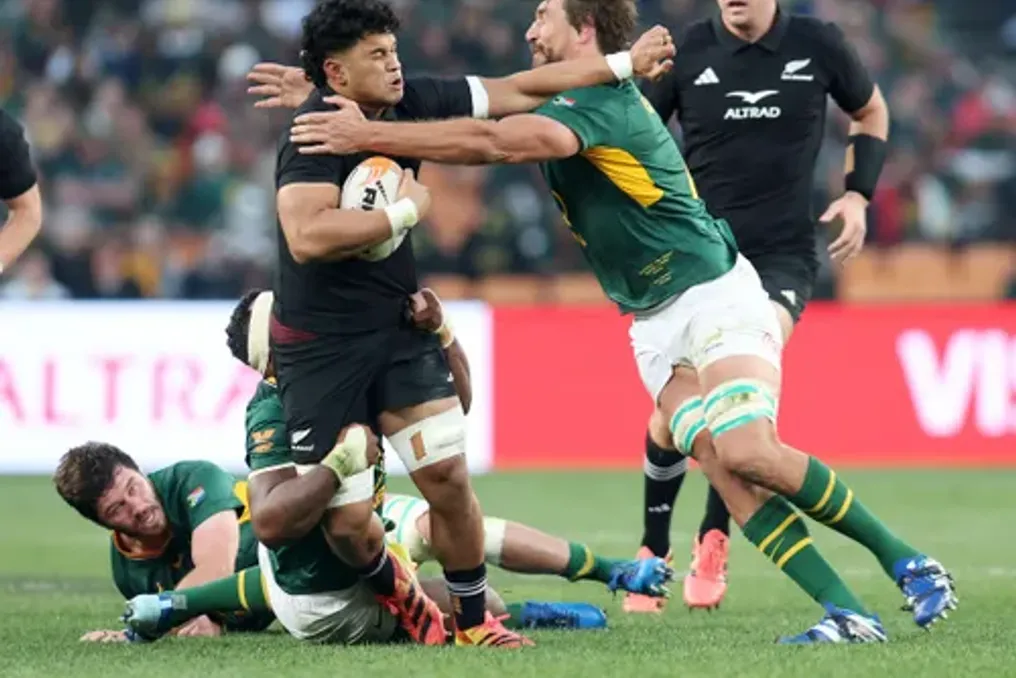
Last Saturday in Soweto, Springbok defender Eben Etzebeth made a tackle on All Blacks forward Wallace Sititi. The veteran of the Springbok team believes that participating in four consecutive matches against New Zealand represents one of the toughest challenges in rugby.

Although the Rugby World Cup remains the pinnacle for the Springboks, even this global event does not require the team to play four consecutive matches against the All Blacks. This is what makes the 'Greatest Rivalry in Rugby' series such an intense test.

With the Springboks currently leading 2-1, they could go down in history by winning their first title, securing a third consecutive victory over their arch-rival in the final match, which will take place in Baltimore on Saturday evening (starting at 23:10 South African time).

Meanwhile, the All Blacks have one last chance to save face at M&T Stadium and prevent the world champions from achieving triumph in the series. Since the start of Dave Rennie's coaching era with an impeccable record, the team has suffered two consecutive defeats.

For Etzebeth, who has experienced both highs and lows in the confrontation with the All Blacks throughout his international career, every match against them holds special significance. Before the final, Etzebeth stated: 'I think, from a challenge perspective, it is undoubtedly the hardest thing in rugby: playing against New Zealand four times in a row and trying to win the series.'

He continued: 'So my answer to the question is that it is not as special as winning the World Cup, but it is still harder than the World Cup because you are playing against New Zealand, which has been one of the top two teams in the world for many years. And it is definitely one of the toughest challenges in rugby.'

The Springboks tested the intensity of this rivalry in the first three matches. The All Blacks won the first match at Ellis Park in Johannesburg, after which South Africa responded with special victories at the DHL Stadium in Cape Town and FNB Stadium in Soweto last week.

Now that the series is decided in Baltimore, Etzebeth and his teammates understand that against a desperate All Blacks team, there will be little room for error. He noted: 'We said after the first game that we couldn't lose anymore, and the pressure was immense. But we all knew what was at stake. This is a special series against them, the first in 30 years, so we want to win it. We had to dig deeper in the last two matches.'

He concluded: 'It is a very special event; we know what this rivalry means to them and to us. This match is decisive; it will determine whether we win it or if it ends in a draw, so it is huge, and we are excited.'
Similar stories

All Blacks forwards coach Barnes states the need to stop opponents' penalties in set-piece battles
Read more
iol.co.za

All Blacks forwards coach Barnes states the need to stop opponents' penalties in set-piece battles

The All Blacks forwards coach, Neil Barnes, expressed dissatisfaction with the team being forced to face opponent penalties during set-piece contests.

The Greatest Rivalry in Rugby

The All Blacks suffered a serious blow before the fourth and final match of the 'Greatest Rivalry in Rugby' series in Baltimore due to the shoulder injury of captain Ardie Savea. Arriving in Baltimore late Sunday, the All Blacks were without three key players while trying to secure a victory in this decisive series.

The Springboks lead 2-1 after a 29-24 win in Soweto over the weekend, leaving New Zealand with only one chance—to win the fourth and last match on Saturday to tie the series 2-2.

One of the most significant setbacks for coach Dave Rennie was the injury to captain and star player Ardie Savea, who sustained a shoulder injury in the third match. Rennie expressed disappointment, noting: 'It's Ardie's shoulder. He's going home. He was huge, wasn't he? But Wallace (City) came out and played well. Of course, we won't use that as an excuse.'

Winger Quinn Tupaea is also heading home due to a knee injury, and flanker Luke Jakobson will miss the Baltimore match after an elbow tendon injury. Jakobson took on the captaincy role after Savea left the field after 30 minutes in Soweto, having already scored two tries.

Rennie emphasized the need for humility and finding solutions: 'But ultimately, we are on the wrong side of the scoreboard, so we must accept our defeat, be honest in our reviews, and focus on finding solutions because we must get better and end up on the other side of the scoreboard.'

The All Blacks believe one of the most crucial battles in Baltimore will unfold within the set-piece. Assistant coach Neil Barnes openly stated before the team's departure to the USA that the Springboks gain a significant advantage from penalties during the scrum.

Barnes noted: 'The Springboks' set-piece is quite dominant, and they receive a stream of penalties because of it.' He added: 'I'm not going to say they are all legal, but we must change the perception among officials to gain a fair advantage.'

Barnes insisted that the All Blacks cannot afford to dwell on the loss but must instead find ways to counter South Africa's strengths. 'We must act based on finding solutions. They are good at what they do, and we must compensate for it. The rest of our game is tense; there isn't much in it.' He continued: 'We won't beat ourselves up too much, but it's disgusting. We are losing to this team, and we tried very hard to achieve the desired result for our country.'

The Springboks won the scrum in the first match, struggled in the second, but regained control in Kabelaba on Saturday. Barnes stated that the All Blacks must find a way to stop the penalties that allow the Boks to turn pressure in the set-piece into territorial advantage. 'In our game, we barely conceded penalties, and the ball goes back into play; that's the mindset.' He clarified: 'In South Africa, your set-piece exists to create penalties to advance toward the opposite end of the field.'

He urged the team to concentrate on finding solutions to stop the opponent's set-piece. 'We had an out-try in our favor that hurt a lot, but we must also find a way to stop scrum penalties.'

Barnes also firmly stated that the All Blacks cannot blame referees or luck for their difficult situation. 'In sports, sometimes you are on the right side of the balance, and sometimes you are not. But we must eliminate luck, eliminate referees, and simply become better.'

Five Key Confrontations Will Determine the Third Match of the Series Between Springboks and All Blacks in Soweto
Read more
iol.co.za

Five Key Confrontations Will Determine the Third Match of the Series Between Springboks and All Blacks in Soweto

The third match in the greatest rugby rivalry between the Springboks and the All Blacks will take place on Saturday afternoon in Johannesburg. The atmosphere is heated following the intense match in Cape Town, which ended with a victory for the Springboks. As a result, the series is tied at 1-1, as the New Zealand team won the first game at Ellis Park.

In Highveld, both teams aim to gain an advantage before the final match in Baltimore, USA, next Saturday. We will examine five key player duels that could influence the course of this competition, which will be held at the FNB stadium in Soweto.

The Greatest Rugby Rivalry

Springboks flyhalf, Sasha Feinberg-Mngomezulu, intends to assert his influence over the All Blacks in the third match, which will be held on Saturday in Johannesburg.

Key Confrontations

Jasper Wiese versus Ardie Savea

The clash between these two players at number 8 is expected to set the physical tone of the game, as both are known for their powerful playing style and willingness to take risks in both attack and defense. The Boks team relies on Wiese for powerful runs and forward momentum, but his work in ball retrieval will also be crucial. Savea is the heart of the All Blacks squad, and his inspiring runs are critical for this team's fast pace. It can be expected that they will fiercely compete against each other for an advantage.

Wilko Lou versus George Bower

Bower noted his love for the scrum this week, while Lou's favorite activity on the field is creating problems for opponents in scrums. There has been fierce scrummaging since the first match, and this element of the game played a significant role off the field. It is hoped that on Saturday both teams can play in the scrum with minimal penalties from referee Nicky Amashukeli, as was the case in Cape Town. Both props will strive to provide forward movement for their team, and the battle between the destructive Lou and the stable Bower could be exciting.

Eben Ezebeta versus Tupu Vaai

This confrontation of 'heavyweights' is a battle for tempo when possessing the ball, but also a fight where physical strength in defense will be decisive in preventing the opponent's advance. This is a task for the two loose forwards (No. 4) on Saturday afternoon. Ezebeta has improved his game and was important during lineout plays, but on Saturday he will need to participate in defensive actions. Vaai will reach his milestone 50th match, and the necessity to show physical power, especially in lineout plays, will weigh on him and his team.

Cobus Reinhart versus Kame Roigard

The outcome will depend on the quality of the ball delivery from the rucks and scrums, as well as who better executes attacks and defenses between these two halfbacks. Both are expected to maintain a high tempo for their teams and make correct decisions under pressure. Reinhart will try to improve his kicking skills after a less brilliant performance in the second match in Cape Town. He will also be vital for the Boks in attack. Roigard's distribution was high quality for his backline, allowing them to attack aggressively in the early matches.

Sasha Feinberg-Mngomezulu versus Ruben Lav

Backline management will be crucial for the flyhalves. Currently, Lav has achieved the most success in having players run behind him. Feinberg-Mngomezulu has not yet fully established himself in the series, giving him a good opportunity to do so in such an important match. The Boks need their talisman at number 10 to launch attacks, especially if they want to start scoring more points. They have lacked this aspect. On the other hand, Lav played a key role in leading the All Blacks' attack and intends to continue showing excellent form.

Rassie Erasmus's tactics and Cheslin Kolbe's mastery helped Springboks defeat All Blacks
Read more
iol.co.za

Rassie Erasmus's tactics and Cheslin Kolbe's mastery helped Springboks defeat All Blacks

The Springboks resumed their campaign in the rivalry dubbed 'The Greatest Rugby Rivalry' in an exciting match at the DHL Stadium. They secured a convincing 33–26 victory over the All Blacks, leveling the four-match series at 1–1.

Recovering from a disappointing loss in Ellis Park, South Africa combined early physical intensity with refined tactical ingenuity to take control of the game from the visitors. This set the stage for the third test in Soweto.

This review presents five key moments from the memorable evening in Cape Town, including bold coaching decisions and individual outstanding performances.

Siya Kolisi's return restored attacking dominance

Siya Kolisi's return to the defensive line provided the Springboks with the necessary physical power and authority in the tackle contest in attack that they lacked in Ellis Park. His presence allowed them to neutralize New Zealand's destabilizing tactics, giving the hosts cleaner ball and a much stronger foundation.

The flanker captain demonstrated his impact by scoring the decisive try shortly before halftime, confirming that his leadership qualities and work rate are absolutely indispensable in high-stakes matches.

Rassie Erasmus's genius front-line plan

Rassie Erasmus once again demonstrated a masterful coaching move by starting the game with Deon Fourie, Gerhard Steenkamp, and Thomas du Toit to absorb the initial onslaught from the opposition. Then, in the 35th minute, he made the bold decision to bring Malcolm Marx and Ox Nche on before halftime. This gamble paid immediate dividends as the fresh, world-renowned pair won a penalty scrum inside the All Blacks' 22-meter zone, directly leading to Kolisi's try and decisively changing the momentum before the break.

Cheslin Kolbe's flawless kicking proved decisive

In a classic test match decided by narrow margins, Cheslin Kolbe's metronomic accuracy in goal-kicking became the determining factor. Playing as the primary goal-kicker playmaker, the winger proved to be man of the match, scoring three conversions and four penalties, totaling 18 points. His perfect percentage allowed the Springboks to punish New Zealand's errors and maintain the scoreline, reducing the significance of Handre Pollard's late absence.

Springbok defense was exposed in the wide areas

The experienced combination of centers Jesse Kriel and Damian de Allende showed immense strength, each scoring a crucial try in the first half. However, their play was not flawless. These two Springboks players conceded two tackles from Will Jordan, leading to an All Blacks attempt. The visitors enjoyed themselves on the flanks, overcoming the Bok defense's pressure and scoring points.

Slow start doomed resilient All Blacks

For the second week in a row, the pace of the game was dictated by an early start, but this time New Zealand found themselves trailing. A conceded try in the first two minutes forced the visitors into a chasing mode in Cape Town. Although goals in the second half from Leroy Carter and Ardie Savea demonstrated their relentless fighting spirit, the All Blacks ultimately set too high a bar against the determined defense of the Springboks.

Popular