There is a fascination in appreciating motorcycles in 2026. Although the author is an automotive enthusiast and became an automotive journalist after more than 15 years, he observes that many new motorcycles still retain characteristics of old models, such as spoked wheels, chrome finishing, and carburetors.
This preservation of design is notable in some markets, as exemplified by the Yamaha TW200, launched in 1987. This motorcycle remains practically unchanged, featuring a 197cc, 16 hp single-cylinder engine with a Mikuni carburetor and a five-speed gearbox. Despite minor improvements in brakes, electrical system, and rear shock absorber, it retains its seven-liter tank, square glass-lens headlight, and simple instrument panel. In the United States, it costs US$ 5,000.
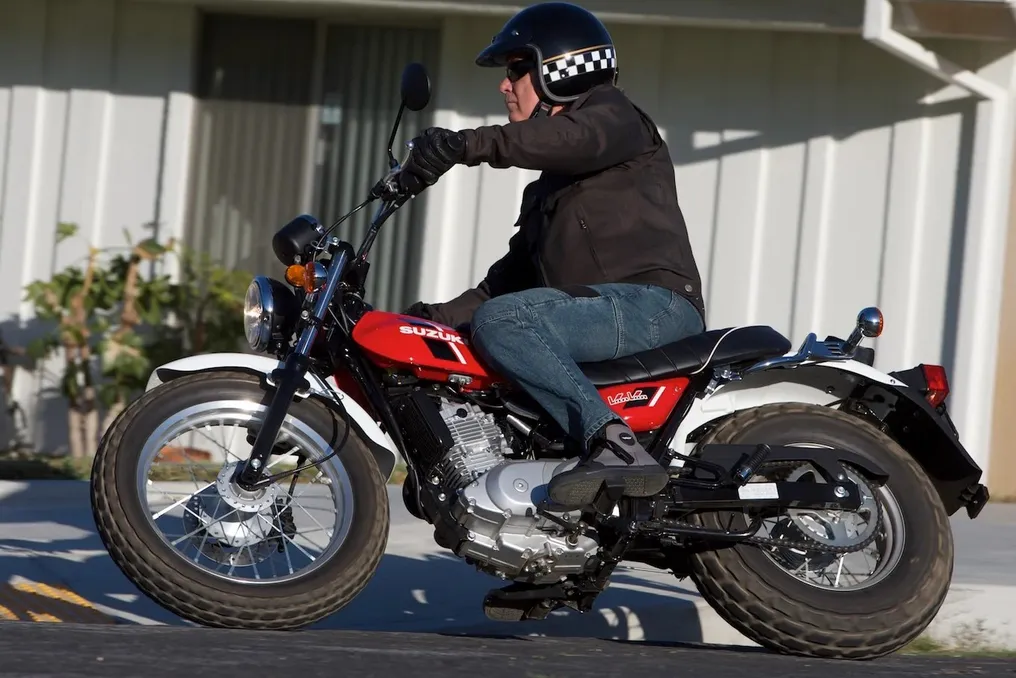
The inspiration for the TW200's adventure came from a competitor: the Suzuki RV line, which also persists today. The Suzuki RV line is known for being extremely faithful to its original design and is often called the VanVan.
In 1971, Suzuki introduced the RV90, whose goal was to merge work and leisure into a single vehicle. This motorcycle was not initially intended for the Japanese market, which was already dominated by Honda; the strategy was to focus on the United States, specifically the East and West coasts, where there was high demand for leisure vehicles.
The official nickname, VanVan, may be an onomatopoeia of the engine sound or an adverb of intensity. The motorcycle was ideal for the beach due to its balloon tires, which used 10-inch wheels and low pressure. However, Suzuki also designed it for agricultural tasks or golf courses.
Although it resembled a cub due to the horizontal engine and under-seat tank, the VanVan had a traditional four-speed gearbox with a manual clutch, unlike cubs. Its 88cc two-stroke engine generated 8 hp at 6,000 rpm and 1 kgfm of torque at 4,000 rpm. The ingenious difference was the air pump embedded in the frame, allowing tires to be inflated after use on sand or mud to ride on asphalt.
This concept of a 'pleasure bike' was a success, leading Suzuki to create several models. In 1972, the VanVan 50 appeared, more affordable and with a semi-automatic gearbox, and the VanVan 125, more powerful, with a five-speed gearbox and asymmetrical wheels. Later, the VanVan 75 filled the intermediate gap, all sharing the philosophy of two-stroke single-cylinder engines and low weight.
The original lineage lasted over a decade, with the last models released around 1982. This niche of leisure bikes with large tires began to influence the industry. In response, Yamaha launched the BW (Big Wheel) line in 1985, essentially trail bikes with ATV tires, demonstrating the viability of creating new products with off-the-shelf parts.
Yamaha expanded this idea with the BW80, BW200, and BW350. However, these motorcycles were not homologated for asphalt and were intended for private properties. Honda reacted in 1986 with the TR200 Fat Cat, using the four-stroke mechanical assembly from its ATC trikes, adding electric start and automatic centrifugal clutch, making it popular among American beginners and farmers.
Both lines, BW and Fat Cat, had short lives because they were very niche products, dependent on Japan's good economic climate. The public showed interest in the comfort and traction of wide tires. Thus, Yamaha focused on the idea, resulting in the 1987 TW200, which combined balloon tires with a four-stroke engine, turn signals, headlight, and license plate for legal use.
The TW200 dominated the segment for almost twenty years until Suzuki resumed the VanVan lineage in 2002, with the RV200 and, the following year, the RV125. These new versions abandoned the original cub style, adopting an appearance closer to the TW200, but retaining classic VanVan elements, such as the round headlight.
The RV200 used a 199cc air-cooled single-cylinder, delivering 16 hp at 8,000 rpm. The RV125 used a 124cc carbureted four-stroke engine, producing 12 hp at 9,500 rpm. Both were designed for low speeds on low-traction terrain. In 2007, the RV125 started using electronic injection. Despite performance similarity to the TW200, Yamaha had established the benchmark in the segment, and Suzuki sought to compete in this space until 2017, when it withdrew both models from the market.