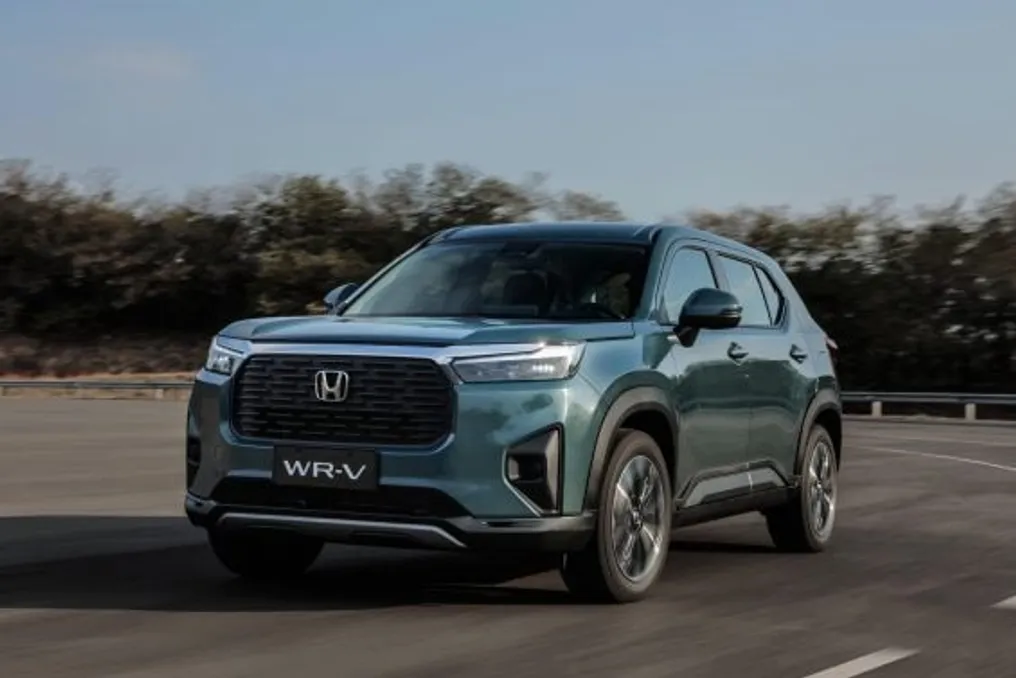
The Honda WR-V, introduced in Brazil in October 2025, will undergo modifications in Asia before possible arrivals in the Brazilian market. Sold in India under the name Honda Elevate, the compact SUV will receive its first facelift in October. This update will include a panoramic sunroof, dual-zone air conditioning, and ventilated seats among the standard features, in addition to a hybrid version expected for the 2027 lineup.
The source of this information is the website Autocar India, and the acceleration of this renewal is attributed to sales performance falling short of expectations. With an average of 1,900 vehicles registered monthly and a cumulative total of approximately 17 thousand units over the last ten months, the model lagged behind competitors such as the Hyundai Creta, Kia Seltos, and Toyota Hyryder.
In response to this situation, the manufacturer plans to incorporate convenience and assistance features that its rivals have offered for longer. Internally, besides the sunroof, new seat coverings and an altered trim pattern, electric passenger adjustment, and an updated multimedia center will be added.
It is relevant to note that during the Brazilian evaluation at launch, the simple trim level (although not identical to the Indian model) was pointed out as a weakness of the utility vehicle.
Safety will also be enhanced in the entry-level versions of the Indian catalog, which will start to feature the Honda Sensing package. This package includes emergency autonomous braking and lane keep assist, complemented by a factory 360-degree camera.
External changes will focus on the front and rear sections, a common tactic in facelifts to minimize bodywork costs. The front will gain a redesigned grille, new bumpers, and a new internal arrangement of LED lights in the headlights. At the rear, the taillights will feature a distinct light signature, and the alloy wheels will be standardized at 17 inches.
The current mechanics remain unchanged: it uses a 1.5-liter naturally aspirated four-cylinder gasoline engine, generating 121 hp and 14.8 kgfm, coupled with a six-speed manual or automatic CVT transmission, following the same setup as the City sedan. However, for the 2027 lineup, local press points to the arrival of a variant with a full hybrid and HEV system. This model would combine the 1.5-liter engine with electric powertrains, similar to what the City already has in other Asian markets, representing Honda's response to the advantage of electrified competitors.
Currently, in India, the SUV has a price ranging between R$ 63 thousand and R$ 87 thousand in direct conversion (equivalent to 1.18 million to 1.63 million rupees), values that are expected to increase with the inclusion of the new equipment.
Meanwhile, the WR-V sold in Brazil is manufactured in Itirapina (SP) and uses the 1.5 flex direct injection engine, producing 126 hp and 15.8 kgfm on ethanol, always with a CVT gearbox—a configuration absent in the Indian version. The Honda Sensing package, which is being made available in India, is already standard in the Brazilian EX and EXL versions, with an initial price starting from R$ 144,900 at launch. Aesthetic changes, meanwhile, are only expected to be implemented in Brazil after 2028.