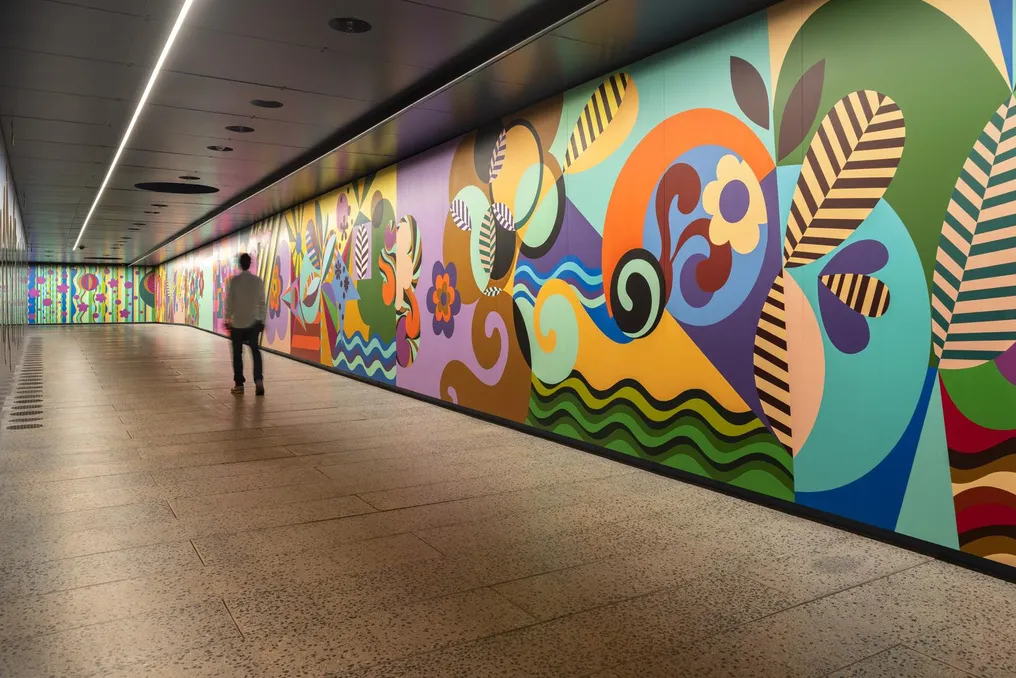
MASP inaugurated a new underground passage on Friday, the 11th, connecting the Lina Bo Bardi and Pietro Maria Bardi buildings located on Avenida Paulista. This tunnel is 50 meters long and houses an unprecedented work by Beatriz Milhazes, created specifically for this new space. The museum reported that this is the first subterranean construction of this size in an artistic institution in Latin America.
The new passage offers visitors the possibility to traverse the entire museum's programming uninterruptedly and will also serve for the transport of equipment and works of art. The space measures 5 meters wide by 2.5 meters high and features skylights that allow pedestrians on Avenida Paulista to observe those passing through.
The Pietrolina Work
This passage contains the piece Pietrolina, an immersive painting by Milhazes. The curation of this work was handled by Adriano Pedrosa, MASP's artistic director, and Amanda Carneiro, the museum's curator. The work totals 98 meters, composed of 60 linear meters of painting complemented by reflective elements arranged on a 38-meter wall.
The title Pietrolina is a tribute to the founding couple of MASP, Pietro Maria Bardi and Lina Bo Bardi, whose names name the two buildings in the complex. The conception of the composition was based on the rhythm and sequence of elements observed in Carnival parades, using various forms that connect as the public advances.
The creative process for the work began with a sketch and evolved into a chromatic study that defined a palette composed of 33 acrylic paints. The planning phase exceeded two years, while the execution of the painting inside the passage took three months.
In Pietrolina, striking characteristics of Milhazes' production are visible, such as arabesques, stripes, organic shapes, and floral motifs. Furthermore, the mural establishes a dialogue with the work Avenida Paulista (2020), also by the artist, which was incorporated into MASP's collection during the exhibition dedicated to her in 2020.
The painting in the tunnel recalls the shade of blue that was prominent in Milhazes' exhibition held six years earlier. According to Amanda Carneiro, this color came to be internally named 'Beatriz Blue' after covering the floor and walls of the museum, and now this same shade appears on the ceiling and one of the walls of the underground passage.
Project Development and Construction
The development of the passage project began in 2019, and its construction was segmented into six distinct phases. Work started in 2023 and required technical studies and approvals from various bodies, including the National Institute of Historical and Artistic Heritage (Iphan), the São Paulo Metro, the Traffic Engineering Company (CET), and the Municipal Secretariat of Urban Infrastructure and Works (Siurb).
The work under Avenida Paulista involved the relocation of sewage and water networks, as well as electrical and telephone infrastructures. Excavations and subsequent sidewalk restoration were also carried out.
To ensure that pedestrian circulation was not interrupted, an inverted construction methodology was employed: first, the tunnel ceiling was built, and only then was the excavation performed beneath the existing structure. Throughout the construction period, the sidewalk only experienced partial closures.
About Beatriz Milhazes
Born in Rio de Janeiro in 1960, Beatriz Milhazes works as a painter, engraver, and illustrator. Her artistic production is notable for its intense use of color, the incorporation of geometric structures, arabesques, floral elements, and other decorative details, extending to techniques such as collage, engraving, tapestry, and sculpture.
Milhazes' creations are part of the collections of renowned institutions such as MoMA in the United States; Tate Modern in the United Kingdom; and the Centre Georges Pompidou in France. In Brazil, her works can be seen at MASP, Pinacoteca de São Paulo, and MAM. She is recognized as one of the most valued living Brazilian artists in the international art scene.
At MASP, the artist has already held two solo exhibitions: 'Beatriz Milhazes: Avenida Paulista' in 2020, and 'Beatriz Milhazes Cabinet' in 2021. She has also participated in editions of the biennials of Sydney, São Paulo, Shanghai, and Venice, as well as the Carnegie International.