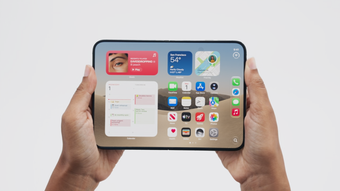
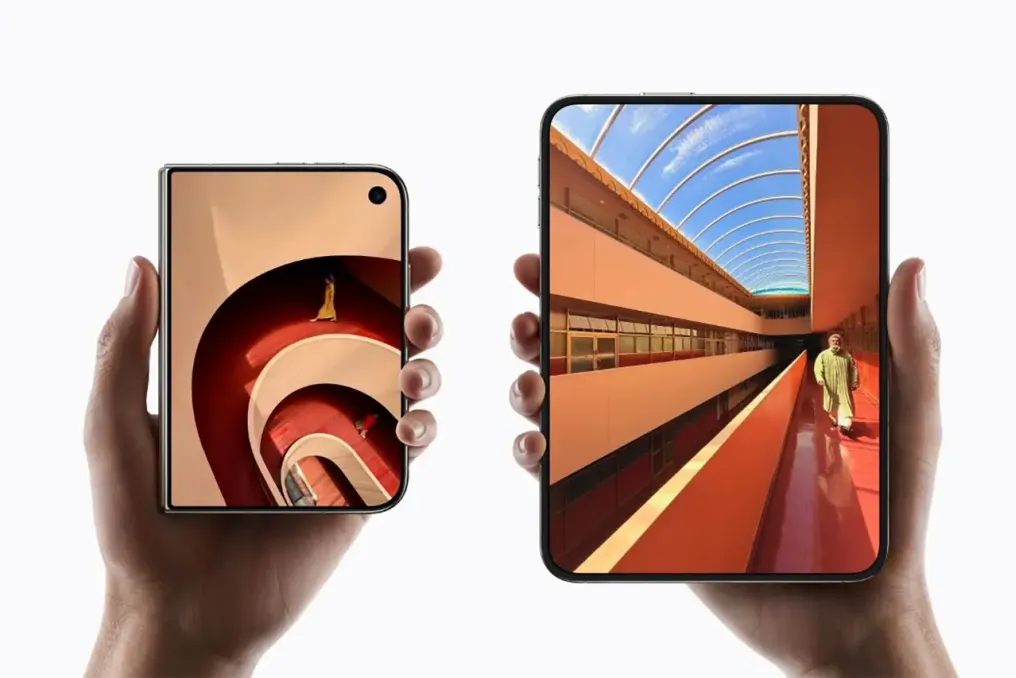
Apple has announced the iPhone Duo, its first foldable smartphone. The device is equipped with a 7.6-inch internal display, a 5.4-inch external screen, an A20 Pro chip, dual batteries, and an updated camera system. Pre-orders for the iPhone Duo will begin on October 16th, with sales starting on October 23rd.
In its unfolded state, the iPhone Duo is Apple's thinnest smartphone. Its 7.6-inch Super Retina XDR internal display is 50% larger than the iPhone 18 Pro Max screen. When folded, it maintains a compact size, and the 5.4-inch external display covers 90% of the iPhone 18 Pro's screen area.
Both displays share the same aspect ratio, allowing content to maintain proportions when switching between screens. They also support ProMotion, Always On mode, and a maximum outdoor brightness of 3000 nits. The internal display features a nano-textured coating designed to reduce glare and reflections; Apple claims this surface makes the crease less noticeable and more pleasant to the touch. The new FaceTime camera is located under the display and remains hidden when not in use.
Later this year, the iPhone Duo will gain support for Apple Pencil via USB-C, enabling users to take notes, draw, and annotate documents on both displays.
Design and Durability
Apple has equipped the iPhone Duo with a precision hinge system that ensures smooth opening and closing. When unfolded, the mechanism supports the center of the display and helps keep the smartphone flat. An integrated magnetic system guarantees a tight closure.
The body is made from Grade 5 titanium with a mirror polish. The hinge cover is 3D printed and features a contrasting micro-sandblasted finish. The back surface is protected by Ceramic Shield, while the exterior uses Ceramic Shield 2, which, according to Apple, offers three times greater scratch resistance than the previous generation. The smartphone has an IP68 rating against water, splashes, and dust. The hinge contains over 100 components. Internal reinforcing ribs enhance structural rigidity, and ceramic fiber inserts in antenna gaps provide additional reinforcement.
The internal display is designed for daily use. It is protected by an anti-scratch coating and a nano-textured polymer layer that, according to Apple, possesses 40% greater hardness than other materials used in the industry. A high-strength glass panel is positioned above and below the display module. Special adhesive joints allow individual layers to move relative to each other, similar to pages in a book, reducing stress during folding. A titanium plate at the bottom of the structure adds extra strength.
Cameras and New Shooting Capabilities
The main camera of the iPhone Duo is equipped with a 48MP Fusion sensor. It is capable of taking photos up to 48MP resolution without shutter lag. By default, images are saved at 24MP, balancing image quality and file size. The system also includes a 2x optical telephoto lens and a 48MP Fusion wide-angle camera. The latter is similar to the camera in the iPhone 18 Pro and supports macro photography.
The main camera utilizes a new computational photography pipeline. The large sensor, wide aperture, and sensor-shift optical image stabilization help improve image quality in low-light conditions. The Center Stage front camera can automatically capture photos and videos regardless of the device's orientation, allowing users to take horizontal selfies without rotating the smartphone.
Updated photographic styles offer additional controls for texture and grain, giving users more options to customize their shots. The foldable design also opens up several additional shooting scenarios. The Smart Take feature uses on-device AI models and A20 Pro capabilities for real-time scene analysis and automatic shooting when people strike a desired pose.
Duo Preview displays a live view of the camera on the external screen, allowing subjects to control composition and their position in the frame. Kid Cue shows Peanuts character animations on the external screen to attract children's attention to the camera. Users can also take selfies using the rear cameras while viewing the image on the external display. Duo FaceTime allows nearby people to join a video call via the external display and camera. Dual Capture in FaceTime, in turn, allows the front and main cameras to transmit video simultaneously. The main camera supports 4K video recording at 120 frames per second and Dolby Vision. Cinematic effects can now be applied after recording video up to 60 frames per second. Audio Mix includes new algorithms designed to improve voice quality and highlight music. Time-lapse supports 4K and Dolby Vision HDR. Thanks to the foldable design, the iPhone Duo can be placed on a surface for extended video recording without a tripod.
New iOS 27 Interface
Apple has adapted iOS 27 specifically for the foldable form factor. The interface retains a familiar structure, but controls on the lock screen, Dock, navigation, and app controls have been moved to the side of the display, freeing up more vertical space for content. When unfolded, the home screen displays two pages, with the left side containing Today View with vertically scrollable customizable widgets.
The status bar features a round, flexible design and is located in the corner of the screen. It displays information about Wi-Fi, mobile network, battery level, and other data. Dynamic Island has also been redesigned: it now runs vertically along the sides of both the external and internal displays and expands to show Live Activities and notifications.
iOS automatically responds to changes in the iPhone Duo's orientation. Content adapts when the device is folded, changes orientation when the smartphone is rotated, and switches to the appropriate display when the device is flipped. Apple has optimized its own apps for the new form factor. Developers can adapt third-party apps using updated APIs in the latest SDK and future support for iPhone Duo in Device Hub Xcode. Netflix, Zoom, and Slack already utilize the foldable design in their applications. In Netflix, users can watch Clips on the external display or unfold the smartphone to view content on a larger screen.
For multitasking, Apple has introduced the ability to open two apps side-by-side on an iPhone for the first time using Split View. Users can also quickly switch between apps, open two windows of the same app, such as Safari, simultaneously interact with Siri AI, and view content on the other part of the screen. App pairs can be saved for quick access later. StandBy has also been revamped. When the iPhone Duo is placed on a surface, it can enter this mode on either the external or internal display, even if it is not connected to a charger. The smartphone can function as a photo frame, clock, or widget hub. Calendar and Weather have been added to the existing Clock and Modular options, and the Photos clock face now supports shared albums. Each option offers additional color, font, and element customization.
Apple Intelligence and Siri AI
The iPhone Duo supports Siri AI—a new version of Apple's voice assistant that will launch in beta with iOS 27. Siri AI leverages Apple Intelligence and can work with the user's personal context. The assistant is capable of finding information in messages, emails, photos, and other data. The Screen Understanding feature allows Siri to perform actions based on information displayed on the screen and answer questions. Users can also formulate tasks in natural language, describing the desired outcome.
The new Siri app allows users to return to previous conversations or start new ones. Conversation history is synchronized across devices via iCloud while maintaining privacy. Apple Intelligence also expands image processing capabilities. Spatial Reframing, Extend, and the updated Clean Up features allow users to change the composition and edit existing photos. Image Playground now supports the creation of photorealistic images. Apple plans to support the SynthID standard in the future, allowing users to identify images created or edited using artificial intelligence. Safari now includes a Notify Me feature that tracks changes on web pages, including product availability or price drops. Apple Intelligence processing occurs directly on the device, while cloud operations use Private Cloud Compute.
A20 Pro Performance
The iPhone Duo uses the A20 Pro processor, which is present in the iPhone 18 Pro. Combined with the new cooling system, it delivers up to 35% higher sustained performance compared to the iPhone 17 Pro. The cooling system is based on approaches used in Apple silicon M-series chips. The A20 Pro is paired with a custom vapor chamber that helps dissipate heat during multitasking, gaming, and AI workloads.
The new display processor manages both screens simultaneously, ensuring smooth transitions between them. The six-core CPU is 20% faster than the A19 Pro, and the seven-core GPU provides up to 40% increased performance and improved energy efficiency. The 16-core dual-cluster Neural Engine offers double the computational power for on-device AI models. The A20 Pro is built using a 2-nanometer process and has 50% greater unified memory bandwidth compared to the A19 Pro.
Battery Life and Connectivity
The iPhone Duo is equipped with high-density energy batteries on both sides of the device. Both batteries operate as a single system thanks to energy redistribution algorithms and Apple silicon capabilities. Apple states that the device can provide up to 31 hours of video playback using the internal display, up to 44 hours on the external screen, and up to 24 hours with balanced use of both displays.
Fast charging allows the battery to reach 50% charge in approximately 20 minutes. With MagSafe or Qi2 wireless charging, the same level is reached in about 30 minutes. The iPhone Duo is available exclusively with eSIM. Apple claims this approach frees up internal space and allows for increased battery capacity. eSIM is supported by over 500 operators worldwide, including AT&T, T-Mobile, and Verizon. iOS 27 also introduces iPhone Handoff, which allows customers of supported carriers to switch between two iPhone models while keeping the same phone number. Wireless connectivity is provided by the N1 chip, which supports Wi-Fi 7, Bluetooth 6, and Thread. The C2 chip uses AI to enhance connection quality and stability and supports mmWave in the United States.
Accessories
Apple has released two new protective accessories for the iPhone Duo. The iPhone Duo Folio case is available in dark blue and taupe colors. It features a built-in stand that can be set at various angles for reading, watching videos, and FaceTime calls. When the device is folded, the stand folds into the case. The iPhone Duo case is available in sand and dark blue colors. It has a thin, lightweight design and consists of two protective sections covering both sides of the smartphone. Both accessories are compatible with MagSafe, Qi2 25W chargers, and standard Qi chargers. Built-in magnets ensure precise alignment and magnetic attachment.
Environmental Features
Apple states that the iPhone Duo was developed as part of its goal to achieve carbon neutrality across its entire business and supply chain by 2030. The smartphone contains 35% recycled materials. Its battery uses 100% recycled cobalt, and the 3D-printed hinge cover contains 100% recycled titanium. Production uses 60% renewable energy, including wind and solar power, throughout the supply chain. The paper packaging is made entirely from fibrous and recyclable materials.