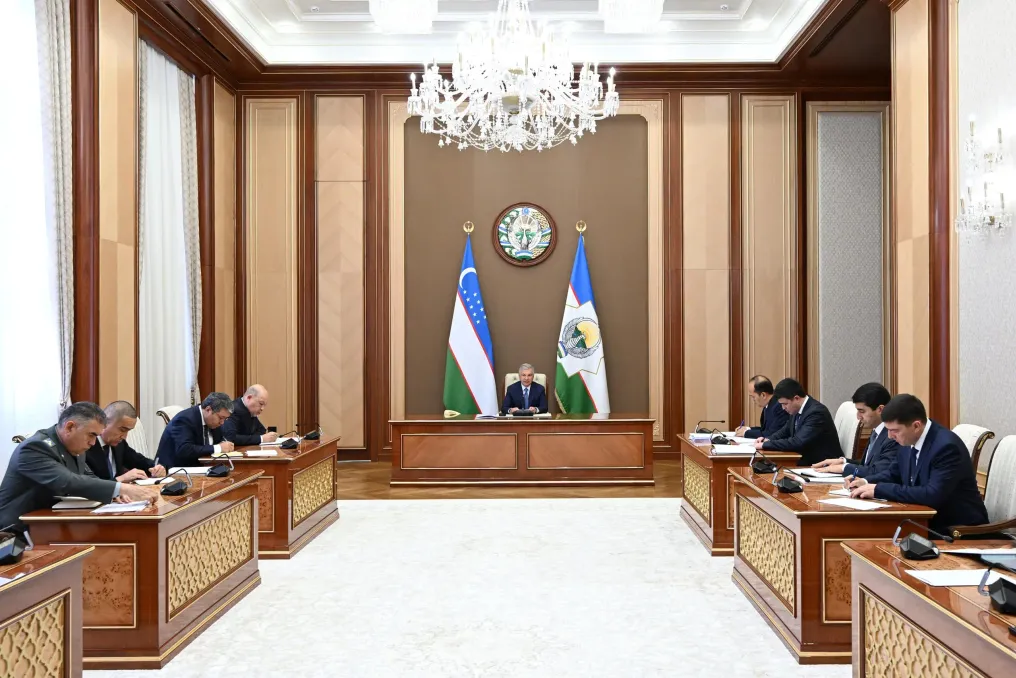
President of Uzbekistan Shavkat Mirziyoyev ordered officials to speed up the process of job creation and intensify efforts to increase household incomes in the regions. He criticized local authorities for insufficient close work with the population and families.
These statements were made at an expanded meeting dedicated to assessing the effectiveness of measures to ensure employment and income growth in various regions. During the meeting, a thorough evaluation of local headquarters established to coordinate work and implement a new system for reducing poverty levels was conducted.
Changes in the organization of this work were approved at a video conference on September 3, when key powers and resources were transferred to the district level. Headquarters headed by hokims are now functioning in all regions and districts. It is expected that employment bodies and economic agencies will interact directly in mahallas to address issues of income growth and employment.
According to the meeting report, the headquarters have begun their activities across all regions. Two responsible senior officials from the economic sector have been appointed in each region, totaling 28 representatives. The new system also includes the reform of headquarters, ministries, banks, and local hokimiyats.
The President reproached officials who continue to work mainly from their offices, do not visit mahallas, and do not study the situation of individual families and enterprises. He emphasized that such an approach will not lead to results.
Social Sphere
The head of state particularly noted that the fight against poverty cannot be limited merely to maintaining a poor registry. True poverty reduction requires the formation of sustainable income sources for families, job creation, necessary infrastructure, and conditions for employment.
One of the priorities will be the more effective use of enterprises and assets held in banks' balances. For example, in the Koshkopyr district, a textile enterprise valued at 43 million euros, intended to create 1300 jobs, has been idle since the beginning of the year. The bank was instructed to attract a crisis manager and restore the enterprise's production capacity to full load.
The government is also considering lifting restrictions on assets of 124 enterprises worth a total of 6 trillion sums and transferring them to bank management. It is expected that this will help restore about 10,000 jobs. Citing the example of Okoltin Mega Textile in the Akaltyn district, the president stated that completed and transferred objects should be put into operation by the banks, not sold off in parts. This approach can provide hundreds of people with jobs.
Currently, state banks own approximately 2500 real estate properties worth a total of 10 trillion sums. It was noted that their effective use could contribute to restoring up to 40,000 jobs. Officials were instructed to conduct a full inventory of enterprises transferred to banks within a week to settle debts. By the end of the year, measures must be taken either to sell them as single production complexes or to restore their operations with the participation of professional managers.
Additional incentives for employment will be applied to rural enterprises. Starting October 1, the social tax rate for workers from needy families hired by such enterprises will be 2%.
The meeting also focused on opportunities for the private sector. The Akaltyn district was cited as an example where an entrepreneur built a private school with a capacity of 880 students, providing free education to 110 children from low-income families. This project involves employing the parents of children receiving free education, provided the children attend classes regularly, thereby creating jobs for parents and ensuring education for their children.
At the same time, in the Khazaraspov district, a textile enterprise has 400 vacant positions. However, some women cannot take these positions due to the lack of childcare facilities. The company head is ready to provide food and transportation to employees if a land plot is allocated for building a kindergarten. In response, the government is ready to offer entrepreneurs land plots through auctions with a starting price of 1 million sums if they propose viable projects for building kindergartens, schools, and technical colleges and are willing to provide free education for children from needy families.
Another priority will be expanding services in residential areas. Hairdressers, beauty salons, small shops, sewing workshops, and shoe and appliance repair can be located on the ground floors of residential buildings. To facilitate this, the government plans to eliminate excessive procedures related to converting residential premises into non-residential ones.
It is proposed to allow the use of apartments on the first floor of residential buildings for retail and service activities without changing their category, using a notification system. Within a month, relevant authorities must prepare a list of permitted activities and safety requirements.
The President also ordered officials to identify vacant and underutilized buildings and land plots in the regions that can be used for developing production and services, and link them with new business projects. Business projects must be located on busy streets of districts and mahallas in accordance with general plans. In historical cities and tourist mahallas, streets must be renovated in the 'old city' style, while increasing the number of guesthouses, retail outlets, and service facilities.
In agriculture, officials were instructed to reconstruct old gardens and direct unused land towards productive use. Increasing the profitability of each hectare should help increase yields and create additional income sources for rural residents.
Officials were also instructed to identify free areas near residential buildings, bring order to illegally occupied territories, set up playgrounds, sports and fitness zones, as well as green areas and provide street lighting. It is expected that mahallas will also expand opportunities for physical activity and encourage residents to participate in mass walks, morning and evening exercises, and other physical activities.
For youth, women, and unemployed citizens, the authorities must organize training in professions, crafts, and foreign languages. Vacant rooms in schools, technical colleges, universities, and other institutions, as well as classrooms outside of class hours, will be used for these purposes.
The role of active mahalla residents and elderly community members was separately noted at the meeting. They need to be more widely involved in public initiatives to strengthen resident participation in mahalla development and reduce dependency.
In accordance with a recently signed decree, the position of Deputy Prime Minister for Mahalla Affairs has been introduced, and a responsible employee has been appointed. This official is responsible for coordinating the work of hokims, district agencies, 'seven mahallas', and banks, as well as ensuring the integration of the electronic platforms they use.
Officials responsible for coordinating the work of 'seven mahallas' were instructed to cease holding separate meetings on mahalla-related issues. Such issues will now be discussed weekly under the chairmanship of the Deputy Prime Minister with the participation of all relevant officials.
Shavkat Mirziyoyev stressed that effective work directly in mahallas, conveying state policy to the grassroots level, and ensuring a sustainable source of income for every family must remain priorities for officials at all levels. During the meeting, reports were heard from regional reform headquarters, regional leaders, district and city hokims, as well as other officials responsible for this work.