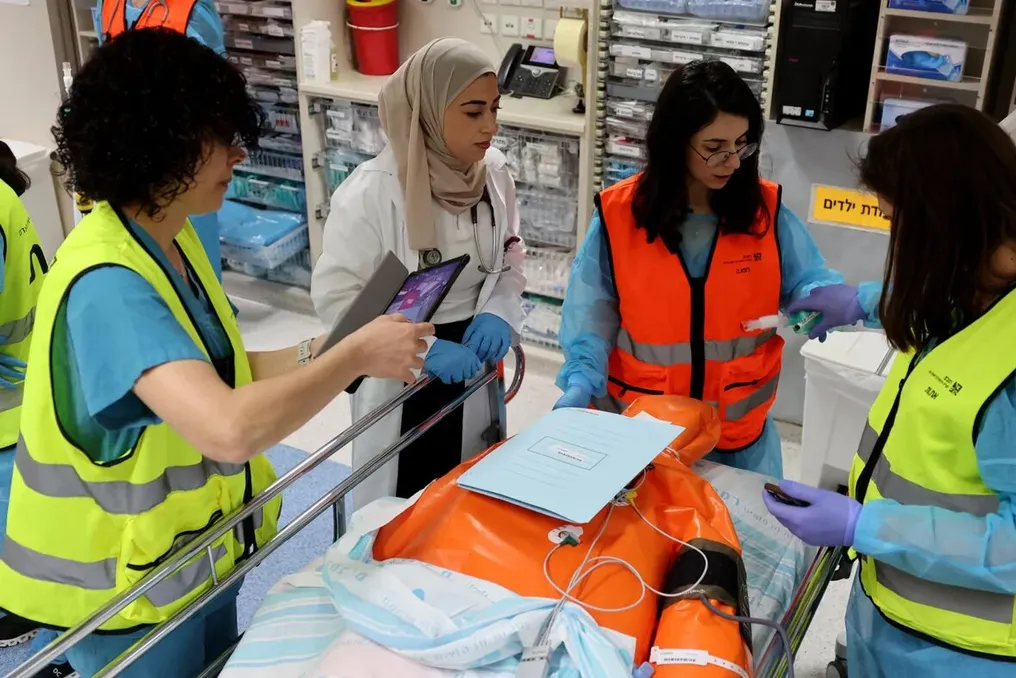
The dismantling of the healthcare system available to Palestinians is not limited to the Gaza Strip or the occupied West Bank. In addition to arrests of doctors in the West Bank, an attack has begun in the media against doctors who are Israeli citizens and work in Israeli hospitals.
The latest wave of the campaign was provoked by relatives of a soldier wounded in Lebanon. Yehoshua Shani, chairman of a forum opposing the ceasefire in Gaza and supporting the continuation of the war, stated that his nephew was subjected to mistreatment by Arab staff at the Rambam medical complex in Haifa.
Shani reported on X that the on-duty nurses were 'Arabic-speaking' and ignored the patient's request for water, and also turned him in bed 'like a sardine,' hitting his head against the mattress. The Rambam hospital management rejected the claim of 'improper' treatment of this patient, but the situation did not end there.
Incitement to open confrontation
Soon, discussions began in Israel about whether Arabs should be allowed to practice medicine at all, especially speaking Arabic in Jewish hospitals. Boaz Golan, an Israeli journalist, noted: 'A soldier should not hear the language of those he is fighting in the hospital... what is happening in this country has simply become madness. The soldier is alone in the room—all are Arabic-speaking.'
One Knesset member used the Hebrew term for positive discrimination—literally 'corrective discrimination'—reinterpreting it as 'detrimental discrimination.' Moshe Saada, a deputy from the Likud party, stated: 'I will continue to fight for you on the issue of Arab doctors and detrimental discrimination that harms our serving children. I will not give up until we fix the situation, cancel discrimination, and prevent students from terrorist universities of the Palestinian Authority from entering Israeli hospitals.'
Osnat Mark, a lawyer and former Likud deputy, called for the exclusion of all Palestinian doctors and medical workers from the healthcare system, stating: 'We just need to make this profession of medicine 'Jewish'... pharmacists, nurses. You come into hospitals and almost feel like you are in Ramallah.'
According to a study published last year, Mark referred to about a quarter of Israeli doctors, 27 percent of nurses and dentists, and slightly less than half of pharmacists. Although there has been an increase in the number of newly registered Palestinians, today the number of unemployed among them is growing; up to 5,000 trained doctors cannot find work because internships for them are being closed, and many are considering emigration.
Wave of persecution
Palestinians working in the Israeli healthcare system are experiencing a wave of racist attacks. There is no official data, but the human rights group Physicians for Human Rights-Israel (PHRI) is tracking disciplinary hearings against Palestinian doctors since the start of the war in October 2023, in at least 15 hospitals and across all four Israeli health organizations.
In a report published in April, the group concluded: 'The Israeli state healthcare system has experienced a wave of persecution directed against Palestinian staff, including hearings, disciplinary investigations, sanctions, and dismissals in response to expressed opinions or social media activity.'
One Palestinian doctor, who wished to remain anonymous, recounted his experience: 'Once I had a patient who came for treatment, and upon seeing my name and realizing it was Arabic, he reacted with shock. He started mocking: 'An Arab wants to treat me! I don't want him at all.' Then he continued to make arrogant, disgusting racist remarks towards me, which I would prefer not to repeat.'
What bothered him most was the sense of superiority he displayed. He felt completely free to say all this in front of the entire medical team, without any embarrassment or hesitation. The doctor reported the incident to his supervisor, providing the patient's name and ID number, but nothing happened. The supervisor was still willing to accept and treat him. In contrast, the hospital secretary reacted very negatively when the patient filed a complaint against the doctor. The secretary suggested that the complaint might have arisen from racism on his part.'
Doctors note that attempts to file complaints against them have increased. Hebrew-speaking patients react with surprise when they hear Arabic. One doctor firmly stated that he sees nothing wrong with speaking Arabic: 'Personally, I see absolutely nothing wrong with speaking Arabic. Once someone asked me: 'Why are you speaking Arabic to me?' I replied: 'Why are you speaking Hebrew to me? Go learn Arabic if you want to understand.'
This doctor insisted that he would continue to speak Arabic to Jewish Israeli patients. He added: 'I see no reason to justify my position with carefully polished words in Hebrew. Anyone who wants us to be merely labor force managed by the hospital has no right to demand that we justify our Arabic to them.'
Another Palestinian doctor with Israeli citizenship told PHRI: 'The system tells you... you can be an Arab... but you must be a 'good Arab.' Arabs who manage to build a career and reach a higher position... must agree with the flag and the soldiers, and the magnifying glass under which they are constantly under scrutiny. You must accept that because you are Palestinian, your career development will be more difficult, and you should not complain about it.'
The article's author notes that while he usually avoids historical comparisons, it is almost impossible not to think about how Nazi authorities in Germany stripped Jewish doctors of their licenses in 1938, allowing only a small number to continue treating exclusively Jewish patients.