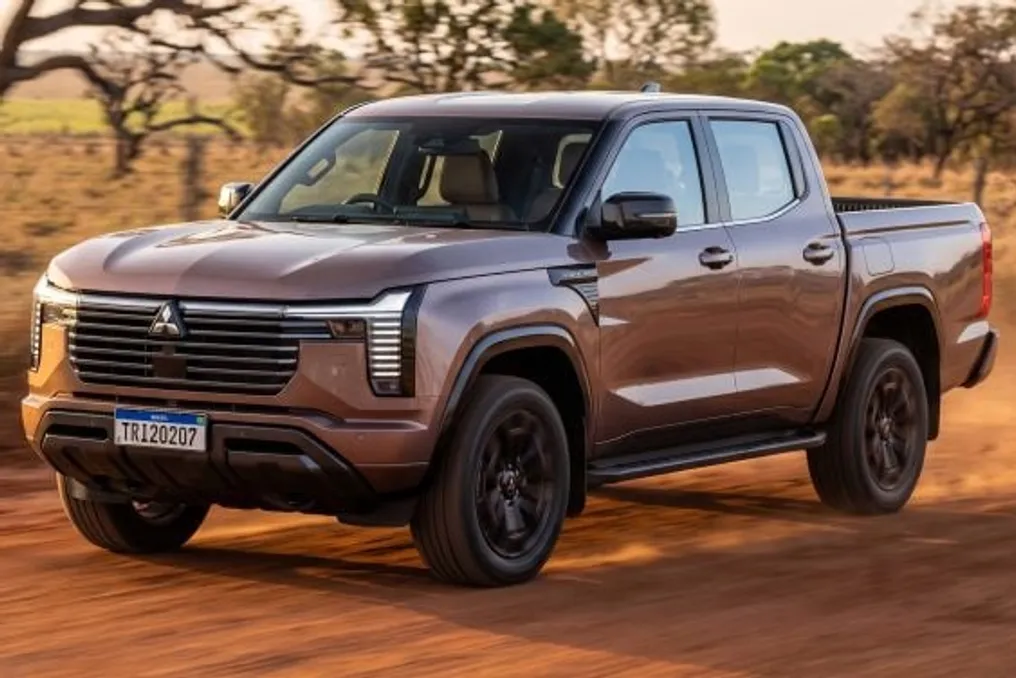
The new Mitsubishi Pajero, unveiled in Tokyo on September 2nd, serves as a preview of future changes to the Mitsubishi Triton, although it is not a pickup truck itself. By sharing the same medium pickup chassis, the design displayed by the seven-seater SUV is expected to signal the modifications coming to the truck's restyling, which is planned for between 2027 and 2028, starting in Asia.
The main difference between the two models lies in the mechanical aspects, which will include a hybrid version. Visually, expectations are focused on the front end, which should incorporate an evolution of the Dynamic Shield language, resulting in a T-shaped lighting cluster and a wider grille. This configuration would replace the narrower headlights and squarer front of the pickup currently available in the international market since 2023. The sides and rear, however, are expected to remain virtually unchanged.
The move towards electrification was formalized in July when Mitsubishi announced an investment of 16 billion baht (approximately R$ 3.5 billion) in Thailand by 2030. This investment aims to convert the Laem Chabang factory into an electrified vehicle export hub. The announcement was made by the company president, Takao Kato, during a meeting with the Thai Prime Minister, Anutin Charnvirakul, and specifically covers the two models based on the chassis produced at that location: Triton and Pajero.
The manufacturer has not yet disclosed what technology will be implemented. Clues suggest an HEV system, or full hybrid, which operates without external recharging and uses a smaller electric motor and battery than a plug-in, possibly coupled with the existing 2.4 turbodiesel engine. Although a PHEV setup was considered early in the project, the electric pickup announced in 2023 lost relevance due to low demand for battery-powered light commercial vehicles.
Regarding the timeline, company executives informed the Australian press after the Pajero presentation that there are no updates on future mechanical setups and indicated that market launch will still require time. This keeps the simultaneous debut with the restyling only in the realm of expectation, not in the official calendar.
Currently, the Triton is manufactured in Catalão (GO) by HPE Automotores since November 2025, taking on the role of the brand's sole pickup after the discontinuation of the L200. It comes equipped with the 2.4 turbodiesel engine producing 205 hp and 47.9 kgfm, the same block that, in the Pajero, generates 204 hp and 48.9 kgfm when paired with an eight-speed automatic transmission. Domestic production presents an obstacle, as a hybrid version assembled in Thailand is not automatically destined for the Brazilian market.
However, competition is intense: the BYD Shark has few sales but already occupies the niche of electrified mid-size pickups in the country. Furthermore, the Ford Ranger will receive a PHEV variant, and the Toyota Hilux will be restyled with a mild hybrid system derived from the 2.8 diesel engine. The Pajero's fate is set, as HPE confirmed the SUV for Brazil in 2027, without setting an exact date.