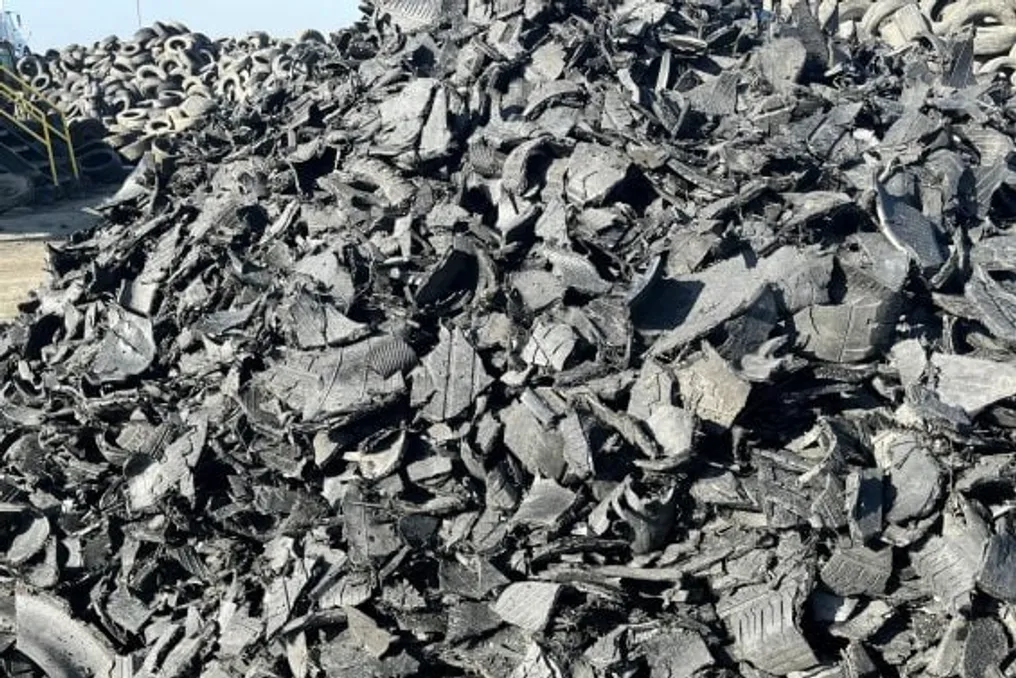
An experiment conducted in 1993 in Richmond, Maine (USA) demonstrated how twenty thousand old tires, shredded and buried under 183 meters of road, managed to halve the penetration of ice into the soil. This study was carried out by civil engineer Dana N. Humphrey, who was then a professor at the University of Maine, and gained notoriety after being reported by the Los Angeles Times that same year.
The initiative arose to solve a practical dilemma: the fate of large quantities of obsolete tires. Instead of discarding them, Humphrey proposed cutting them into pieces ranging from 5 to 30 cm and using them as a base layer under the pavement, exploiting three characteristics of rubber: its low weight, good drainage capacity, and thermal conductivity significantly lower than that of earth and stone.
In the specific section of Richmond, the tires were fragmented into pieces of 5 to 7.5 cm and distributed in a layer 15 to 30 cm thick, subsequently covered by up to 60 cm of gravel. Sensors installed on the road proved that, in addition to inhibiting freezing, the road showed greater resistance to spring thawing, a period when saturated soil tends to give way and form potholes.
Humphrey named this material Tire Derived Aggregate (TDA) and dedicated the following decades to applying this technique in projects in the United States, in addition to consulting in Canada, Australia, and Europe. In subsequent research, he highlighted the aggregate's low density as an advantage for light embankments over soft soils and for filling retaining walls. However, the main obstacles to its adoption remain the high initial cost and the inherent complexity of its implementation.
In countries without rigorous soil freezing cycles, the reuse of tires followed another path: the incorporation of rubber powder into the asphalt binder. The first national stretch using rubber-asphalt was inaugurated in 2001 on BR-116, between Guaíba and Camaquã (RS), using technology developed by Greca Asfaltos in partnership with the pavement research center of UFRGS. The company itself reports that the product contains approximately 15% rubber powder and has used 30 million tires over 25 years.
Currently, this material is used in the Anhanguera-Bandeirantes systems and in parts of the Washington Luís, Régis Bittencourt, and Imigrantes highways, located in São Paulo. A survey conducted by Artesp in 2021 recorded more than 1,355 km with recycled rubber across 22 state highways in São Paulo. According to Anip, the association representing tire manufacturers, the resulting pavement is 40% more resistant than traditional pavement and has an average lifespan of 14 years, surpassing the 10 years of common asphalt. Additionally, including rubber powder in the mixture can reduce rolling noise by up to 5 dB.
The scale of waste disposal of these materials justifies the interest: data from Ibama indicate that 7.7 million tons of unusable tires should have been disposed of properly between 2009 and 2020, according to CONAMA Resolution 416/2009, which imposes on manufacturers and importers the obligation to collect the volume equivalent to what they sell. Despite this, academic estimates suggest that Brazil recycles only about one-third of the total discarded.