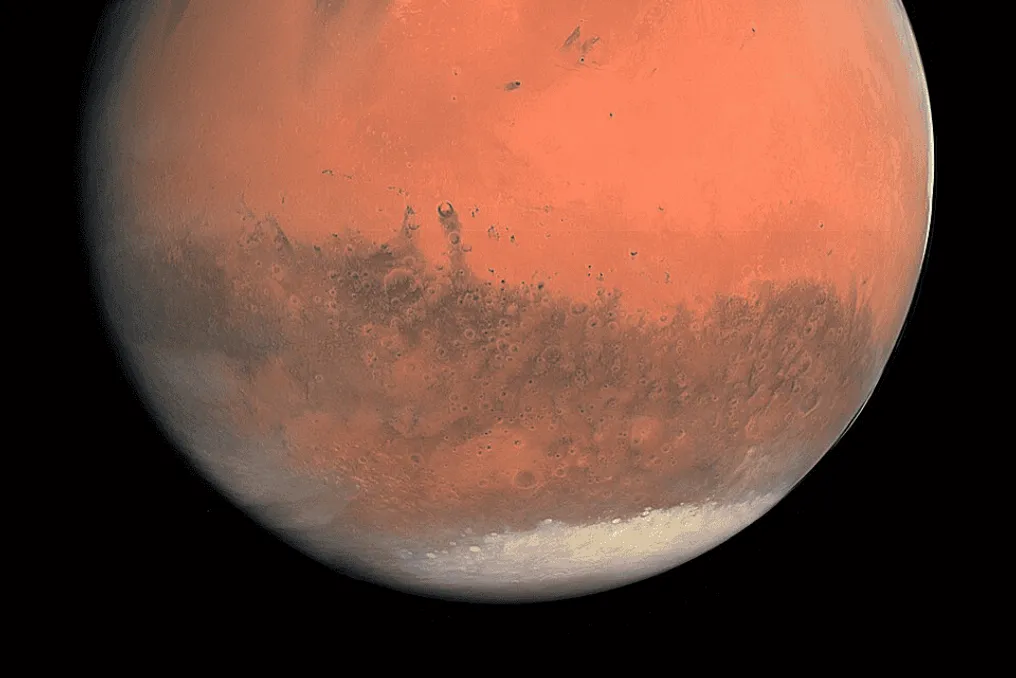
Space exploration is going through a significant period, marked by more frequent launches, reduced costs, the advent of space tourism, and the future human return to the Moon. However, the next major goal for humanity after the Moon is considered to be Mars.
Visiting the Red Planet presents considerably greater difficulties than going to the Moon, as the distances are vast and the journeys last for months. In these cases, the concern is not only about the lowest cost but also about the ability to keep humans alive and healthy during long periods in deep space and ensuring their safe return.
The difference in scale is noticeable: while the Moon is an average of 384,000 kilometers from Earth, Mars can range between 55 and 400 million kilometers, depending on the orbital position of the two celestial bodies relative to the Sun. This requires the spacecraft to follow a precise trajectory to meet Mars at the correct time.
Mars missions generally utilize launch windows, which occur approximately every 26 months. At these times, the arrangement of the planets allows for a route that optimizes energy consumption, taking advantage of Earth's orbital velocity and the Sun's gravitational pull. However, even on this most efficient route, the travel time is about eight and a half months, which represents an extreme challenge for human crews.
Since there will be no logistical support along the route, travelers must carry almost all necessary resources for survival, including water, food, oxygen, clothing, and spare parts. Even with maximum recycling, the extension of the journey increases the need for supplies and the crew's exposure to the dangers of deep space.
A critical risk is radiation. On Earth, the atmosphere and magnetic field offer substantial protection, but on Mars, passengers are more vulnerable to cosmic radiation and solar particles. Although protective materials can be used, this increases the mass of the spacecraft, forcing a search for a balance between safety and weight.
Additionally, microgravity poses serious risks to human health, causing bone and muscle mass loss, as well as cardiovascular changes. Although concepts of ships with rotating structures to simulate gravity exist, such structures are currently unfeasible in size. Due to these factors, the first astronauts will have to be selected with extreme caution, as any serious emergency will require the crew to solve the problem onboard, given the insurmountable distance.
The idea of accelerating the journey by building a more powerful rocket to reduce it to three months runs into the laws of physics. Acceleration requires energy, and if this energy comes from onboard propellant, more fuel must be carried, which in turn adds mass, demanding even more fuel to accelerate. This cycle is known as the 'tyranny of the rocket equation.'
Therefore, reducing transit time to Mars is a primary challenge, not only for comfort but fundamentally for health and safety issues. However, speed of arrival does not guarantee a quick return. Due to the continuous movement of Earth and Mars around the Sun, another favorable orbital configuration will be needed for an efficient departure.
In the current configuration, a human mission would require more than a year on the surface before starting the return. Consequently, to perform a 'round trip' to Mars with existing technology, about three years of absence would be necessary. After this period of exposure to radiation, Martian low gravity, and space microgravity, the return would be extremely risky.
Furthermore, there are other crucial problems not detailed, such as food and energy production, which are expected to be solved in the re-conquest of the Moon. This demonstrates that a trip to Mars requires a complete architecture, covering everything from flight and landing to survival on the surface and return to Earth. Time remains the decisive factor, and the focus must be on developing propulsion technologies that make the journey faster and safer.