For the first time, the PISA exam assessed the effect of artificial intelligence (AI) on studies. PISA, which stands for Programme for International Student Assessment, is conducted by the Organisation for Economic Co-operation and Development (OECD), an organization responsible for measuring global economic development.
Roberto “Pena” Spinelli, a physicist from USP and an AI specialist from Stanford University, observed a trend in the PISA 2025 results, released on Tuesday (08). He commented on the program Olhar Digital News that students who use AI rarely or never tend to achieve better results than those who use it little, while those who use it intensively outperform those who use it sporadically.
In summary, Spinelli points out that those who do not use AI perform better, those who use it a lot also do well, and those who use it moderately show slightly inferior performance.
To understand the expert's analysis, it is necessary to examine the research findings. PISA is applied every three years with the objective of measuring students' knowledge in reading, mathematics, and science. The current edition revealed that approximately half of 15-year-old Brazilian students (48%) use AI chatbots, such as ChatGPT, at least once a week for study purposes.
Additionally, the survey indicated that students who frequently use AI to summarize texts, conduct initial research, or draft essays score, on average, 20 points lower in science compared to those who do not use the technology. According to the OECD metric, this disparity corresponds to the loss of an entire year of schooling compared to their peers.
However, Pena emphasizes that there are other ways of frequent use that can be beneficial to learning. Spinelli divided his PISA 2025 analysis into three distinct categories.
Firstly, students who claim never to use AI. These students do not resort to shortcuts, being forced to exercise their critical thinking and memory, which results in good performance precisely because they do not delegate tasks to AI. Spinelli emphasized that this student must complete all schoolwork and conduct research independently.
The second category includes students who use a lot of AI. For the expert, these may be using the technology as a private tutor. This tutor can answer many questions that, otherwise, the student would have to wait for the teacher to be present, especially if there is hesitation in asking. Pena added that AI can teach in potentially superior ways to the traditional school method, thus justifying the possible improvement in performance.
Finally, there are students who use AI sporadically. Pena considers that this group may be practicing the most harmful use of the technology, such as asking AI to do the work or write it for them, without often performing any revision. Spinelli warned that this profile runs the risk of delegating their thought process to AI, not learning effectively, and consequently showing worse performance on tests.
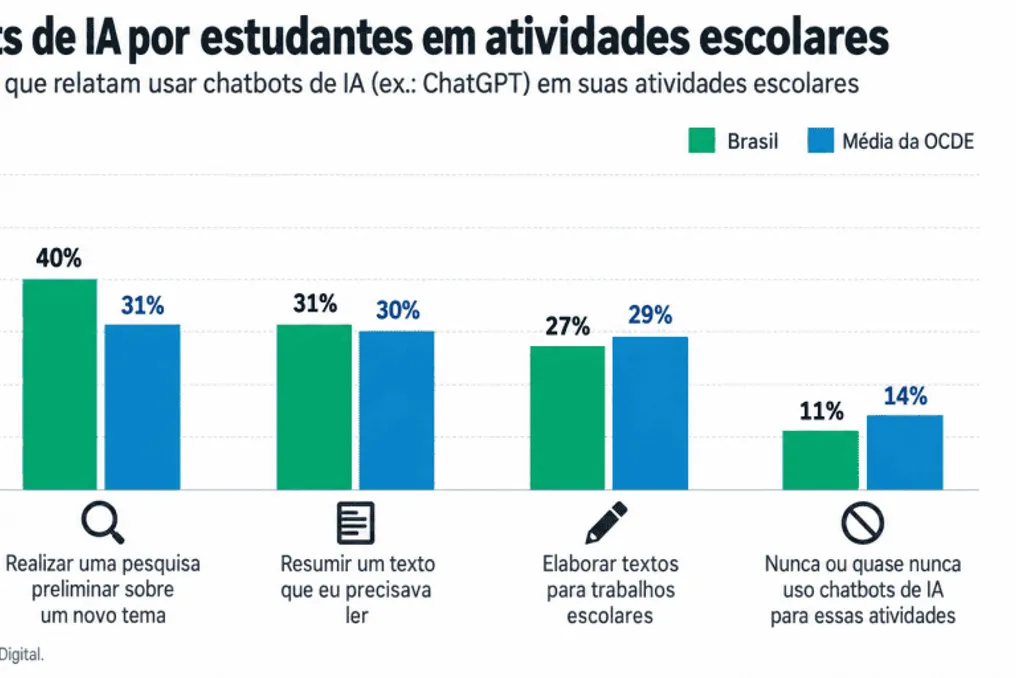
While those who never use it maintain the need to maximize brain exercise without depending on AI, those who use it a lot may be taking advantage of the benefits of a personalized tutor and technology that accelerates knowledge formation. Brazilian students demonstrated significantly higher use in two crucial areas: assisting in learning and conducting preliminary research on new topics. The Brazilian average reached 40% in this second category, surpassing the 31% recorded by the OECD.
Preliminary research, in this context, means using a chatbot instead of a traditional search engine. In this way, the AI's response, rather than a list of links, becomes the student's starting point. Pena considers this positive but strongly criticizes when AI is used to draft the final work.
For Spinelli, PISA 2025 signals a period of transition, a moment of discovery where people are understanding how to apply AI. Pena concluded that half of the students are using the tool and half are not, and that both paths present positive results. However, he highlighted the major challenges related to harmful use, characterized by excessive delegation to AI and consequent lack of learning. The expert concluded by stating that Brazilians are naturally early adopters, and that the study only exposes the inherent challenges of the technology, indicating that much is yet to be learned and compared in the coming years.