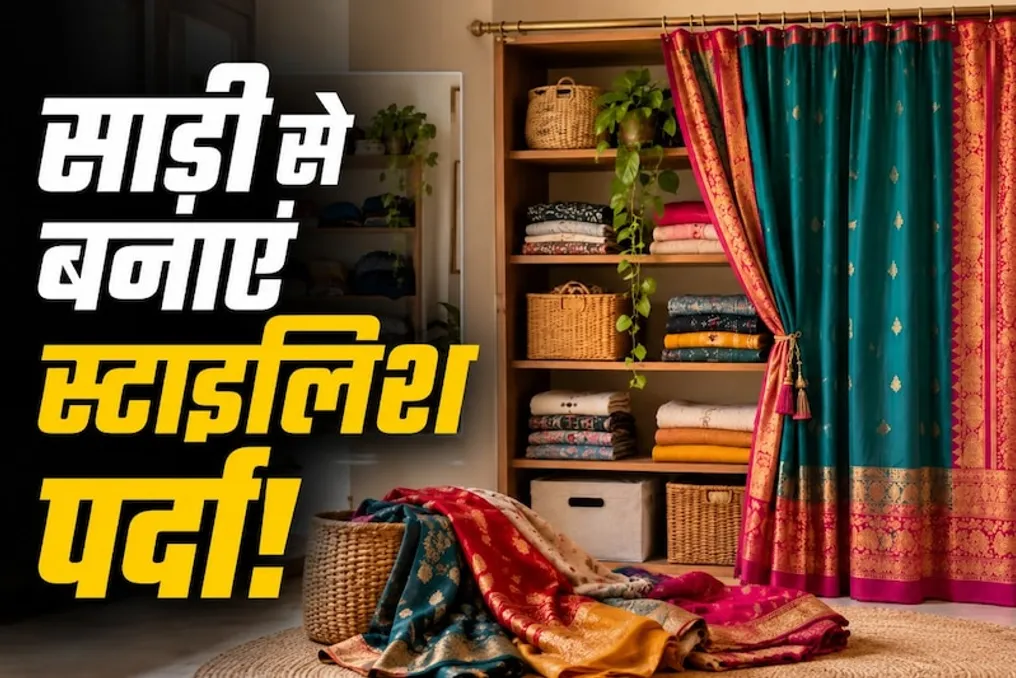
Many wardrobes contain old saris that are no longer worn, but due to the memories associated with them, people do not want to throw them away. Among them might be a mother's favorite saris, antique silk items from grandmothers or nannies, or pieces whose color has faded or whose fashion is outdated, but the fabric remains in good condition. Instead of leaving such items useless in the closet, they can be used to decorate the home.
If there are open shelves, cabinets, or racks in the house where items are visible from the outside, an old sari can be used as a curtain. This will help hide clutter and make the room more aesthetic, without the need to buy expensive curtains from a store. With an old sari, some ingenuity, and simple materials, you can create a beautiful curtain yourself.
Before starting to create the curtain, it is necessary to accurately measure the space where the sari will be attached—the width and height of the cabinet or shelf. This will determine whether the sari needs to be cut or if it can be used whole.
If the length of the sari is sufficient, it does not need to be cut. Using the entire sari will ensure a nice flowing edge and minimize the need for sewing. The top part of the sari should be slightly folded and sewn so that there is enough space for a curtain rod or pipe to pass through. After that, the sari can be hung in front of the cabinet or shelf.
If installing a curtain rod is not possible, you can use a rope or cord. If you want to completely avoid sewing, you can secure the sari using strong fabric clips or special curtain rings.
Not every sari is suitable for use as a curtain. For covering cabinets or shelves, light or medium-weight saris are best, such as those made of cotton, synthetic material, or light silk. If you need to completely hide a large number of items in a wardrobe, choose saris in darker shades or with a dense print so that the contents are not too noticeable.
The most attractive element of an old sari is its border or pallu. Therefore, when designing the curtain, it is recommended to place the border at the bottom. This allows even a simple curtain to look more elegant. If the sari has a beautiful print or embroidery, place it so that the design is clearly visible, utilizing all the beauty of the sari.
To prevent the sari curtain from looking like a foreign element in the room, its color can be chosen to harmonize with the other interior items. For example, choose a shade similar to the color of the pillows on the sofa, bedding, or existing curtains. This small trick will help create a unified and more stylish look for the entire room.
If the sari turns out to be too heavy to use as a curtain, it can be divided into small pieces and used for other decorative purposes. Beautiful fragments can be used to make table covers, decorative strips, or other home decor items.
In conclusion, updating the appearance of a home does not always require purchasing new curtains, furniture, or expensive decorative accessories. Often, it is enough to use old things in a new, creative way to give the home a fresh look.