
South Africans Reassess the Meaning of Heritage Day, Balancing Tradition and Modernity
Read more
IOL
iol.co.za

South Africans Reassess the Meaning of Heritage Day, Balancing Tradition and Modernity

The national holiday of Heritage Day in South Africa, celebrated on September 24th, is traditionally accompanied by traditional costumes and the smoke from barbecues. However, beneath this seemingly unified celebration of the 'Rainbow Nation' lie deep disagreements about the true meaning of this day.

Some citizens view this day as a sacred time to honor indigenous identities, living ancestors, and languages, while others reduce it to a 'National Barbecue Day.' The younger generation actively uses this holiday as a platform to recover erased histories and challenge which narratives deserve recognition.

Traditional Core: Identity and Origin

Heritage Day serves as a vital cultural and spiritual compass for millions of South Africans. Originally, this holiday is linked to Shaka Day, which commemorates King Shaka Zulu for his decisive role in uniting disparate clans into a single nation.

After the abolition of apartheid, Parliament established the official public holiday as Heritage Day during negotiations to acknowledge and showcase the rich cultural diversity of all South Africans. This holiday goes far beyond a simple day off for the older generation; it symbolizes a firm commitment to protecting systems of indigenous knowledge, spiritual connections to ancestors, and oral traditions that have survived centuries of colonial oppression.

Zandile Mthethwa, 70 years old, deeply contemplated the meaning of this day, noting: 'Heritage is much more than a costume worn for a photograph; it embodies the living memories of our grandmothers, the preservation of our native languages, and the enduring strength of the generations that came before us.' She emphasized that true heritage requires a constant effort to pass down oral histories, traditional practices, and cultural pride to the youth so that these rich ancestral legacies remain alive and relevant in an rapidly modernizing world.

Susan Daniels, 60, shared her opinion: 'In my youth, our identity did not require an official holiday to maintain—our heritage was woven into every meal we prepared and every story told around the fire. Now my grandchildren grill sausages over a flame and call it 'culture.' The true purpose of the fire is to warm and transmit wisdom, not just to cook meat.' For Daniels, reducing Heritage Day to a national barbecue signals a worrying loss of tradition. She fears that replacing spiritual roots, reverence for ancestors, and narratives with casual barbecuing dilutes vital historical lessons. Consequently, the older generation calls for a return to a heritage focused on intergenerational dialogue, the preservation of oral information, and engagement with indigenous identities.

Youth Perspective

Young South Africans, such as Gen Z and younger millennials, approach the 'Rainbow Nation' narrative post-1994 with critical nuance rather than the reverence shown by older generations. Having grown up amidst economic stagnation and heightened political awareness, they bring a distinct perspective to Heritage Day.

Siyabonga Dlamini, a 24-year-old university student, stated: 'Although youth unemployment remains widespread, we are expected to celebrate Heritage Day once a year under the guise of national unity. Our demand is for real economic heritage, not superficial cultural aesthetics.' For Dlamini and many of his generation, wearing traditional clothing for just one day does little to solve systemic inequality, persistent poverty, or lack of employment opportunities faced by young people across South Africa.

Afelele Khoza, 21, expanded on this point, saying: 'For me, our culture lives in the digital space. It is defined by the influence of Amapiano globally, the formation of online culture on South African Twitter, and how our generation actively redefines history on its own terms.' Khoza stressed that modern technology, social media, and global movements give young people the opportunity to share contemporary South African culture worldwide. By mastering digital spaces, young South Africans act as active creators reshaping national identity, rather than passive custodians of history.

Noma Mtshali, 26, noted: 'Heritage is not frozen in stone. For us, modern African youth, it is respecting the richness of our traditions while simultaneously dismantling harmful practices that no longer contribute to our growth.' In Mtshali's view, preserving cultural identity requires critically evaluating patriarchal norms, gender inequality, and outdated social structures that have historically limited personal freedom. She stated that by challenging these inherited traditions while celebrating oral histories, indigenous artistic expressions, and ancestral values, the younger generation seeks to create an inclusive cultural model.

Heritage Day in South Africa is an evolving, debated celebration, not a static event. Its significance stems from the tension between tradition, commercialization, and social revitalization. Whether celebrated around a fire, at an ancestor gathering, or through systemic critique, September 24th showcases a nation confronting its past to shape its future. Heritage remains something that is actively fought for, discussed, and redefined.

Similar stories

How heritage storytelling transforms ordinary goods into recognizable brands through the premium of authenticity
Read more
yourstory.com

How heritage storytelling transforms ordinary goods into recognizable brands through the premium of authenticity

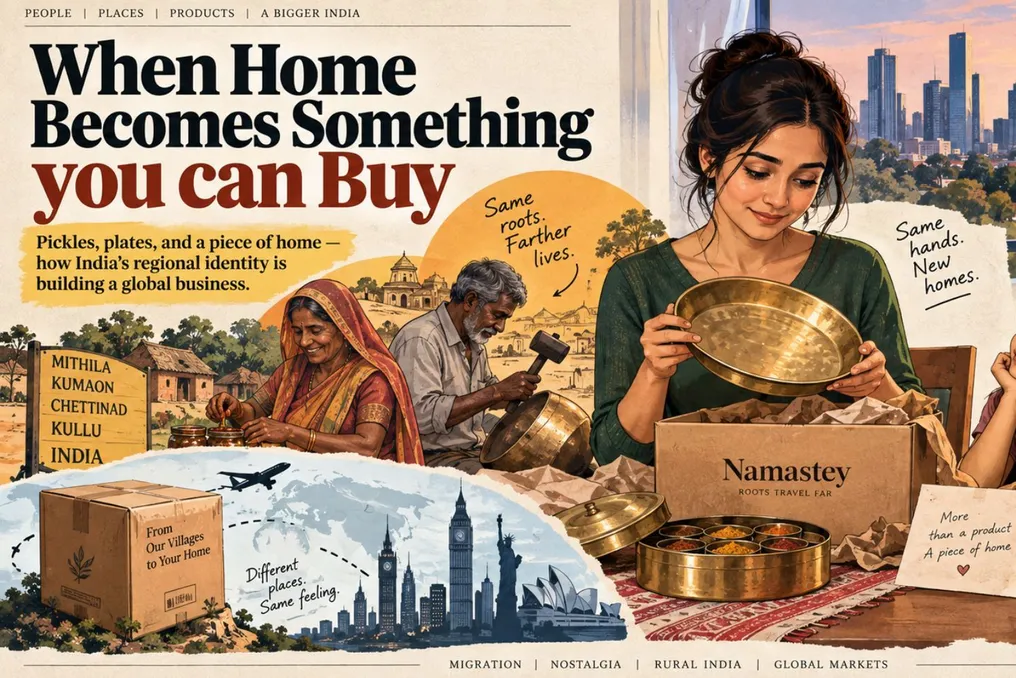
It is impossible to package an entire home, so someone decided to deliver that feeling. In one of the apartments in Melbourne, a woman sets the table for her daughter, and she pauses for a moment, noticing a plate made of tin—a traditional alloy of copper and tin. She remembers the last time she ate from such a plate while sitting in her grandmother's kitchen.

She ordered this item, as well as a round brass spice box with seven small bowls, which was previously used in every home in her homeland. Although she had a perfectly decent steel tableware set, her daughter grows up in a house where she lacks reminders of her culture. Since it is impossible to transport an entire village across the ocean, she bought several items so that the child could see them daily.

The brand managed to sell this using the slogan: 'handcrafted by the same family workshop for three generations, sourced directly from these artisans in India,' and also by promising that one percent of the profit would go back to villages like their own. This is what the woman bought—not the metal itself, but the transmitted message.

India is a country consisting of 28 states, 8 union territories, almost 800 districts, and possesses more diverse cultures than one can learn in a lifetime. Amidst the constant migration of Indians from villages to cities and from cities to other countries, a gap arises between a person's place of residence and their true belonging. It is in this niche that an entire category of business has formed.

These companies do not just sell food, textiles, or utensils; they sell the feeling of home to people who are deeply connected to their roots but lack practical ways to maintain that connection. Notably, the product itself is rarely special: it might be a jar of pickled vegetables, a bottle of oil, a packet of spices, or a cotton sari. These things are simple to produce, widely available, and not patented.

Thus, the competition is not for the commodity, but for the story. The questions resolved in this struggle are: who made it, where was it produced, whose recipe is it, was it made as authentically as at home, or adapted to everyone's tastes? Two absolutely identical jars can be next to each other in the same store, and one will sell for three times more than the other solely because of the label. This extra amount is what can be called a premium for authenticity, and it is not trivial; it is a full-fledged business model. Nostalgia has its price, and migrants are willing to pay it.

Brands often use a specific approach to self-presentation: they print a phrase in the local dialect on the packaging and always specify the region, not the whole country, because 'India' is too vast to feel personal. On the contrary, names like 'Mithila,' 'Kumaon,' or 'Chettinad' evoke a strong response in a specific group of people. When a person feels addressed personally, they stop comparing prices.

Take, for example, the brand of pickled vegetables Jhaji from Darbhanga, which promises to bring the taste of Mithilanchal into your home. The storyteller, being a representative of a migrating Maithil family who has lived their whole life in Delhi, notes that good achaar is felt not as a product, but as a grandmother's hand, because the taste comes from mangoes grown in that soil, prepared according to her recipe and with her patience. Therefore, when the brand speaks of bringing Mithilanchal home, the storyteller knows exactly which string he is pulling.

Jhaji participated in the show Shark Tank India but did not receive investment. Objections related to market saturation and the fact that pickled vegetables are not scalable. However, after several years, the brand is valued at approximately $7.89 million and sends over 10,000 orders monthly. Investors valued the company based on pickled vegetables, while customers bought Mithila.

Some criticize such brands for exploiting vulnerable, homesick customers. However, the author believes they are simply doing business and returning something real. A few minutes of nostalgic dinner and food that seems prepared just for you, not for the whole country.

Both camps understand what is being sold. The author admits that sometimes he thinks the village is finally getting deserved recognition, and on other days, he grieves that he now has to buy proof of his origin.

There is a myth that business must be conducted in English, with presentations, and after obtaining an MBA. Jhaji was founded by two homemakers from Darbhanga who had been preparing achaar for their families all their lives and appeared on national television in Hindi, knowing not a word of startup language. Their main asset was the story, not the diploma.

Rural India has never lacked products or skills; it lacked distribution and someone willing to loudly name the region. The internet helped solve the first half of this problem. A similar model works in the field of hand weaving, regional sweets, brass utensils, and spice mixes. For example, Pahadan—a sustainable fashion brand from Himachal Pradesh—does to clothing what Jhaji does to pickled vegetables. They sell not just a kurti or a cotton set, but mountains, as well as the handmade Kutluvi Patti brush, traditionally used in the clothing of Himachali residents, but now sewn onto clothing that a working woman in Gurgaon or Pune can wear in the office. This is a sensible position, as the buyer does not need to dress like a villager to feel connected to it.

However, the real strength of Pahadan lies in the fact that they also promote the women who make the clothes: their faces, names, villages, and the fact that one piece of clothing means several days of paid labor for a woman in the mountains. This is analogous to how Namastey names the family that crafted your plate. The kurti comes with a receipt showing that someone in Kulu received payment for their skill and was not forced to leave their village. This is another kind of premium, different from nostalgia, but built on the same principle—the ability to point to a real person.

This business model is not an Indian invention, and its potential is much broader than a jar of pickled vegetables. Champagne produced anywhere is just sparkling wine, but the same wine from a specific region of France is called Champagne and sells for several times more without any apparent reason other than the place of production, and this is protected by law because the story has become so valuable that governments have begun to protect it as property. Parmigiano Reggiano is a hard cheese produced by small dairy farms in a specific part of Italy, with a seal on the rind for traceability, and it sells in supermarkets worldwide at a higher price than an identical Parmesan next to it. This is rural produce created by farming families that has become a global export almost entirely due to origin protection. India is already using this tool: Mahana Mithila has a GI tag, as does the Kulu shawl, meaning both regions mentioned in the article are already legally recognized as sources of their products.

What is missing is not authenticity, but the number of people willing to build a business on this basis. These brands have understood a very simple thing: people will always pay for a reminder of who they are, and those who sell this reminder are not actually selling pickled vegetables, plates, or kurtis; they are selling an address. The author writes not as a critic, but as one of their customers, because when he ordered the jar, he bought not achaar, but two months of summer in the village, a part of which he now owns only half.

This feeling is not limited to a few people. There are about 41.4 million interstate migrants living in India, and about 18.5 million Indians born in India live abroad. Globally, about 304 million people live outside their country of birth. As Indians continue to leave their homes, someone will find a way to deliver this small piece of home to them.

3
KZN Event Calendar for September 2026: Festivals, Music, and Sports Events
Read more
iol.co.za

KZN Event Calendar for September 2026: Festivals, Music, and Sports Events

September promises music, gastronomy, culture, and sports in KwaZulu-Natal, offering a packed schedule of events covering areas from Durban to Richards Bay and the South Coast.

As Heritage Month begins, KwaZulu-Natal is preparing to be an entertainment hub, with festivals, live performances, theatrical productions, sporting events, and family activities taking place across the province.

Whether you are looking for a weekend out with friends, celebrating Heritage Day, or something for the whole family, there are plenty of options in the calendar.

From September 4th to 6th, the Durban Street Food Festival will take place at the Pavilion Shopping Centre. This festival promises a combination of street food, live performances, participation from local and national artists, family activities, and food vendors. Organizers describe the 2026 edition as a three-day celebration featuring African and Indian cuisine, as well as Asian street food and gourmet snacks.

The 'Shimza and Friends' event will take place on September 5th from 3:00 PM to 2:00 AM at the Durban Exhibition Centre. Additionally, Liquideep in the Park will be held at Chris Sonder's Park in Umhlanga from 12:00 PM to 7:00 PM, offering a Sunday of outdoor music.

For active recreation enthusiasts, the WOA iQembu Cycle Challenge is scheduled for September 6th. The race starts at 7:00 AM, with the route running along the M4 highway. The start and finish area is located near the Kings Park swimming pool and Moses Mabhida Stadium.

The cultural event 'Shall We Dance' will take place at the Opera Playhouse in Durban, offering accessible cultural entertainment.

Heritage Day will be one of the busiest days on the KwaZulu-Natal events calendar, as concerts, festivals, and international sporting competitions will take place across the province.

Music lovers can celebrate Heritage Day at the Durban Botanic Gardens, where Sjava, Simmy, and Q Twins will perform. Gates open at 1:00 PM, and the event will take place in the garden lake area.

For cricket fans, there is another major celebration option: a match between South Africa and Australia in the first ODI series at the Hollywoodbets Kingsmead Stadium in Durban. Cricket South Africa has scheduled this match for September 24th at 10:00 AM.

In Richards Bay, the Dolosfees festival will take place over the Heritage Day weekend from September 24th to 26th. The festival will feature artists such as Prime Circle, Die Heuwels Fantasties, Fatman, Tino, ANGUS, and Saxby Twins, alongside cultural performances, fairs, beauty pageants, artistic activities, and children's entertainment.

In Durban, at Berea Rovers, the Shisanyama Heritage Festival will take place on September 26th, featuring Kelvin Momo. The event will start at 12:00 PM.

For maskandi enthusiasts, one can travel to the South Coast of KwaZulu-Natal for the sixth annual Ugu Maskandi Festival at the Ugu Sports and Recreation Centre. The festival gates open at 12:00 PM, with performances starting at 2:00 PM. Scheduled performers include Sjava, Mafikizolo, Mbuzeni, Ntencane, Phuzekhemisi, and Mjolisi.

Families can conclude the month by participating in the Scottburgh Mall Family Trail Run on September 27th. Registration begins at 7:00 AM, with races scheduled for 8:00 AM and 8:30 AM.

The September calendar in KwaZulu-Natal offers numerous ways to spend the month, from gastronomic and musical events to theatrical performances, maskandi, international cricket, and outdoor activities. Since many major events fall on Heritage Day, September promises to be particularly eventful for entertainment across the province.

Popular