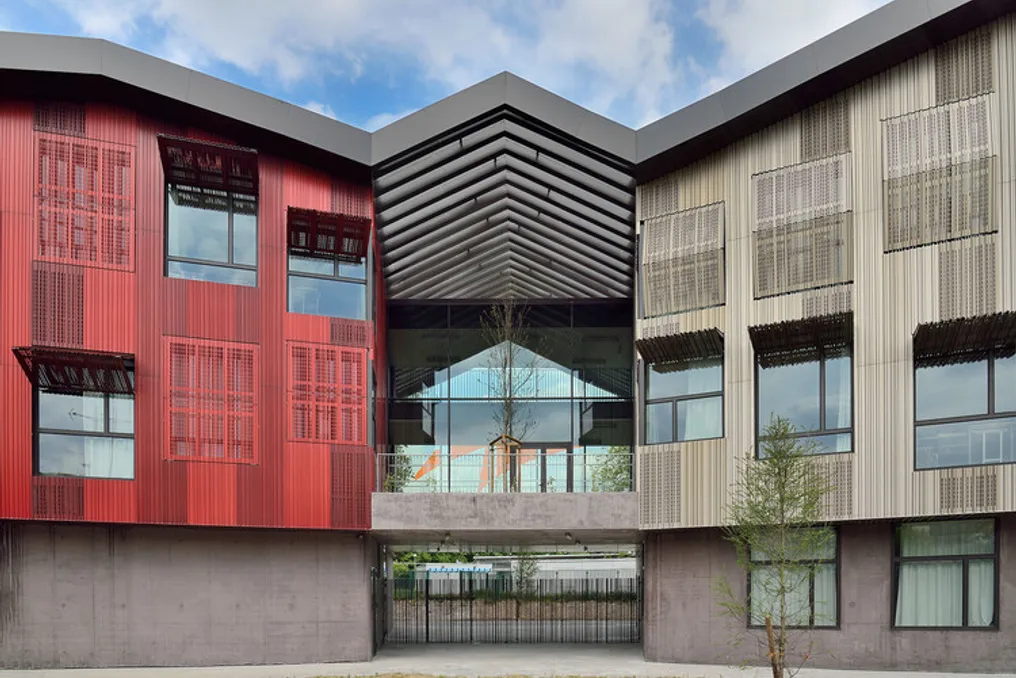
The Franco-Moroccan twin architects, Salwa and Selma Mikoü, have established a professional practice that integrates architecture, engineering, craftsmanship, and the preservation of cultural memory. As founders of the Mikoü Architecture firm, located in Paris, the sisters utilize their distinct design approaches, influenced by having grown up in both Morocco and France.
In an interview with Louisiana Channel, they detail how Moroccan architecture impacted their work, describing their collaborative method and interest in harmonizing modern construction techniques with manual traditions.
For the Mikoüs, understanding architecture began in the environments they experienced during childhood in Morocco. They lived in a traditional riad, structured around an internal courtyard, with terraces facing neighboring houses, which established a direct link between private and communal life. Salwa described Morocco as 'a very sensual country, full of colors and smells,' and specifically Marrakech as an 'immersive city,' where souks, markets, and common areas facilitate people's gathering.
These initial experiences also introduced them to architecture through contrasts. Salwa noted that 'Living with contrasts is something very significant,' referring to the transition between external spaces, which were bright and narrow, and the interiors, which were more reserved and shaded. The progression between these spaces remains crucial in their methodology, as variations in scale, lighting, and enclosure generate various forms of coexistence, from the collective aspect of the city to the privacy of the home.
Selma recalled how the terraces of her childhood riad served as places to observe neighboring families and interact with the surrounding environment, highlighting 'this tradition of neighborhood' and linking it to her ongoing focus on how architecture can shape human relationships.
The sisters acknowledge having 'very different views on architecture' and consider themselves 'very complementary.' Initially, when developing a project, they usually work separately, creating ideas through sketches and drawings before unifying the concepts. Dialogue is considered a vital phase of the process, as 'we love to talk because words have a very deep resonance for us.' Eventually, individual drawings lead them to use collage techniques, blending their distinct imaginations into a final joint composition, stating that 'our richness lies in being different.'
Their professional careers reinforced these distinctions. After studying architecture at the same university, Salwa worked at Ateliers Jean Nouvel, while Selma was part of the Renzo Piano Building Workshop. Both described these environments as mirrors of their particular interests: Salwa was drawn to intellectual issues, abstraction, and concepts, while Selma identified with the practical and material aspects of architectural construction. This contrast of views began to permeate both the design and execution of projects.
The connection between theory and constructive practice is notable in their mutual interest in engineering. They explain that 'we are interested in engineering because, for us, all this internal structure represents the foundations of a building's architecture.' The appreciation for how buildings are assembled is also related to ecological transition and prefabrication. They state they like the 'idea of the industrialization of architecture because, for us, it is a gesture of progress,' arguing that industrialized methods can make architecture 'intelligent, without being standardized in any way.'
However, this technological inclination does not imply a departure from artisanal work. Their Moroccan roots provided contact with a rich heritage of craftsmanship and ornamentation, which they continue to reinterpret within the context of contemporary construction. They express great satisfaction in 'uniting technology and craftsmanship,' defining their practice as an 'Architecture Manufactory.' From this perspective, construction serves as a vehicle to integrate diverse knowledge, making visible what would otherwise remain hidden.
These principles guide their projects. In Bordeaux, Art de Rives functions as an urban 'cultural melting pot,' integrating residences, artistic dwellings, and student accommodations. Its permeable design aims to expand the city towards the Garonne River, promoting meeting spaces for various groups. Other completed works include Aquazena, a pool and wellness center in Greater Paris; Balsanéo, a aquatic complex and spa in Châteauroux; and the Simone Veil School Campus in Boulogne-Billancourt.
Louisiana Channel, produced by the Louisiana Museum of Modern Art, is a platform that hosts video interviews with artists, architects, designers, writers, and musicians, analyzing their ideas and perspectives on current culture. Recently, the series also interviewed figures such as Pedro Reyes, Liam Young, Tsuyoshi Tane, Xu Tiantian, and Zhu Pei, addressing themes such as collective memory, material culture, and the evolution of the relationship between architecture and society.