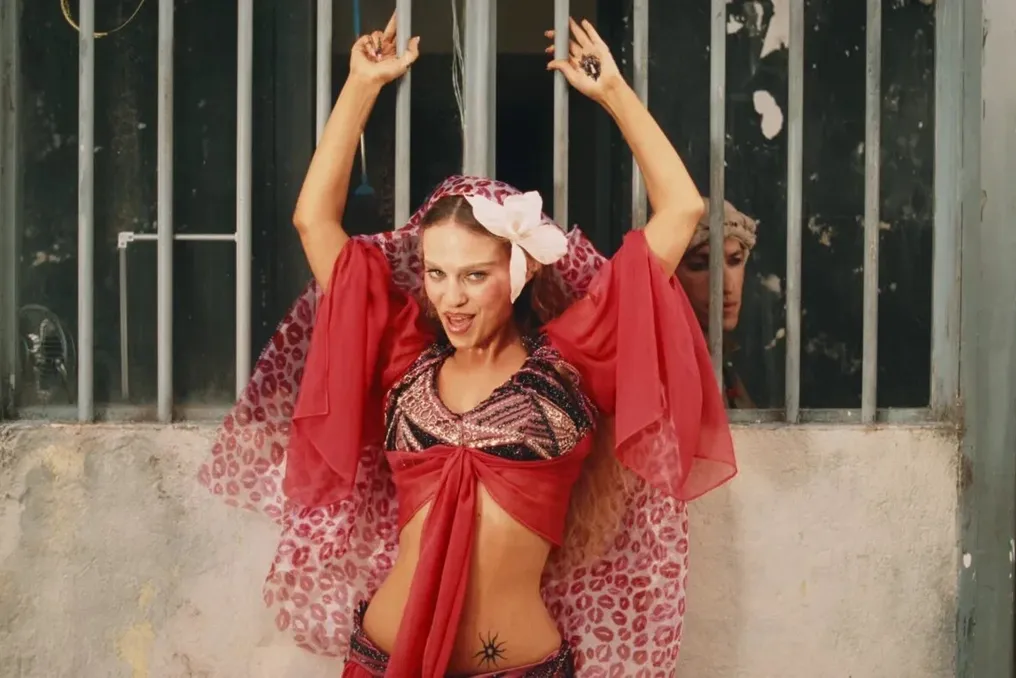
Palestinian artist Elyanna faced a wave of criticism following the release of her latest music video, 'BOSA'. Viewers expressed doubts about the decision to set the bright and playful video in a prison, especially against the backdrop of widespread violence against Palestinian women in Israeli prisons.
The video 'BOSA', released on September 4th, begins with an image of Elyanna behind metal bars. The action then moves to a stone complex resembling a prison, where she performs with a group of dancers in courtyards and near barred windows. Throughout the song, Elyanna invites listeners to 'kiss her.'
Later, the women leave this complex. In an interview with Complex MENA, Elyanna stated: 'With BOSA, I invite women to speak loudly about their femininity, desire, confidence, and freedom.'
Perception of Prison Themes
However, for some audiences, the prison setting was too close to the reality of Palestinians held in Israeli detention facilities. One commentator wrote: 'What the hell, why is this filmed in a prison?' Another questioned whether anyone on the team considered the concept 'repulsive.'
Some viewers also criticized the dancing, accusing Elyanna of 'self-Orientalism'. They argued that Palestinian, Arab, and South Asian motifs and dances were deliberately transformed into an 'exotic' visual aesthetic aimed at the Western gaze. User Nerdeen Kiswani emphasized that for Palestinians, prison is not an abstract symbol but a 'real institution of colonial violence,' mentioning torture, sexual violence, and humiliation suffered by inmates.
Reaction also appeared on X, where users questioned the choice of a prison as a backdrop for a stylized music video. One user noted that the situation was 'too insensitive, especially in the current climate,' recalling daily instances of Palestinian women being abducted, arrested, and sexually assaulted by Israeli occupation forces (IOF).
Harsh Detention Conditions in Prisons
According to Palestinian organizations, nearly 100 Palestinian women, including pregnant women and teenagers, are currently held in Israeli detention. Israel's ultra-right-wing National Security Minister, Itamar Ben-Gvir, boasted about the deterioration of conditions for Palestinian detainees during a visit to women after one inmate reported a lack of basic necessities.
Former inmates and human rights groups have described conditions such as inadequate food, hygiene and medical care restrictions, searches, and other forms of mistreatment. This issue became particularly evident shortly before the release of 'BOSA'. Itamar Ben-Gvir filmed a video on August 30th in the Deimon prison, which houses dozens of Palestinian women. Following an inmate's complaint about harsh conditions, including the lack of proper showers, Ben-Gvir stated: 'I am satisfied with these conditions.'
On social media, he labeled the issues raised by the Palestinian woman as 'complaints,' stating that the days of 'summer camp' in Israeli prisons were over, and boasting that he was responsible for reducing conditions to the 'absolute minimum.'
For critics of 'BOSA', the contrast between the video's release time and how Palestinian women were depicted in prison was particularly stark: while Palestinian women demonstrated detention conditions in Deimon prison, 'BOSA' showed a group of dancing women in prison before their release.
Nevertheless, not everyone agreed with the negative reaction; some viewers accused the critics of over-interpretation. One TikTok user stated that Elyanna should be able to create a 'fun love song,' and that critics were 'weird' for being upset about her clothing, lyrics, and dancing.
Others rejected the label of 'Orientalism' altogether. Elyanna herself dismissed the accusations of Orientalism, responding to a video criticizing her clip with the phrase 'give me 💋💋💋' in Arabic. Supporters pointed to Elyanna's history of public support for Palestine, noting that she was the first Palestinian artist to perform a full set in Arabic at Coachella, shouting 'freedom for Palestine' and waving a keffiyeh. Others highlighted her background: 'Elyanna was born and raised in Palestine to a Palestinian mother and Chilean father,' urging people to just accept it and move on.
Middle East Eye contacted Elyanna and her management, SALXCO, for comments but received no response by the time of publication.