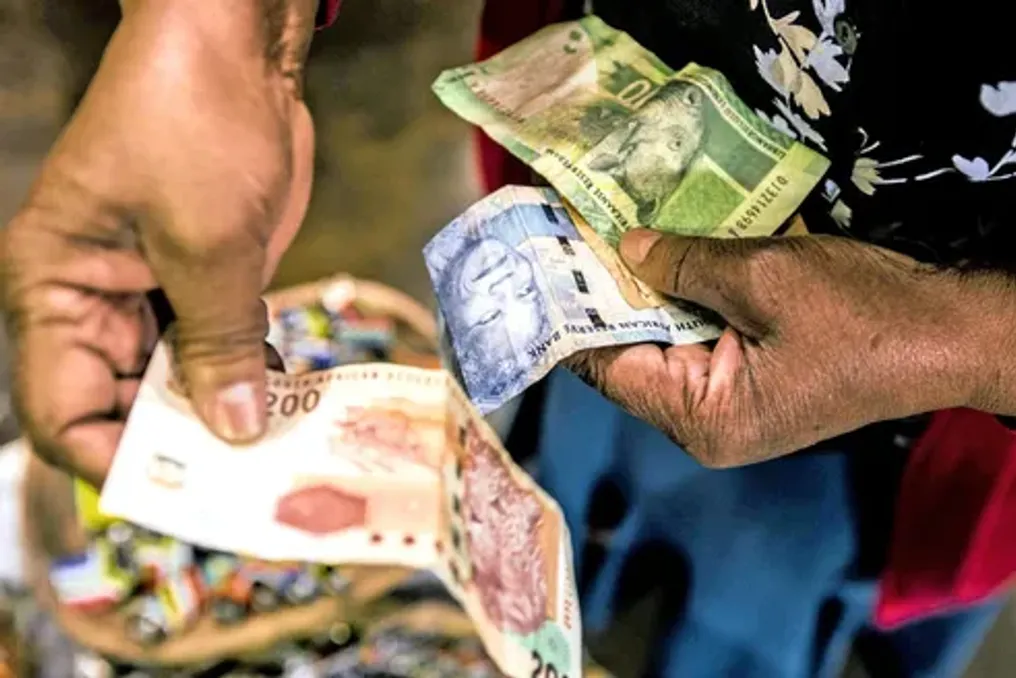
The dynamics of the rand exchange rate against the US dollar remains a key indicator of South Africa's economic health. Last week, the rand traded below the R16 mark against the US dollar, which was the first time since February of this year.
Some analysts interpreted this as a psychological barrier or an important milestone, but for most readers, the question is simpler: does it reach them, and is it noticeable? The honest answer is that the effect manifests differently—quickly in some places, slowly in others, and not at all in a third.
The most obvious example is the purchase of goods abroad followed by resale domestically, such as laptops, auto parts, phones, or imported medicines. Since these items are purchased in dollars, the movement of the rand from R17 to R16 allows for a reduction in the cost of a thousand-dollar item by approximately one thousand rands. This mechanism works, albeit not instantly, as retailers continue to sell stock bought at old rates, and it takes several months for the new rate to reflect on the shelves. It should also be acknowledged that savings on imports are not always passed on to the end consumer.
The situation with fuel is more complex to perceive, as it is also bought in dollars, but the dollar price of fuel constantly changes. The price of gasoline is not set based on the daily exchange rate but on an average value over a specific period. This month, that period covered the end of July and August 25th, and the rand dropped below R16 only in the final days. The currency strengthening came too late to significantly impact prices; gasoline was predicted to rise by almost one rand per liter on September 2nd, while the currency reached its best level in six months.
Both statements are true: a stronger rand curbed growth but could not prevent it, and the reduction in growth achieved through the exchange rate is unnoticed by the consumer. Other household expenses pass through a chain of intermediaries—factory, transporter, wholesaler, landlord, and retailer. Each of these participants bears their own local costs, and the exchange rate sits somewhere within this chain, performing an invisible work that cannot be precisely pinpointed.
This is why the rand rarely feels like it has changed. It reaches the consumer last, and by then it is already 'dressed in someone else's name.' A more useful question than where the rand will move next is where this specific shift originated. Approximately half of this movement is not related to domestic factors.
The weakening of the US dollar this year led to the strengthening of most emerging market currencies, including the rand. Furthermore, rising prices for gold and platinum, which are sold, attract more dollars, contributing to the rand's strength. However, this is not an achievement of South Africa, but rather an arithmetic consequence of external circumstances.
The second half of the changes is linked to domestic factors: foreign investors have invested significant funds in South African government bonds. To lend in rands, they must first acquire the rands themselves, which contributed to the currency strengthening above R16. The attractiveness of these investments is driven by high interest rates relative to global inflation standards. However, there is a downside: the same interest rates attracting capital are used to repay mortgage and car loans. Thus, a strong rand comes at a cost.
Similar fluctuations were observed previously: between April of last year and the end of January, the rand fell from nearly R20 to about R15.70. A large part of this appreciation was earned thanks to the cessation of power outages, the country's exit from the grey list, improved credit ratings, and progress in ports. Investors reassessed South Africa based on real internal changes. Then, at the end of February, the escalation of the conflict in the Middle East caused a spike in oil prices and global currency fluctuations, after which the rand returned to around R17. Nothing went wrong in South Africa itself; this episode simply revalued all markets, and the country was involved in these external processes. Now, the rand has returned to its previous level, again largely due to events outside the country.
Thus, the answer to whether this is a temporary phenomenon lies in this year's experiment: the strengthening we earn tends to persist, whereas the strengthening given to us by external forces often fades unnoticed. The main takeaway from currency headlines is that the number itself is not a signal to follow. For a household, it is far more important that the basket of goods costs roughly the same over three months and that prices rise smoothly rather than in sharp jumps. It is this behavior of the currency that is perceived as stability, which is more valuable to an ordinary family than the strengthening itself.
A strong rand attracts attention in headlines, but a stable rand allows people to plan for the future. The country reached this level twice this year but lost it once, and the decision of whether it will maintain it is not made on a trading screen. It is made at the level of power plants, ports, railway hubs, and offices where budgets are drawn up, which are then either executed or quietly ignored. The rand has indeed changed; the question is whether anything else has changed inside the country, and what needs to change before that happens.