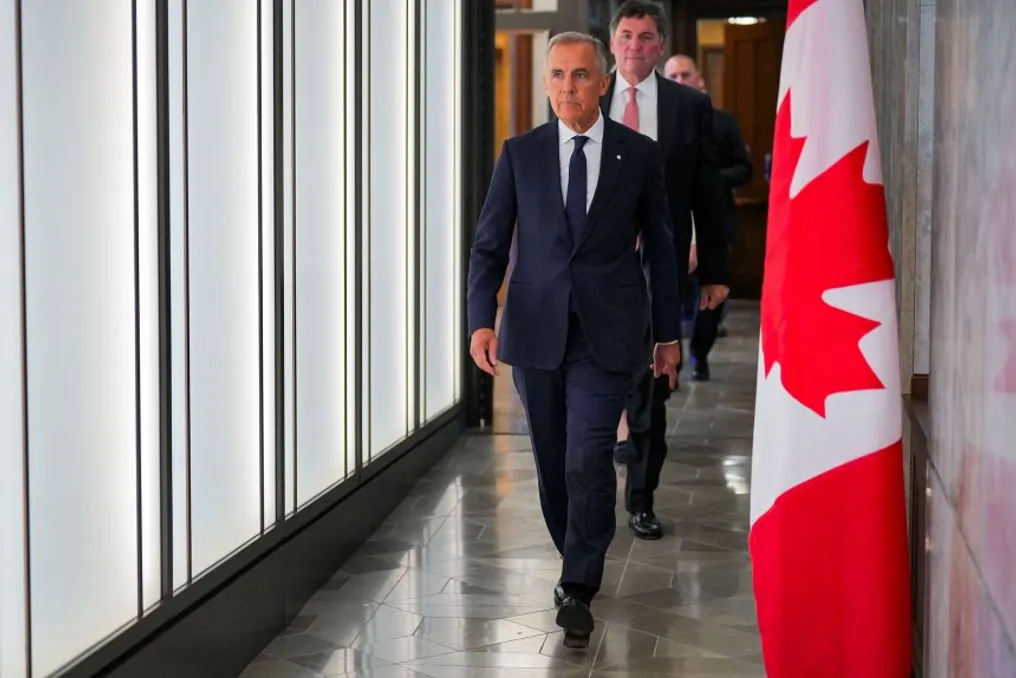
At the beginning of Tuesday, Canada implemented its promise to impose tariffs on US goods worth $20 billion in response to President Donald Trump starting to tax Canadian goods last month.
Less than a day after these charges were introduced, Trump presented his next move aimed at increasing pressure on Ottawa. Tariffs are no longer the only tool he is willing to use; Trump intends to introduce a complete ban on a number of Canadian goods.
He also threatened to prevent the US government from purchasing Canadian-made products through a major federal procurement program if Canada does not provide American companies and farmers with greater access to its markets.
Canadian Prime Minister Mark Carney previously stated his intention to respond 'dollar for dollar' and is likely to react to Trump's threats. This includes an effective ban on the import of a wide range of Canadian alcoholic beverages, motorcycles, and serum for Americans. According to White House materials published Tuesday evening, this ban will take effect on September 29th at 00:01 Eastern Time. Before this date, many products will be subject to a 50 percent tariff.
Trump also expanded the list of goods subject to these charges, adding golf carts, drafting paper, as well as more steel and aluminum components.
Trade negotiations between the two neighboring countries, which have been major trading partners for almost half a century, collapsed at the last minute last month. Trump initially postponed the deadline he himself set for imposing tariffs, advertising a reachable deal. However, both sides failed to overcome the remaining disagreements while negotiators discussed the final details.
Since then, Trump and Carney have exchanged increasingly sharp remarks. Trump even renamed Lake Ontario to 'America Lake,' which draws objections from Canadians and even some Republicans. He also threatened to double auto tariffs to 50 percent starting next year and planned to ban one of Canada's leading airlines, Bombardier, from selling its products in the US unless they were manufactured there.
The Montreal-based company responded to CNN, stating that it maintains a significant manufacturing presence in the US and continues to expand in the country. The company noted: 'The American aerospace industry is a clear winner in trade and exports. Bombardier is a strong player in the sector, creating tens of thousands of jobs across the United States.'
Throughout the trade negotiation process, Carney accused Americans of having an unserious approach to negotiations. Last week, he stated: 'When Americans stop making memes, stop mocking, stop trying to look tough, and start discussing these issues seriously—we can conduct these discussions.'
The escalation of the trade war between neighbors is happening just two months before the US midterm elections, putting Republicans in competitive regions in a position where they must explain their stance on the tariffs imposed by the president. Among them is Senator Susan Collins from Maine, who faces a tough re-election battle and has criticized Trump's tariffs.
Canadian Industry Minister Melanie Jolly stated that the government is deliberately developing its countermeasures to 'apply political pressure' on the Trump administration to review its actions. Nevertheless, Ottawa exempted American seafood from a 25 percent tariff, saving industries in key states like Alaska and Maine from a potentially significant blow.
For Americans, this new retaliatory move may feel closer to home. Governor Doug Ford of Ontario stated that his province could impose restrictions on electricity exports to bordering states it supplies, such as New York and Michigan.
Canadian officials reported that their American counterparts insisted on changing rules regulating how prominently French language content and French language content are displayed on streaming platforms, as well as requirements for product labeling in English and French. Carney defended these measures as fundamental to Canadian culture.
Carney stated last month: 'For Americans, issues about the French language, Quebec culture, Francophone culture, and Canadian culture are irritants. Here, in Quebec, here in Canada, these are rights, fundamental rights.'
Meanwhile, Trump stated: 'I will never interfere with how Canadians speak French!' He added in a post on Truth Social that he views Carney's position toward the US as an attempt to strengthen his political base.
US Trade Representative Jamieson Green denied that discussions about French language requirements caused the collapse of negotiations. Carney interpreted this as a retreat from discussions held. 'Suddenly they don't care about the Canadian language or culture and these elements. Well, if they didn't care, they shouldn't have left them in the deal,' Carney said last week.'
US Trade Minister Howard Latnick stated that the deal fell apart due to requests made by Canadian trade officials at the last minute, including lowering tariffs on trucks. Currently, the US imposes a 25 percent tariff on these vehicles, with an exception for part of each vehicle that complies with the trilateral trade agreement between the US, Canada, and Mexico, which Trump concluded during his first term. The same 25 percent tariffs apply to cars and auto parts.
As part of a preliminary deal, the US agreed to lower auto tariffs to 15 percent, 'with the possibility of reducing to 7 percent,' Green said in an August interview with CBC News. He also reported that they agreed to reduce tariffs on steel and aluminum to 25 percent.
On the sidelines of the G20 finance ministers and central bankers meeting last week, US Treasury Secretary Scott Bessent suggested that America has an advantage in the trade war. He stated in an interview with CNBC on August 31st: 'I don't think you can participate in retaliatory measures against someone who is 13 times larger than you.'
Although the fact is that the US economy is 13 times larger than the Canadian economy in gross domestic product last year, this does not mean that the US can exit the situation without losses. However, Trump stated on Friday that the US would save money by ceasing trade with Canada. 'If we don't trade with Canada, we will simply stop all trade with Canada, we will save ourselves $90 billion.'
This is not entirely accurate: trade relations between the US and Canada are structured in such a way that both sides depend on each other regarding goods that cannot be easily replaced by other trading partners, which multiplies the pain for both sides, regardless of the size of their economies.
Overall, when a trade war begins, the smaller economy loses more compared to the larger one, said Ari Van Assche, Professor of International Business at HEC Montréal, specializing in international trade. This is because larger economies tend to rely less on trade for access to goods and services compared to smaller economies.
Take, for example, the Ford plant in Windsor, Canada, which produces specialized engines for some of the largest trucks made by the American manufacturer. Van Assche told CNN: 'Ford finds it difficult to say: 'Oh, no problem. We import this from Mexico now,' because the components produced in Mexico are very different.'
Gordon Hanson, a professor at Harvard University's School of Public Administration who studies trade and immigration, noted that since businesses often agree on price contracts long before goods arrive at ports, consumers on both sides of the border are unlikely to see immediate consequences of new tariffs. However, by next summer, they may notice noticeably higher prices.
_}, 3.